
Rotogravure
Ink is one colour. A photograph is a continuous range of greys. Every printing process has to bridge that gap somehow, and there are only two honest ways to do it.
The halftone answer — used by letterpress and offset — is to lie convincingly. Break the image into dots of a single ink density and vary their size. Big dots read dark, small dots read light, and the eye blends them at normal distance. There is no grey anywhere on the paper.
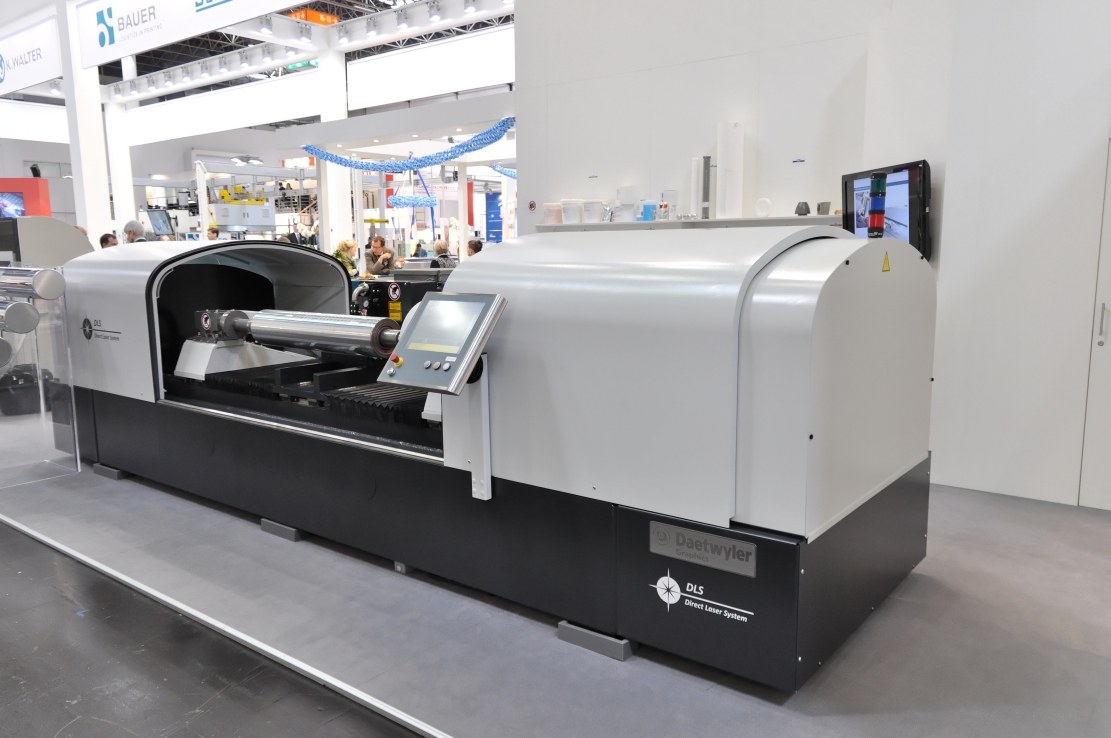
The gravure answer is to actually vary the ink. The image is engraved into the cylinder as a grid of tiny cells of differing depth. A deep cell holds more ink and prints darker; a shallow one holds less and prints lighter. The cells are all the same size and the tone comes from volume.
That is a genuine continuous tone, and it is why gravure photographs have a smooth, almost photographic quality that halftone struggles to match.
The printing is intaglio at speed: the whole cylinder is flooded with thin, fast-drying ink, a steel doctor blade scrapes the surface completely clean so ink remains only in the cells, and the paper is pressed against it to draw the ink out — thousands of metres a minute, on a continuous web.
Talimatlar
See both ways of faking grey
See both ways of faking grey
Find a newspaper photograph and a magazine photograph and examine both under a loupe.
Expect the newspaper to resolve into a grid of dots of different sizes, and a gravure-printed magazine or packaging to show an even grid of same-size cells with differing ink density.
Then hold both at arm's length.
Record where each one stops convincing you. Halftone breaks down when the dots become visible; gravure holds together because there is genuinely more ink in the dark areas.
Gerekli aletler:
 Büyüteç Lupu
Prove depth carries volume
Prove depth carries volume
Make a test block with recesses of the same area but three different depths — drill or carve them. Fill all with ink or thin paint, wipe the surface flat, and press paper onto it.
Expect the deepest recess to print densest.
Measure the depths and rank the printed densities.
You have just made a three-step gravure scale. Everything else in the process is about producing millions of such cells accurately and wiping between them without disturbing what is inside.
Bu adım için malzemeler:
 Ağaç Baskı Mürekkebi1 adet
Gerekli aletler:
 Dijital Kumpas 6 İnç
Understand why the cells need walls
Understand why the cells need walls
Now make a single long groove of varying depth instead of separate cells, fill and wipe it, and print.
Expect the wipe to drag ink out of the shallow end and the groove to print unevenly.
The grid of walls between cells is what the doctor blade rides on. Without those lands the blade would dip into the image and scoop it out.
This is why a gravure image is always screened into cells even though the tone is continuous — the cell walls are structural, not pictorial.
Wipe with a blade and find the tolerance
Wipe with a blade and find the tolerance
Wipe your inked test block with a flexible steel edge held at a shallow angle, then repeat with the blade held steeply, then with a nicked blade.
Expect the shallow angle to leave a film on the lands, the steep angle to clean well, and the nicked blade to leave a continuous streak down the print.
That streak is the characteristic gravure fault, and it appears instantly and runs the whole length of the job.
The blade is a consumable running against a hard cylinder, and its condition is checked constantly — a reminder that the highest-speed processes usually depend on one humble part in continuous contact.
Gerekli aletler:
 Esnek çelik bıçak (rakle)
Work out when the cylinder is worth it
Work out when the cylinder is worth it
Consider the setup: a steel cylinder, copper-plated, imaged cell by cell, then chrome-plated for hardness. Expensive, slow to make, and specific to one job.
Now consider what it repays: it prints millions of impressions without measurable wear, at very high speed, on thin films and cheap papers, with thin solvent inks that dry almost instantly.
Compute a rough per-copy cost at 10,000 copies and at 10 million.
Expect gravure to be absurd at the first and unbeatable at the second. It is the process for things printed in quantities that are hard to imagine — snack packaging, catalogues, banknote backgrounds, laminate flooring, wallpaper.
History & Context
History & Context
It is etching, industrialised. Gravure descends directly from the intaglio tradition in this batch — ink below the surface, wiped clean, lifted out by paper. What changed is that the plate became a rotating cylinder, the wiping became a blade instead of a hand, and the image became photographic rather than drawn. Karel Klíč is the name usually attached to the photographic version, combining a carbon-tissue resist with a dusted grain.
Depth-modulated tone was a genuine alternative to the halftone. Both were solving the same problem in the same decades. Halftone won the general market because it works with ordinary relief and offset presses; gravure won wherever image quality or run length justified the cylinder. That two incompatible answers to one problem both survived for a century is unusual, and it is because the economics differ more than the results do.
Packaging is where it ended up. Thin solvent inks that dry on contact suit plastic films, which absorb nothing. Gravure prints the flexible packaging around a great deal of what you buy — and the pattern on laminate flooring and printed wood-grain surfaces, which are photographs of real timber printed by gravure and repeated.
The modern imaging is diamond, not acid. Cells are now cut by an electromechanical engraving head — a diamond stylus striking the copper tens of thousands of times a second — or by laser. The chemistry went away; the geometry did not. The cell is still a pit whose depth carries the tone.
Honest limits. Cylinder cost makes short runs impossible, and any change means a new cylinder. Solvent inks demand serious vapour recovery and are a real environmental and safety burden. Fine text can look slightly ragged because every edge is broken into cells — which is why gravure magazines often printed text by another process. And the doctor blade, as step 4 showed, will ruin a whole run the moment it nicks.
Malzemeler
1- 1 adetYer Tutucu
Gerekli Aletler
3- Yer Tutucu
- Yer Tutucu
- Yer Tutucu
Bağlı Plan Malzemeleri

İlgili Blueprint'ler
Bu blueprint'ler bilgi paylaşır — teknikler, malzemeler veya ilkeler
CC0 Kamu Malı
Bu plan CC0 lisansıyla yayınlanmıştır. İzin almadan kopyalayabilir, değiştirebilir, dağıtabilir ve herhangi bir amaçla kullanabilirsiniz.
Planı üzerinden ürün satın alarak Maker'ı destekleyin, böylece Maker Komisyonu Satıcılar tarafından belirlenen komisyonu kazanırlar veya bu Planın yeni bir versiyonunu oluşturun ve gelir paylaşımı için kendi Planınıza bağlantı olarak ekleyin.