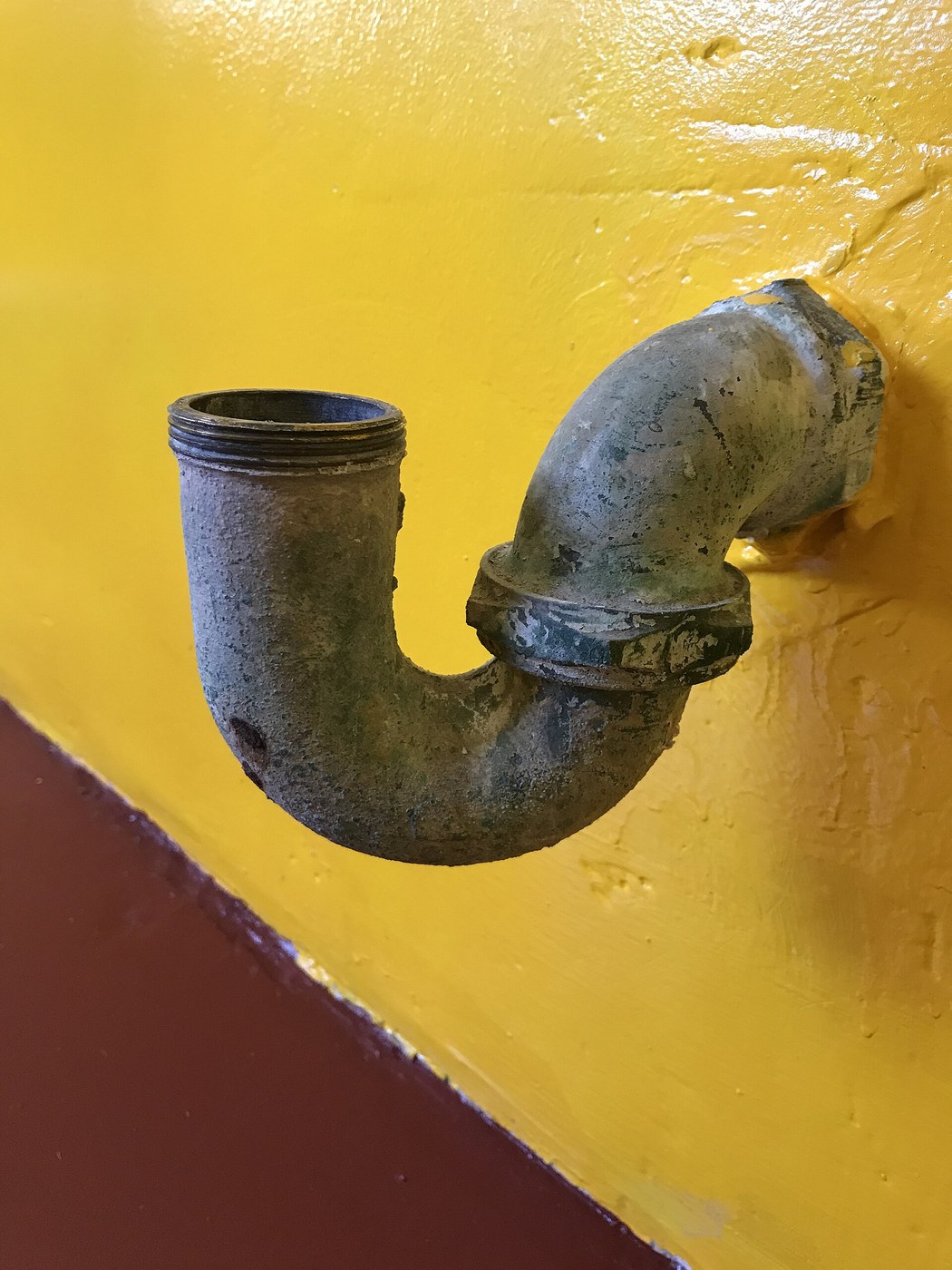


The S-Bend Water Trap
To put a drain inside a house you must open a pipe that runs to the sewer. That pipe carries methane, hydrogen sulphide and every airborne thing the sewer contains, and it will deliver all of it into the room, continuously, forever.
You cannot close the pipe — waste has to pass. You cannot fit a valve — it would foul on the first use and jam open. Whatever seals it must let solids and water through freely, seal itself again immediately afterwards, need no operation, and have no moving parts to fail.
The answer is to seal the pipe with the waste water itself. Bend the pipe downward and back up, and the low point stays permanently full. Anything you pour in pushes the water round and out, and the bend refills behind it from the same flow. Gas cannot cross, because gas cannot displace a column of water it has no pressure to move.
The depth of that column — usually 50 to 75 mm — is the entire safety margin. It is the seal, and it is also what the rest of this blueprint is about, because a trap loses to evaporation, siphonage and back-pressure long before it ever wears out.
The idea is attributed to Alexander Cumming. What matters is that it is a seal made of the thing being drained, self-restoring by design, in a component with nothing in it to break.
Talimatlar
Build the seal and prove gas cannot cross it
Build the seal and prove gas cannot cross it
Bend clear tubing into a U, clamp it upright, and fill the bend with water.
Blow gently into one end. The water rises on the far side and pushes back. Blow harder and it eventually clears with a burp.
Measure the height difference between the two water levels at the moment it breaks through.
That height is the seal strength, in millimetres of water column. Nothing else about the trap matters as much: a 50 mm seal resists 50 mm of water pressure, and not one millimetre more.
Bu adım için malzemeler:
 Silikon Hortum1 m
Gerekli aletler:
 Şerit Metre
Watch it reseal itself
Watch it reseal itself
Blow the trap clear, then pour water through it.
Look at what happens as the flow stops: the bend fills, the excess runs on, and the seal is back without anyone doing anything.
This is the property that makes it work in a real house. A valve must be operated and inspected. A trap is restored by the ordinary use of the fixture — every time you run the tap you are maintaining it.
Note the corollary now, because it is the commonest real-world failure: a fixture nobody uses is a trap nobody refills.
Dry one out and find the first failure mode
Dry one out and find the first failure mode
Fill a trap, then leave it in a warm dry place for a week without touching it. Measure the water depth each day.
Expect it to fall steadily.
Evaporation empties an unused trap, and when the seal is gone the pipe is simply open. This is why a spare bathroom or a floor drain smells after a holiday, and why the fix is not a chemical but a jug of water.
Nothing broke. The seal was consumed by ordinary physics because nothing replaced it.
Suck one dry and find the dangerous failure mode
Suck one dry and find the dangerous failure mode
Attach your trap to a vertical tube and send a full, fast slug of water down past it.
Watch the trap's water level as the slug passes.
Expect it to be pulled down or emptied. Falling water drags air with it and leaves a partial vacuum behind, and the easiest air for that vacuum to find is whatever it can suck through the nearest trap.
This is siphonage, and it is why the trap alone is not a complete solution — a neighbour flushing upstairs can empty your seal without your fixture being used at all. Step 5 is the answer, and it is a separate invention.
Break the vacuum with a vent
Break the vacuum with a vent
Repeat step 4 with an open tube teed into the pipe just downstream of the trap.
Expect the trap to hold.
The vent gives the vacuum somewhere easier to draw air from than through your seal. That is the whole function — it does not carry waste and it is not a smell pipe; it is a pressure-relief path.
This is why every building has a soil stack open to the roof. The trap seals the gas; the vent protects the trap. Neither works alone, and plumbing codes are largely about the second one.
History & Context
History & Context
The idea, and why it kept having to be re-found. The water trap is credited to Alexander Cumming, a watchmaker, and improved by others afterwards — but the striking thing is not who thought of it. It is that Rome had drains, sewers and piped water, and Europe then went roughly fourteen centuries without recollecting how to keep sewer air out of a building. The knowledge did not expire. Nobody carried it, so it had to be invented again from nothing, by a man who made clocks.
It was adopted for the wrong reason and worked anyway. Nineteenth-century cities feared miasma — the belief that disease was caused by foul air itself. Traps were fitted to stop the smell. The smell was not the danger; the water supply was. But sealing houses from sewers, and building the sewers that made traps necessary, cut cholera and typhoid enormously regardless of why anyone thought it worked. A correct solution reached through a wrong theory is still a correct solution, and this is one of the clearest cases in engineering.
Why the shape is what it is. A U holds water but traps solids in the bottom; the S and the modern P-trap carry the flow onward while keeping the seal, and the removable cleanout at the low point admits that debris will collect and makes it retrievable rather than pretending it will not. The bottle trap sacrifices some flow for compactness. All are the same idea shaped around plumbing that has to fit under a basin.
Where else the idea turns up. Anywhere a pipe must pass matter but not gas: the trap in a floor gully, the water seal on a gas holder, the airlock on a fermenting vessel that lets CO₂ out and keeps oxygen and insects from getting in. Same principle, three industries — a liquid seal is a one-way door that needs no hinge.
Honest limits. It fails dry, as step 3 showed; it fails to siphonage without a vent, as step 4 showed; and a strong enough back-pressure from a blocked sewer will push straight through it, which is what a blocked main smells like from inside a house. Waterless traps exist for places that stand unused — a flexible sleeve or a floating disc — precisely because the water seal's one weakness is needing water.
Malzemeler
1- Yer Tutucu
Gerekli Aletler
1- 1 vendor sell this, none ship to you yetYer Tutucu
CC0 Kamu Malı
Bu plan CC0 lisansıyla yayınlanmıştır. İzin almadan kopyalayabilir, değiştirebilir, dağıtabilir ve herhangi bir amaçla kullanabilirsiniz.
Planı üzerinden ürün satın alarak Maker'ı destekleyin, böylece Maker Komisyonu Satıcılar tarafından belirlenen komisyonu kazanırlar veya bu Planın yeni bir versiyonunu oluşturun ve gelir paylaşımı için kendi Planınıza bağlantı olarak ekleyin.