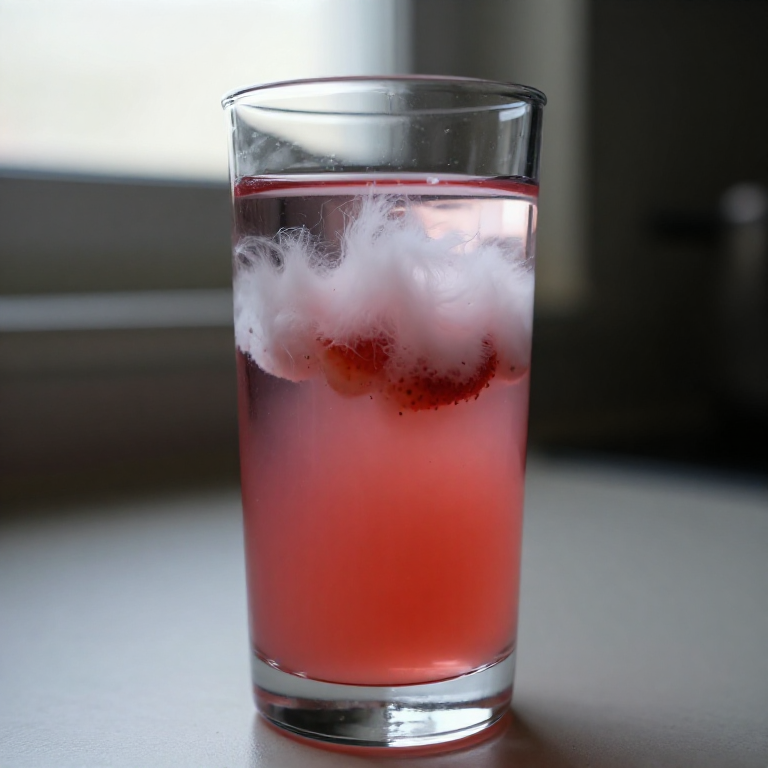


Strawberry DNA Extraction
DNA is not hidden in some inaccessible vault. It is in every cell of the fruit in your hand, and you can have a visible clot of it sitting in a jar within fifteen minutes, using washing-up liquid, table salt and cold alcohol.
Strawberries are the ideal subject and not by accident. The cultivated garden strawberry is octoploid — it carries eight sets of chromosomes where you carry two — so a single crushed berry yields an unusually generous amount of DNA for its size. The fruit is also soft enough to mash without any equipment.
Three reagents do three separate jobs: soap tears open the membranes, salt persuades the DNA to clump, and alcohol makes it fall out of solution. Nothing here is a trick — each step is doing exactly what it looks like it is doing.
Talimatlar
Chill the alcohol first
Chill the alcohol first
Put the isopropyl alcohol in the freezer for at least 30 minutes before you start. Warm alcohol gives a poor yield — this single step matters more than anything else in the method.
Bu adım için malzemeler:
 İzopropil Alkol %99100 ml
Mix the extraction buffer
Mix the extraction buffer
Stir together 100 ml water, 1 teaspoon washing-up liquid and half a teaspoon of table salt. Stir gently — froth traps your DNA and makes it impossible to see.
Bu adım için malzemeler:
 Kastilya sabunu (sıvı)5 ml
 Sofra tuzu3 g
Gerekli aletler:
 Ölçü sürahisi
Take one or two strawberries and remove the green tops
Take one or two strawberries and remove the green tops
Fresh or frozen both work. Discard the hulls — leaf tissue adds fibre and pigment with no extra DNA.
Bu adım için malzemeler:
 Çilek2 adet
Seal the fruit in a bag and mash it thoroughly
Seal the fruit in a bag and mash it thoroughly
Squash it to a smooth pulp with your fingers for a full minute. You are breaking cell walls mechanically — the soap cannot reach a cell that is still inside intact tissue.
Add the buffer to the bag and mash again
Add the buffer to the bag and mash again
Pour in about 50 ml of buffer, seal out the air and squash gently for another minute. Gently — vigorous shaking shears the DNA into fragments too short to see.
Let it stand for 10 minutes
Let it stand for 10 minutes
The soap needs time to dissolve the lipid membranes around each cell and around each nucleus. This is the slowest chemistry in the process.
Filter the slurry through a coffee filter
Filter the slurry through a coffee filter
Pour it through filter paper into a clean glass. You want the liquid, not the pulp — cell wall debris is what makes the final result look like porridge instead of thread.
Gerekli aletler:
 Kahve filtresi / filtre kağıdı
 Saplı Cam Huni
Be patient with the filtration
Be patient with the filtration
It drips slowly. Do not squeeze the filter to hurry it — squeezing forces pulp through and ruins the clarity you just spent ten minutes gaining.
Pour the filtrate into a tall narrow glass
Pour the filtrate into a tall narrow glass
A narrow vessel concentrates the DNA into a visible band. About 2 cm depth of pink filtrate is plenty.
Gerekli aletler:
 Cam Kavanoz
Tilt the glass and pour cold alcohol down the side
Tilt the glass and pour cold alcohol down the side
Add roughly the same volume of ice-cold alcohol, running it slowly down the inside wall. Do not stir. You want two distinct layers with a sharp boundary.
Watch the boundary
Watch the boundary
Within seconds a white, stringy, cloud-like mass appears exactly at the interface between the two layers. That is DNA coming out of solution.
Spool it onto a stick or a hook
Spool it onto a stick or a hook
Twirl a wooden skewer or a bent paperclip slowly in the alcohol layer. The DNA wraps around it in threads you can lift clear of the liquid.
Look at what you have actually got
Look at what you have actually got
It is not pure. The white mass is DNA tangled with RNA and protein. Calling it “DNA” is honest at this scale; calling it pure DNA is not.
Gerekli aletler:
 Büyüteç
Repeat with another fruit and compare
Repeat with another fruit and compare
Try a kiwi, a banana and an onion side by side with the same volumes. Record which gives the biggest clot and think about why.
Compendium — three reagents, three jobs
Compendium — three reagents, three jobs
Why the strawberry. The cultivated garden strawberry, Fragaria × ananassa, is octoploid: eight sets of chromosomes, 2n = 8x = 56, arising from a hybridisation between two already-polyploid American species in eighteenth-century Europe. Eight copies of the genome per cell means far more DNA per gram of tissue than a diploid fruit, and ripe strawberry flesh is soft enough to disrupt by hand. Polyploidy is common in cultivated plants — bread wheat is hexaploid — and it is one reason plant genetics developed differently from animal genetics.
What each reagent does. The detergent is an amphiphile: one end mixes with water, the other with fat. It inserts itself into the phospholipid bilayers of the cell membrane and the nuclear envelope and pulls them apart, releasing the nuclear contents. Salt supplies sodium ions that crowd around the DNA's negatively charged phosphate backbone, screening the repulsion between strands so they can aggregate instead of staying dispersed. Alcohol is the precipitant: DNA is readily soluble in water and effectively insoluble in ethanol or isopropanol, so adding alcohol drops it out of solution. Cold matters because solubility falls with temperature and because cold slows the nucleases that would otherwise chop the strands.
Why it looks like thread. A single DNA molecule is about 2 nanometres wide and invisible. What you spool is millions of molecules aggregated together with trapped air bubbles from the alcohol layer, which is why the mass looks white and fibrous rather than clear. The stringiness is real, though — DNA is an extraordinarily long thin polymer, and the human genome in one cell would stretch about two metres if laid end to end.
The historical thread. Friedrich Miescher isolated what he called nuclein from white blood cells in pus-soaked bandages in 1869 — the first DNA extraction, using alkali and acid rather than washing-up liquid. Its role as the hereditary material was not accepted until Avery, MacLeod and McCarty in 1944 and Hershey and Chase in 1952, and the double helix followed in 1953. For seventy-five years DNA was a known molecule with no known job. The extraction was the easy part; working out what it was for took three generations.
Malzemeler
4- 100 mlYer Tutucu
- Yer Tutucu
- 3 gYer Tutucu
- 2 adetYer Tutucu
Gerekli Aletler
5- Yer Tutucu
- Yer Tutucu
- Yer Tutucu
- Yer Tutucu
- Yer Tutucu
İlgili Blueprint'ler
Bu blueprint'ler bilgi paylaşır — teknikler, malzemeler veya ilkeler

CC0 Kamu Malı
Bu plan CC0 lisansıyla yayınlanmıştır. İzin almadan kopyalayabilir, değiştirebilir, dağıtabilir ve herhangi bir amaçla kullanabilirsiniz.
Planı üzerinden ürün satın alarak Maker'ı destekleyin, böylece Maker Komisyonu Satıcılar tarafından belirlenen komisyonu kazanırlar veya bu Planın yeni bir versiyonunu oluşturun ve gelir paylaşımı için kendi Planınıza bağlantı olarak ekleyin.