SANAT
GÜZELLİK & SAĞLIK
ZANAAT
KÜLTÜR & TARİH
EĞLENCE
ÇEVRE
YİYECEK & İÇECEK
TERS MÜHENDİSLİK
BİLİMLER
SPOR
TEKNOLOJİ
GİYİLEBİLİR ÜRÜNLER
Youblob (generated from this blueprint's notebook) · CC0

The Bucket Elevator: Lifting Grain by the Bucketful, and Where It Lands
A bucket elevator is an endless belt with buckets bolted to it, running round a pulley at the bottom (the boot) and one at the top (the head). The buckets dig grain out of the boot, carry it straight up, and empty it as they turn over the head pulley.
Oliver Evans used elevators to move grain inside his automated flour mill in the 1780s. In 1842 Joseph Dart and the engineer Robert Dunbar built a steam-powered elevator on the Buffalo River, whose 'marine leg' was let down into a ship's hold and lifted the grain out, in place of men carrying it in sacks. Every grain elevator since works the same way.
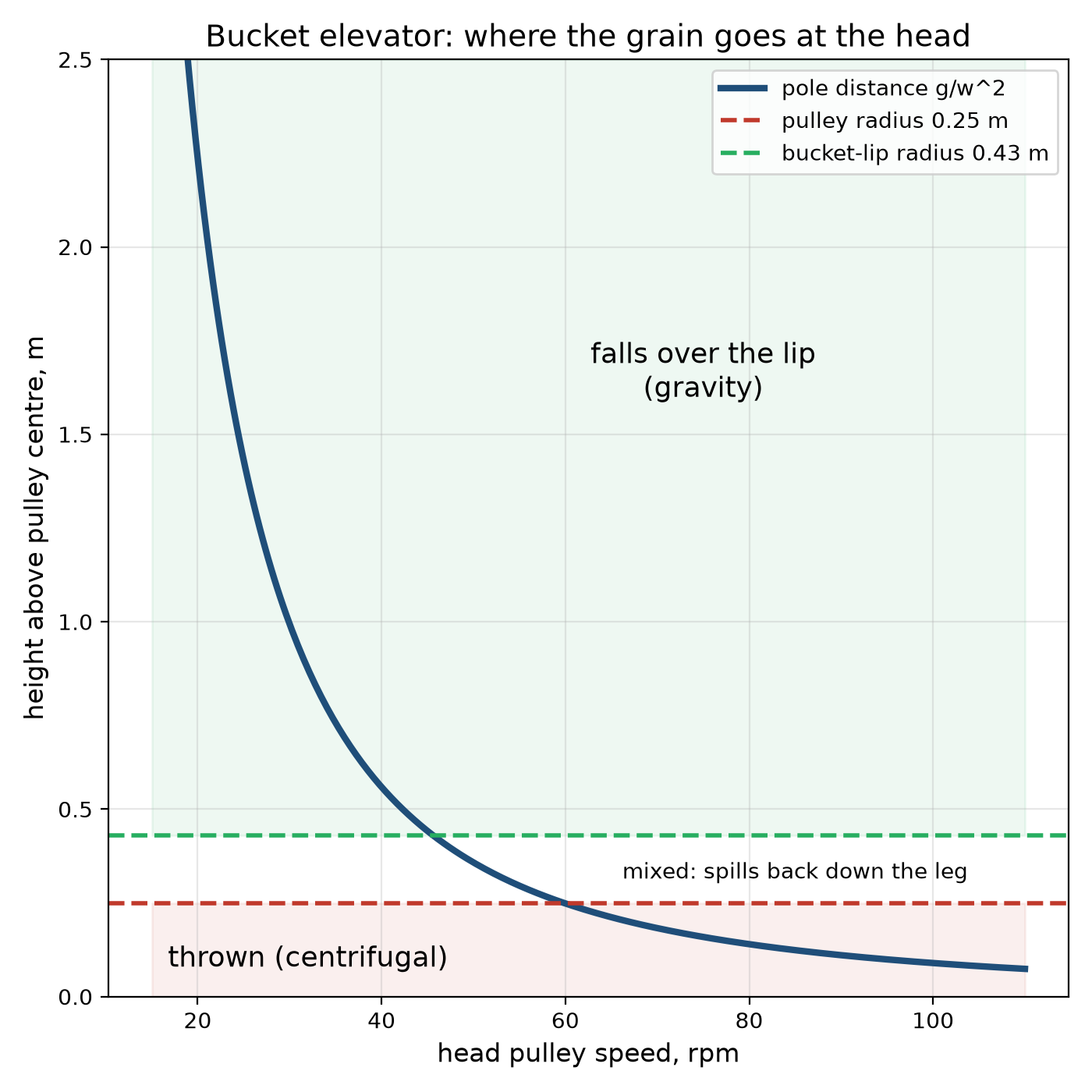
The one design choice that decides whether it works is the speed of the head pulley: too slow and the grain spills back down the leg, fast enough and it is thrown cleanly into the chute. This rung works that out, then builds a bench elevator that shows it.
Orta
About 5 hours
Talimatlar
1
1
Pole distance, capacity and power
Pole distance, capacity and power
Jupyter defteri yükleniyor…
2
2
Build a bench elevator
Build a bench elevator
Print eight small buckets, about 40 mm wide, 30 mm deep and 30 mm from back to lip, each with a flat back and two 5 mm holes. Bolt them to a loop of 25 mm nylon webbing at 60 mm spacing with elevator bolts: their flat heads sit flush on the belt side so they run smoothly over the pulleys.
Make two drums from 50 mm PVC pipe on 8 mm steel shafts in skateboard bearings, one at the foot of an upright plywood board and one about 600 mm above it. Tension the belt by sliding the foot drum down in a slotted hole. Drive the head shaft from a geared DC motor on an adjustable power supply.
Build a boot box round the foot drum that you can fill with lentils, and fix an open-topped chute on the down-going side of the head, just below the level of the head shaft, where thrown grain will land.
Bu adım için malzemeler:
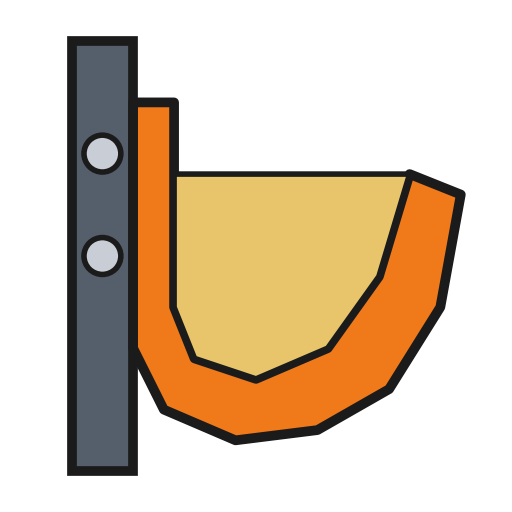 Kovalı elevatör kovası8 adet
 Naylon kolan2 metre
 Kare boyunlu cıvata16 adet
 PVC Boru1 metre
 Ham çelik çubuk1 adet
 Kaykay rulmanları4 adet
 Kontrplak levha1 adet
 Redüktörlü DC motor1 adet
 Kuru mercimek2 kilogram
Gerekli aletler:
 FDM 3B yazıcı
 PETG filament
 Doğru akım güç kaynağı
 Kablosuz Matkap
 Matkap Ucu Takımı
 Alyan takımı
 Kurbağacık anahtar
 Cetvel
 Dijital Kumpas 6 İnç
 Şeffaf Koruyucu Gözlük
3
3
Find the speed where it throws cleanly
Find the speed where it throws cleanly
With the drum radius and bucket-lip radius of your build, compute the two speeds from the notebook: $n_c = \frac{60}{2\pi}\sqrt{g/r_1}$ and $n_g = \frac{60}{2\pi}\sqrt{g/r_2}$. With a 25 mm drum and 55 mm to the bucket lip they come to about 190 and 130 rpm.
Fill the boot. Start slow, well below the gravity speed, and raise the speed in steps, reading each with a tachometer on the head shaft. Watch the head. At low speed the buckets tip their lentils out late and many fall back down the up-going side. Through the mixed band some are thrown and some dribble. Above the centrifugal speed the lentils leave in a clean arc into the chute.
At each speed run for 30 s, weigh what reached the chute, and note what fell back. Plot grams per minute against rpm: capacity rises with speed as the notebook says, and the fraction lost down the leg drops to nearly nothing once the throw is clean.
Gerekli aletler:
 Dijital Takometre
 Kronometre
 Dijital Mutfak Terazisi
 Kova
Kova4
4
When an elevator misbehaves
When an elevator misbehaves
Real legs fail in a handful of ways. Work down the tree.
Flow
Loading...
5
5
One bucket's round trip
One bucket's round trip
Blockly Çalışma Alanı
Loading Blockly workspace...
6
6
History and context
History and context
**Oliver Evans** built bucket elevators into his automated flour mill in the 1780s, moving grain from floor to floor without carrying it; his milling improvements were patented in 1790.
**Joseph Dart** and the engineer **Robert Dunbar** built the first steam-powered grain elevator and storehouse on the Buffalo River in 1842, working from 1843. Its marine leg was lowered into a lake boat's hold and lifted the grain out in buckets on a belt. No patent was taken; Dunbar went on to design elevators across the Great Lakes and beyond.
**Honest limits.** Grain dust is explosive, and elevator heads and legs are where dust explosions start: real elevators need dust control, bearing temperature and belt-slip monitors. Belt speed is limited too — too fast and the buckets throw grain past the chute and damage it, so every head speed is a compromise.
Malzemeler
9- 8 adetYer Tutucu
- 2 metreYer Tutucu
- Kare boyunlu cıvata%10 komisyon16 adetYer Tutucu
- 1 metreYer Tutucu
- 1 adetYer Tutucu
- Kaykay rulmanları%10 komisyon4 adetYer Tutucu
- 1 adetYer Tutucu
- şu fiyattan$2.53
- 2 kilogramYer Tutucu
Gerekli Aletler
14- Yer Tutucu
- Yer Tutucu
- Yer Tutucu
- 1 vendor sell this, none ship to you yetYer Tutucu
- Yer Tutucu
- Yer Tutucu
- Yer Tutucu
- Yer Tutucu
- Yer Tutucu
- Yer Tutucu
- Yer Tutucu
- Yer Tutucu
- Yer Tutucu
- Yer Tutucu
İlgili Blueprint'ler
Bu blueprint'ler bilgi paylaşır — teknikler, malzemeler veya ilkeler

The Troughed Belt: Two Tipped Rollers That Doubled What a Conveyor Carries
Emma tarafından
Mekanik
9
0
0
0
0
0
Threshing Machine
Martin tarafından
Mekanik
28
0
0
0
0
0
The Bin That Stops Flowing: Arching, Ratholing, and the Gate That Causes It
Martin tarafından
Metal işleme
12
0
0
0
0
0
Grain Binder Knotter
Pixel tarafından
Mekanik
56
0
0
0
0
0
CC0 Kamu Malı
Bu plan CC0 lisansıyla yayınlanmıştır. İzin almadan kopyalayabilir, değiştirebilir, dağıtabilir ve herhangi bir amaçla kullanabilirsiniz.
Planı üzerinden ürün satın alarak Maker'ı destekleyin, böylece Maker Komisyonu Satıcılar tarafından belirlenen komisyonu kazanırlar veya bu Planın yeni bir versiyonunu oluşturun ve gelir paylaşımı için kendi Planınıza bağlantı olarak ekleyin.