SANAT
GÜZELLİK & SAĞLIK
ZANAAT
KÜLTÜR & TARİH
EĞLENCE
ÇEVRE
YİYECEK & İÇECEK
TERS MÜHENDİSLİK
BİLİMLER
SPOR
TEKNOLOJİ
GİYİLEBİLİR ÜRÜNLER
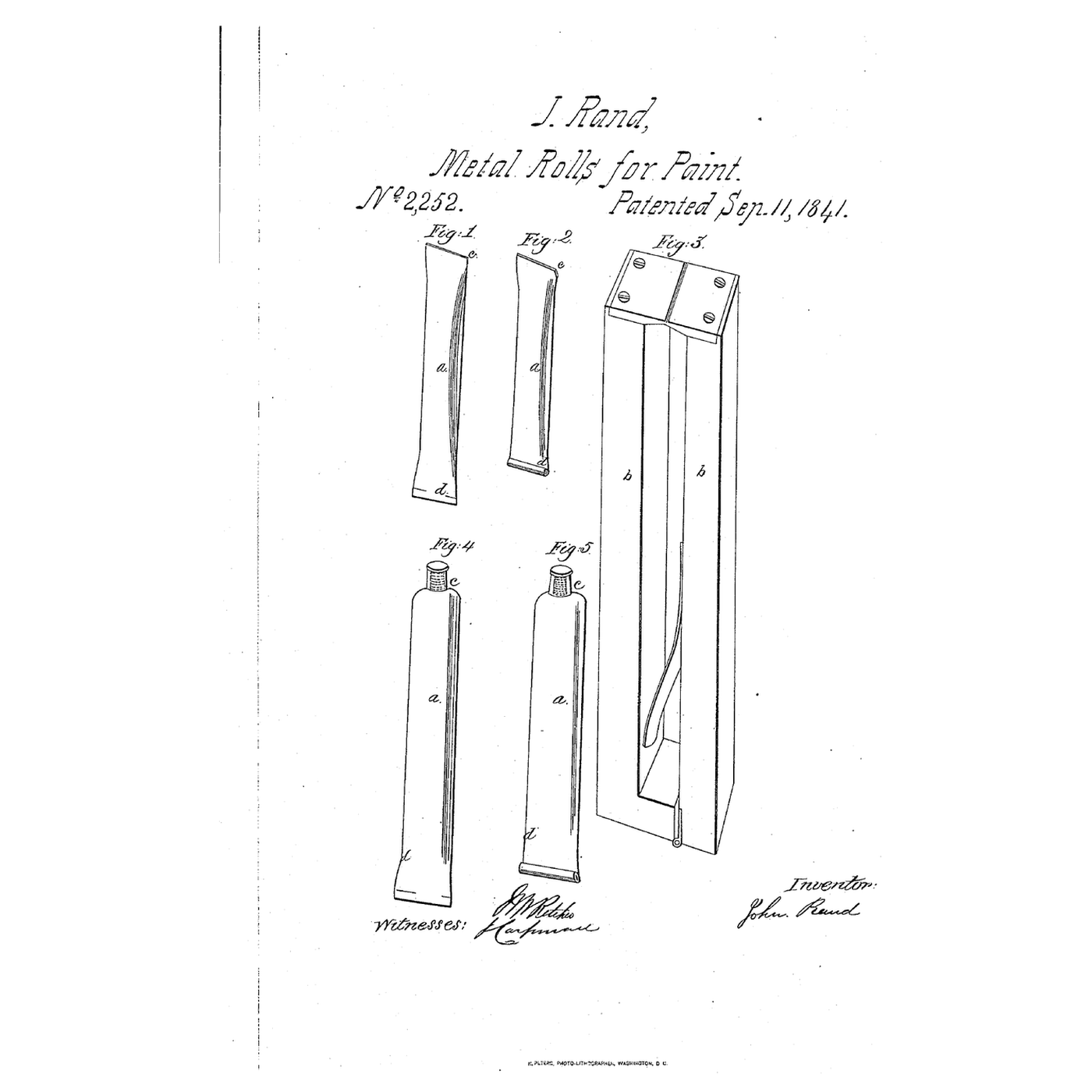

The Collapsible Tube: A Container That Is Always Full
Before the 1840s a painter kept ground oil colour in pig's bladders tied with string, pricked to squeeze some out; once opened, the paint began to dry. A tube of soft metal, squeezed from the end and capped, keeps the rest sealed from the air.
US 2,252, dated 11 September 1841, was granted to John Rand, then living at Howland Street, Middlesex, England — the American portrait painter John Goffe Rand. Its drawing sheet is titled "Metal Rolls for Paint". Tubes of grain-tin, lead or pewter thin enough "to be caused to be permanently collapsed" are filled, closed at both ends, pierced or fitted with a screw-capped nozzle, and rolled up from the end as the paint is used.
This rung works out why a soft metal tube stays collapsed, and fills and tests tubes of paint.
Başlangıç
About 2 hours
Talimatlar
1
1
Dose per millimetre and fold strain
Dose per millimetre and fold strain
Jupyter defteri yükleniyor…
2
2
Why paint must be kept from the air
Why paint must be kept from the air
Oil paint cures by reacting with oxygen. The embedded blueprint explains the drying mechanisms that a sealed tube stops.
3
3
Read US 2,252
Read US 2,252
Rand's invention relates to "a mode of preserving paints and other fluids by confining them in close metallic vessels so constructed as to collapse with slight pressure, and thus force out the paint or fluid confined therein through proper openings", which can then be closed air-tight. The vessels are "at all times full, whatever be the quantity of fluid matter remaining therein".
He names "grain-tin, lead, and pewter" as the best and cheapest metals, of such thickness "as readily to yield to pressure and to be caused to be permanently collapsed". Fig. 1's vessel is "made of grain-tin drawn into a tube", the metal "about one seventy-fifth of an inch in thickness", its ends closed by melting the pressed edges or by soldering; a pair of forceps b holds the end for closing it with a blowpipe or hot iron.
A hole is made at c and "it is better that the pressure should be made at the end, d, of the vessel", so the collapsed end "may be rolled up". Fig. 4 adds a short tube with "a screw-cap". He warns that the fluid must not be one "chemically prejudicially acted on by the metal employed".
4
4
Fill tubes and test the seal
Fill tubes and test the seal
Mix a little oil paint from the set with a few drops of linseed oil. Fill two empty paint tubes from the open end with a palette knife, fold the end over twice with flat-nose pliers and crimp it flat. Put the same paint in a small open-topped jar with a loose lid.
Each day for a week, squeeze a pea of paint from a tube and rolling up the end, and take a pea from the jar. Note when the jar's paint grows a skin and when the tube's does. Measure the flattened length per squeeze with the caliper and compare with the notebook's millimetres per millilitre.
Bu adım için malzemeler:
 Boş boya tüpleri2 adet
 Yağlı boya seti1 adet
 Bezir Yağı1 adet
 Cam Kavanoz1 adet
Gerekli aletler:
 Yassı Ağızlı Pense
 Dijital Kumpas 6 İnç
 Maket Bıçağı
5
5
A tube that dries out or leaks
A tube that dries out or leaks
Collapsible tube troubleshooting.
Flow
Loading...
6
6
History and honest limits
History and honest limits
**US 2,252**, dated 11 September 1841, was granted to **John Rand**, a citizen of the United States then living in Middlesex, England; he is the portrait painter John Goffe Rand. It claims the mode of preserving paint in vessels that collapse by slight pressure as their contents are removed.
**Honest limits.** Tin's modulus and yield stress in the notebook are typical values; lead and pewter behave similarly. Lead tubes are not used for food or cosmetics today.
Malzemeler
4- 2 adetYer Tutucu
- Yağlı boya seti%10 komisyon1 adetYer Tutucu
- 1 adetYer Tutucu
- 1 adetYer Tutucu
Gerekli Aletler
3- Yer Tutucu
- Yer Tutucu
- Yer Tutucu
İlgili Blueprint'ler
Bu blueprint'ler bilgi paylaşır — teknikler, malzemeler veya ilkeler
Extracting Tin from Cassiterite — Smelting the Bronze Alloying Metal
Forge tarafından
Metal işleme
94
0
0
0
0
0
Drawing Wire Through a Drawplate — Reducing Iron Rod to Fine Wire
Forge tarafından
Metal işleme
48
0
0
0
3
0
Making Azurite Blue Pigment — Grinding the Copper Mineral into the Blue of Medieval Painting
Charlie tarafından
SANAT
69
0
0
0
4
0
Drying Is Not Evaporating: Three Different Mechanisms, Three Different Films
Mary tarafından
Kimya
25
0
0
0
0
0
CC0 Kamu Malı
Bu plan CC0 lisansıyla yayınlanmıştır. İzin almadan kopyalayabilir, değiştirebilir, dağıtabilir ve herhangi bir amaçla kullanabilirsiniz.
Planı üzerinden ürün satın alarak Maker'ı destekleyin, böylece Maker Komisyonu Satıcılar tarafından belirlenen komisyonu kazanırlar veya bu Planın yeni bir versiyonunu oluşturun ve gelir paylaşımı için kendi Planınıza bağlantı olarak ekleyin.