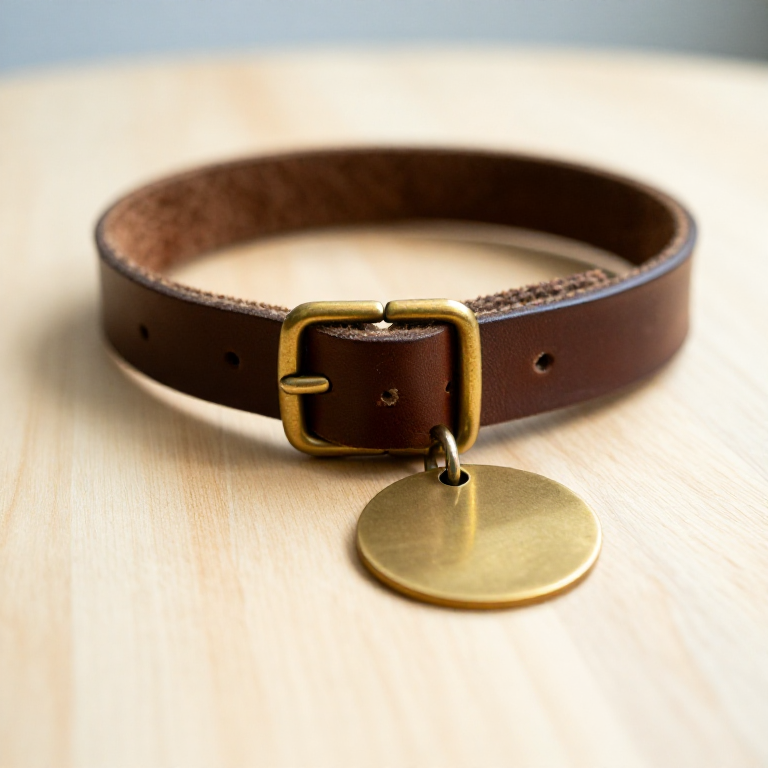


The Pet Collar and ID Tag
A collar carries a name and an address, and that is genuinely the most effective way a lost animal gets home — faster than a microchip, because anyone who finds the animal can read it without a scanner or a vet.
It is also, uniquely among the things in this corpus, a wearable that can kill the wearer. Collars catch on branches, fences, furniture and other animals' jaws. A cat that hangs itself on a fence post did so because its collar was strong.
So the design brief is contradictory and has to be resolved deliberately. A dog collar must not fail — a lead attaches to it and a dog that breaks free at a road is in danger. A cat collar must fail, reliably, at a low and predictable force, which is what a breakaway or snap-opening buckle is for. The two are not interchangeable, and a homemade collar that ignores the distinction is a hazard rather than a project.
Fit is the other half. The rule is two fingers between collar and neck: any looser and a paw or a jaw gets through, any tighter and it chafes and restricts. Growing animals need it checked constantly.
Cut, stitch, stamp a tag, and — the step that matters most — measure the force at which yours releases.
Talimatlar
Measure the animal, not a size chart
Measure the animal, not a size chart
Measure the neck with a soft tape where the collar will sit, then add the two-finger allowance and measure that as a number.
Write it down along with the animal's weight and species.
Breed size charts are averages and your animal is not an average. Two fingers is a measurement you can repeat as the animal grows or gains weight.
Gerekli aletler:
 Tape Measure
 All-Weather Field Notebook (3-Pack)
Choose the failure mode before the material
Choose the failure mode before the material
Decide now: is this a dog collar that must hold, or a cat collar that must release?
For a cat, fit a breakaway or snap-opening buckle. For a dog, a conventional buckle and, if a lead attaches, a metal D-ring stitched into a reinforced fold.
Never fit a cat with a fixed buckle, and never walk a dog on a breakaway collar — each of those errors is the other one's safety feature applied to the wrong animal.
Bu adım için malzemeler:
 Leather Strap1 metre
 Belt Buckle Hardware Set1 takım
Cut, edge and stitch
Cut, edge and stitch
Cut the strap to length plus a generous fold at each end. Round and burnish the edges. Fold the buckle end around the buckle bar and stitch a rectangle with a cross through it.
Punch adjustment holes in a line, evenly spaced.
The box-and-cross again — the same reason as on a bag strap. The load is trying to tear the material along a line of holes, and spreading it over an area is the only defence.
Bu adım için malzemeler:
 Sewing Thread1 adet
Gerekli aletler:
 Needle File Set
Stamp the tag with the right information
Stamp the tag with the right information
Stamp a metal blank with a phone number and, if it fits, a name.
Stamp from the centre outwards, and check spacing on scrap first.
Do not put your home address on it, and consider omitting the animal's name — a stranger who can call the animal by name has an easier time taking it. A contactable number is the only field that actually gets an animal home.
Bu adım için malzemeler:
 Belt Buckle Blank Set (Brass, 10-Pack)1 takım
Gerekli aletler:
 Metal Stamping Kit (Jewelry)
Measure the release force — the step nobody does
Measure the release force — the step nobody does
For a breakaway collar, fasten it around a rigid former and pull with a spring scale until it releases. Record the force. Repeat ten times.
Expect a modest force and, more importantly, look at the spread.
A buckle that releases at wildly different forces is not a safety device. Re-test after a month of wear — dirt and corrosion raise release force, which is exactly the wrong direction.
Gerekli aletler:
 Force Meter (Spring Scale)
Fit it, then check it three times
Fit it, then check it three times
Fit to the two-finger standard. Check after an hour, after a day, and after a week — looking under the collar at the skin each time.
Watch for rubbing, damp trapped fur, and any attempt to get a paw under it.
Most collar injuries are slow. They come from a fit that was right in November and wrong in March, or from a young animal that grew, and they are found by looking rather than by assuming.
Compendium — the safety case, and the honest limits
Compendium — the safety case, and the honest limits
Collars work because they need no technology at the other end. A microchip is permanent and cannot be lost, but it requires a scanner, which means a vet or a shelter, which means the animal has already entered a system. A legible tag is read by the neighbour who finds the animal in their garden, and that route is faster and commoner. The two are complements, not alternatives — chip for permanence, tag for speed. Many jurisdictions legally require a dog in a public place to wear an identifying tag; check your local rule, because it is often more specific than people expect about what must be on it.
The strangulation risk is real and is why cat collars are built to fail. Cats climb, squeeze through gaps and hook collars on branches, fence spikes and latches; they also get a foreleg or a lower jaw through a loose collar and then cannot get it out. Breakaway buckles — which pop open under a sustained pull — and elasticated sections exist because of documented injuries and deaths. The counter-argument that a cat that loses its collar is unidentified is answered by the microchip, not by a stronger collar.
Materials matter more than they look. Leather is strong, comfortable and ages well, but it holds moisture against skin and rots; it is a poor choice for an animal that swims. Nylon webbing dries fast and is the practical default. Anything that absorbs and holds damp against fur causes the classic collar dermatitis, and a collar that is never removed and never inspected is the usual precondition.
🔴 What this blueprint is not. It does not cover choke chains, prong collars or electronic shock collars. Those are training devices with real potential for injury and, in the case of shock collars, are banned or restricted in a number of countries; they are outside a maker blueprint and belong with a qualified behaviourist. It also does not cover collars for livestock, which have different load and safety requirements entirely. And no collar is a substitute for supervision: a very young animal, a very small one, or one recovering from surgery should not be left unsupervised in any collar at all.
Malzemeler
4- 1 metreYer Tutucu
- 1 takımYer Tutucu
- 1 adetYer Tutucu
- Yer Tutucu
Gerekli Aletler
5- 1 vendor sell this, none ship to you yetYer Tutucu
- Yer Tutucu
- Yer Tutucu
- Yer Tutucu
- Yer Tutucu
Bağlı Plan Malzemeleri

İlgili Blueprint'ler
Bu blueprint'ler bilgi paylaşır — teknikler, malzemeler veya ilkeler

CC0 Kamu Malı
Bu plan CC0 lisansıyla yayınlanmıştır. İzin almadan kopyalayabilir, değiştirebilir, dağıtabilir ve herhangi bir amaçla kullanabilirsiniz.
Planı üzerinden ürün satın alarak Maker'ı destekleyin, böylece Maker Komisyonu Satıcılar tarafından belirlenen komisyonu kazanırlar veya bu Planın yeni bir versiyonunu oluşturun ve gelir paylaşımı için kendi Planınıza bağlantı olarak ekleyin.