

Neem Seed Oil Extraction — Traditional Cold-Press Method of Andhra Pradesh
Talimatlar
Learning about the Neem Tree (Azadirachta indica)
Learning about the Neem Tree (Azadirachta indica)
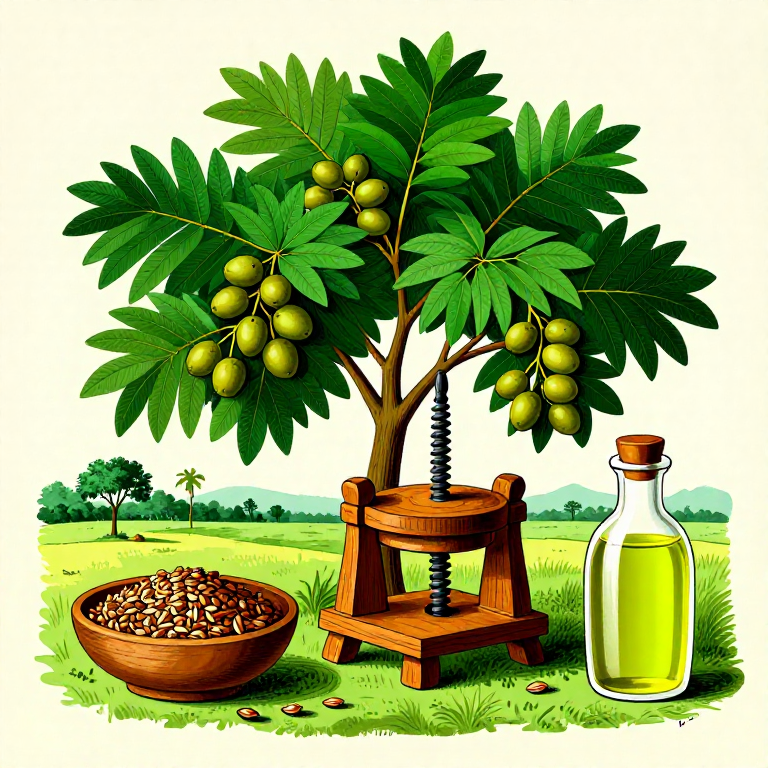
Neem (Azadirachta indica, Meliaceae family) is an evergreen tree native to the Indian subcontinent. This tree grows to a height of 15-20 meters, with broad, dense, umbrella-shaped green branches. The leaves are compound type, 20-40 cm long, with 8-19 small leaflets per leaf. These leaflets have serrated margins. The tree bears white, fragrant flowers between March-May. The fruits ripen between May-August — changing from green to yellow-green. Each fruit is an oval drupe 1-2 cm long, containing a hard seed kernel inside. A mature tree yields 30-50 kg of fruits per year. Neem contains over 300 biologically active compounds, of which azadirachtin is the most important — it is a potent natural insecticidal chemical.
Identify the neem fruit collection season
Identify the neem fruit collection season
In Andhra Pradesh, neem fruits ripen and fall between June and August — the onset of the monsoon season. Ripe fruits change from green to yellow-green and fall naturally. The pulp of fallen fruits is soft and sweet — birds and bats eat the pulp and disperse the seeds. The best time for collection is early morning, picking up fresh fruits that fell overnight. Fruits left on the ground for more than 2-3 days after falling begin to rot — rotted pulp reduces seed quality. Neem trees grow naturally along roadsides, field boundaries, and in villages — every village in rural Andhra Pradesh has ten to hundreds of neem trees.
Fruit collection method
Fruit collection method
Start collection between 6:00-9:00 AM. Gather the yellow-green fruits fallen under the tree. Leave behind green (unripe) fruits — their seeds are not fully developed, and oil percentage is low. Also leave black, decomposed fruits. One person can collect 15-25 kg of fruits per day. Fill collected fruits in burlap sacks — do not tie in plastic sacks, as moisture gets trapped and decomposition starts. Do not fill the sack more than three-quarters, as fruits at the bottom get crushed. Start processing collected fruits on the same day or the next day.
Bu adım için malzemeler:
 Jüt toplama çuvalı3 adet
Gerekli aletler:
 Örme bambu sepet
Remove the pulp (depulping)
Remove the pulp (depulping)
The outer pulp must be removed from the collected fruits — only the seed is used for oil extraction. Soak the fruits in a large bucket of water — soaking for 12-24 hours softens the pulp for easy removal. Remove the soaked fruits and squeeze by hand to separate the pulp. The seeds are hard, oval-shaped, and grayish-white in color. Do not pour the pulp-soaked water into drains — this water contains saponins, which are harmful to fish. Instead, pour the pulp water into a compost pit — it makes good organic fertilizer. From 10 kg of fruits, approximately 5-6 kg of seeds are obtained.
Bu adım için malzemeler:
 Plastik kova 20 l2 adet
 Damıtılmış Su40 litre
Gerekli aletler:
 Lastik eldiven
Wash and clean the seeds
Wash and clean the seeds
After depulping, wash the remaining pulp fibers adhering to the seeds thoroughly in clean water. Change the water and wash 2-3 times — until the water runs clear. If pulp residue remains on the seeds, mold will develop during drying and oil quality will decrease. Take the washed seeds immediately for drying — do not pile wet seeds together, as they will heat up and rot. Clean seeds have a rough, grayish-brown outer shell.
Bu adım için malzemeler:
Damıtılmış Su30 litreGerekli aletler:
 Plastik süzgeç (büyük)Lastik eldiven
Drying Seeds
Drying Seeds
Spread washed seeds in a single layer on a mat (mat) and dry them in the sun. Do not dry directly on the ground — moisture will return. Dry on a mat, bamboo mat, or tarpaulin. Turn 3-4 times a day — it should dry evenly on all sides. Well-dried seeds are ready in 3-5 days. When a dried seed is tapped with a finger, it should crack hard with a 'tuck' sound — if it bends softly, there is still moisture. The moisture percentage should be less than 10%. Cover with tarpaulin at night, protect from rain. Oil from improperly dried seeds contains high free fatty acid (FFA), reducing quality.
Bu adım için malzemeler:
 Örme bambu kurutma hasırı3 adet
 Branda örtü1 adet
Gerekli aletler:
 Ahşap tırmık
Removing the shell and separating the kernel from the seed
Removing the shell and separating the kernel from the seed
Dried neem seeds have a hard outer shell (shell), inside which there are 1-2 kernels (seed kernels) — these are the parts that yield oil. The kernel contains 40-50% oil content. Gently crack the seeds with a small stone roller or wooden mallet to break the shell — if too much force is applied, the kernel will be damaged. Separate the shell pieces from the kernel. The kernel is white-yellowish in color and slightly oily. Do not discard the shells — they can be used as organic fertilizer. Collect the kernels in a clean container. From 10 kg of seeds, approximately 5-6 kg of kernels are obtained.
Bu adım için malzemeler:
 Paslanmaz çelik toplama kâsesi2 adet
Gerekli aletler:
 Ahşap Tokmak
 Taş havan
Preparing Kernels for Oil Pressing
Preparing Kernels for Oil Pressing
Coarsely crush the separated kernels in a stone mortar or grinder — do not grind too finely, they should remain as coarse crush. If ground too finely, they will turn into paste during pressing and the oil will not separate properly. Keep the coarsely crushed kernels at room temperature (25-30°C) before putting them in the pressing machine. Do not heat — heating is prohibited in the cold-pressing method, because heat causes azadirachtin to degrade (azadirachtin degrades above 60°C). Take 3-5 kg of crushed kernels per batch.
Bu adım için malzemeler:
 Neem tohumu içi (kurutulmuş)5 kg
Gerekli aletler:
 Taş Havan ve Havaneli
Oil extraction through cold-pressing
Oil extraction through cold-pressing
Place the kernels soaked in water into a traditional wooden oil press (ghani) or manually operated screw press and apply pressure. The wooden ghani is a traditional Indian oil pressing method — operated by a machine turned by oxen or by hand. The modern manual screw press is suitable for small-scale production. Ensure that the temperature during pressing remains below 50°C — this is the definition of cold-pressing. The oil flows slowly, drop by drop — do not hurry and press at high speed. From 5 kg of kernels, approximately 1.5-2 liters of neem oil is obtained (30-40% yield). After pressing, remove the remaining press cake and set it aside — it is a valuable organic fertilizer and insecticide.
Gerekli aletler:
 El ile çalışan vidalı yağ presi
 Yağ toplama kabı
Filter the oil
Filter the oil
Bu adım için malzemeler:
 Müslin bez2 adet
 İnce pamuk süzme bezi2 adet
 Cam çöktürme kavanozu1 adet
Gerekli aletler:
 Paslanmaz çelik huni
Oil quality testing
Oil quality testing
Gerekli aletler:
 Cam Örnek Şişesi
 Termometre
Store the oil and use neem cake
Store the oil and use neem cake
Bu adım için malzemeler:
 Amber cam şişe5 adet
 HDPE saklama kabı1 adet
 Yapışkanlı Etiketler10 adet
Gerekli aletler:
 Ölçü bardağı
Malzemeler
14- 3 adetYer Tutucu
- 2 adetYer Tutucu
- 70 litreYer Tutucu
- Yer Tutucu
- 1 adetYer Tutucu
- Yer Tutucu
- Yer Tutucu
- 2 adetYer Tutucu
- 2 adetYer Tutucu
- 1 adetYer Tutucu
- 5 adetYer Tutucu
- 1 adetYer Tutucu
- 10 adetYer Tutucu
- 1 adetYer Tutucu
Gerekli Aletler
13- Yer Tutucu
- Yer Tutucu
- Yer Tutucu
- Yer Tutucu
- Yer Tutucu
- Yer Tutucu
- Yer Tutucu
- Yer Tutucu
- Yer Tutucu
- Yer Tutucu
- Yer Tutucu
- Yer Tutucu
- Yer Tutucu
CC0 Kamu Malı
Bu plan CC0 lisansıyla yayınlanmıştır. İzin almadan kopyalayabilir, değiştirebilir, dağıtabilir ve herhangi bir amaçla kullanabilirsiniz.
Planı üzerinden ürün satın alarak Maker'ı destekleyin, böylece Maker Komisyonu Satıcılar tarafından belirlenen komisyonu kazanırlar veya bu Planın yeni bir versiyonunu oluşturun ve gelir paylaşımı için kendi Planınıza bağlantı olarak ekleyin.