

Smoking Meat the Viking Way — Cold-Smoke Preservation
Talimatlar
Build the Smokehouse Frame
Build the Smokehouse Frame
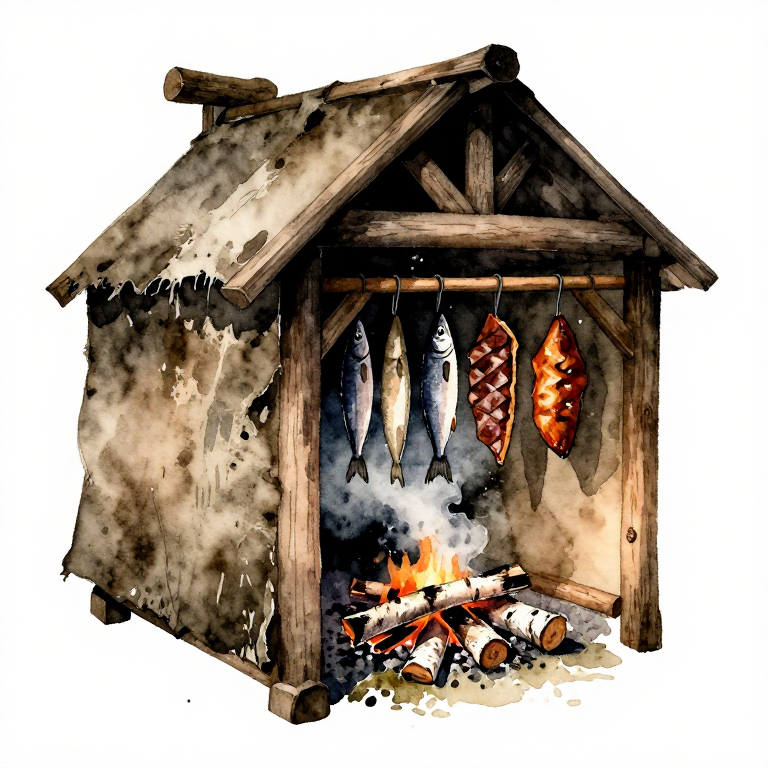
Construct a simple timber frame approximately 1.5m tall, 1m wide, and 1m deep from straight poles lashed together at the joints. Enclose the frame with hides, woven wattle (interlaced sticks), or bark panels. The enclosure should trap smoke but does not need to be airtight — some ventilation is needed.
Leave an opening at the bottom for the fire and a small vent at the top to allow smoke to circulate upward and slowly exit. Install cross-poles at multiple heights inside for hanging meat. The fire source can be directly below the meat (in a pit) or fed through a short trench from an adjacent fire pit for better temperature control.
Bu adım için malzemeler:
 Kuzu etiAs needed adet
 İnce Deniz Tuzu3-5% by weight of meat adet
 Tütsüleme odunuSeveral kg adet
 Ardıç (meyve ve odun)Handful of berries + branches adet
 Ahşap direkler ve ipFor smokehouse frame adet
Prepare the Meat
Prepare the Meat
Cut meat into strips (for jerky-style preservation) or leave as manageable joints. Rub all surfaces generously with coarse salt. Use approximately 3-5% salt by weight of the meat. For fish, apply salt liberally to both sides of fillets.
Place the salted meat in a cool location for 12-24 hours. The salt draws moisture from the surface, beginning the preservation process and creating a pellicle (a tacky surface layer) that smoke compounds adhere to better. After salting, brush off excess salt but do not rinse.
Hang the Meat
Hang the Meat
Thread salted meat strips onto wooden racks or hang from the cross-poles inside the smokehouse using iron hooks, wooden pegs, or cord tied through pierced holes. Space pieces generously so smoke can circulate freely around all surfaces of each piece.
Meat should not touch each other or the walls of the smokehouse — any contact points will not smoke properly and may spoil. Heavier joints can be hung from sturdy hooks; lighter strips can be draped over thin poles.
Build the Cold-Smoke Fire
Build the Cold-Smoke Fire
Build a small fire below or adjacent to the hanging meat using birch, alder, or juniper wood. The critical requirement is that the fire smolders — producing dense, heavy smoke — rather than burning with open flames that would cook the meat. Keep the temperature inside the smokehouse below 30°C.
Achieve smoldering smoke by using damp wood chips, sawdust, or partially green wood. Juniper wood and berries are particularly valuable — they produce antimicrobial smoke compounds and add a distinctive resinous flavor. A mix of birch (mild, sweet smoke), alder (delicate, slightly sweet), and juniper (sharp, preservative) creates the classic Scandinavian smoke profile.
Bu adım için malzemeler:
Kuzu etiAs needed adetİnce Deniz Tuzu3-5% by weight of meat adetTütsüleme odunuSeveral kg adetArdıç (meyve ve odun)Handful of berries + branches adetAhşap direkler ve ipFor smokehouse frame adetMaintain Smoke for Days
Maintain Smoke for Days
Cold-smoking is a slow process. Maintain steady, dense smoke for 2-5 days, tending the fire regularly to keep it smoldering. Add damp wood chips or sawdust as needed. The smoke should be thick enough that you can barely see the meat inside the smokehouse.
Check periodically that the temperature has not risen above 30°C — if it feels warm inside, reduce the fire. The goal is to saturate the meat surface with smoke compounds without cooking it. In cold weather, the process may take longer; in warm weather, watch for flies and ensure the enclosure is sealed.
Cure and Store
Cure and Store
After 2-5 days of cold-smoking, the meat should be noticeably darker on the surface, firm to the touch, and dry on the outside while still slightly moist inside. The surface should have a glossy, lacquered appearance from the condensed smoke compounds.
Remove from the smokehouse and hang in a cool, dry, well-ventilated location for further air-drying and curing. Properly cold-smoked meat can be stored for months in cool conditions. Slice thinly and eat as-is, or rehydrate in soups and stews. Viking-era smoked meat and fish were essential provisions for long sea voyages and winter survival.
Malzemeler
5- As needed adetYer Tutucu
- 3-5% by weight of meat adetYer Tutucu
- Several kg adetYer Tutucu
- Handful of berries + branches adetYer Tutucu
- For smokehouse frame adetYer Tutucu
CC0 Kamu Malı
Bu plan CC0 lisansıyla yayınlanmıştır. İzin almadan kopyalayabilir, değiştirebilir, dağıtabilir ve herhangi bir amaçla kullanabilirsiniz.
Planı üzerinden ürün satın alarak Maker'ı destekleyin, böylece Maker Komisyonu Satıcılar tarafından belirlenen komisyonu kazanırlar veya bu Planın yeni bir versiyonunu oluşturun ve gelir paylaşımı için kendi Planınıza bağlantı olarak ekleyin.