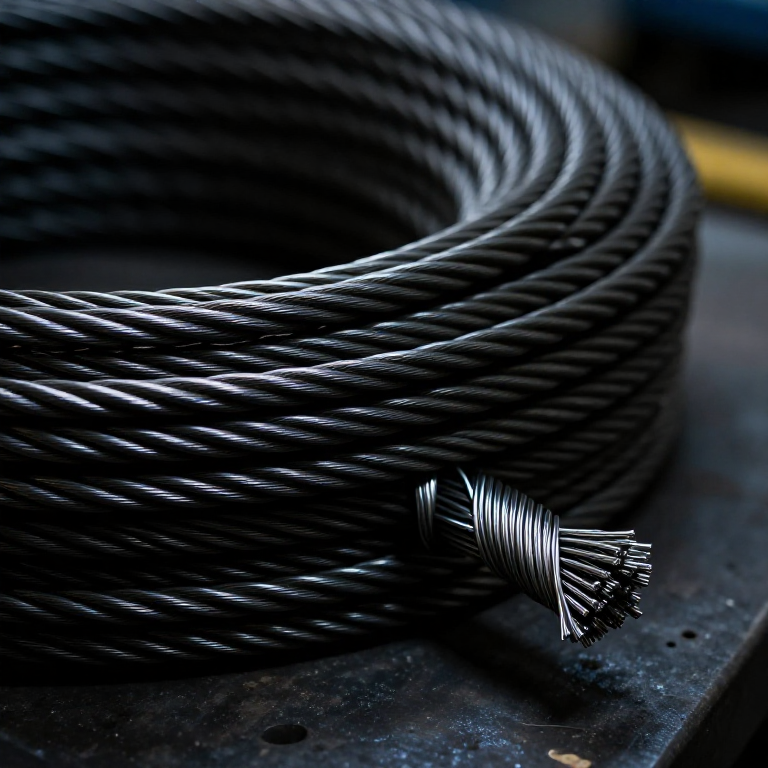


Wire Rope
Talimatlar
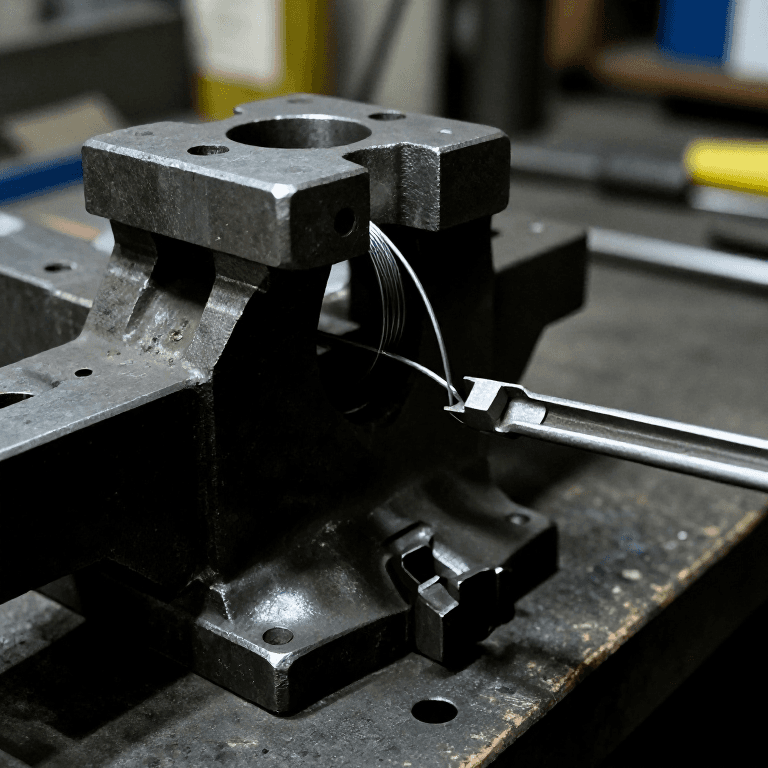
Build a stranding jig
Build a stranding jig
Several wires must be twisted together at a controlled, even lay.
- Make a rotating head carrying six spools of fine steel wire, running on a 608 bearing.
- Make a fixed die plate ahead of it with a hole that gathers the six wires around a seventh central wire.
- Mount both on a plywood bench with M6 × 50 hex bolts × 4, M6 flat washers × 8 and M6 hex nuts × 4.
- Fit a hand crank to the head and a take-up drum beyond the die.
Six around one is the standard strand. Six circles of equal diameter fit exactly around a seventh of the same size — a geometric fact, not a convention — so the strand packs tightly with no wasted space and each outer wire touches its neighbours and the core.
The die plate is what makes the lay even. Without it the wires twist together at whatever pitch they choose, which varies with tension, and the strand comes out lumpy and unequal in strength.Bu adım için malzemeler:
 Baltık Huş Kontrplak1 yaprak
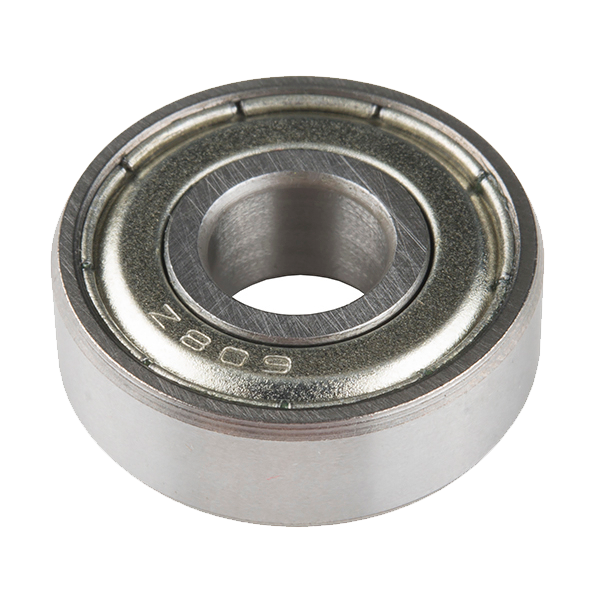 Ball Bearing - Non-Flanged (8mm Bore, 22mm OD)2 adet
 Alüminyum Plaka1 adet
 Düz Pul8 adet
 Altıgen Somun4 adet
Gerekli aletler:
 Dekupaj Testere
 Kablosuz Matkap
 Matkap Ucu Takımı
 Alyan Anahtar Takımı
 Eğe Takımı
 Dijital Kumpas 6 İnç
Lay six strands around a core
Lay six strands around a core
Twice-twisted: wires into strands, strands into rope.
- Make six strands, each seven wires, all with the same lay direction and pitch.
- Now lay those six strands around a fibre or wire core, using the same jig at a larger scale.
- Keep the strand lay length consistent — measure the distance for one full turn of a strand around the rope.
- Record the lay length; it is the rope's key specification.
Lay direction is a genuine design choice. Twist the strands the same way as the wires within them and you get a lang lay rope: more of each wire lies along the surface, so it wears better and flexes more easily, but it untwists under load unless both ends are fixed. Twist them opposite and you get regular lay: less wear resistance, but the rope is stable and will not spin a suspended load. Cranes use regular lay for that reason alone.
Consistent lay length is what makes a rope's strength predictable. An uneven lay concentrates load on whichever strands are tightest, and those break first.Bu adım için malzemeler:
 Pamuk Müslin Bez1 metre
Gerekli aletler:
Dijital Kumpas 6 İnç Kombine GönyeAlyan Anahtar Takımı
Compare bending stiffness against a solid bar
Compare bending stiffness against a solid bar
The whole reason for the construction, demonstrated directly.
- Take a solid steel rod of the same total cross-sectional area as your rope.
- Bend both around a 100 mm former and note the force required.
- Bend both around a 30 mm former and note what happens to each.
- Straighten both and inspect for permanent set.
Bu adım için malzemeler:
 Alüminyum Yuvarlak Çubuk1 adet
Gerekli aletler:
 Tezgah MengenesiDijital Kumpas 6 İnç
 Kronometre
Load it to destruction and watch how it fails
Load it to destruction and watch how it fails
The failure mode is the invention, so observe it deliberately.
- Anchor a sample and load it steadily, well away from anyone.
- Listen: individual wires begin to break with distinct pings well before the rope parts.
- Record roughly how many wires break before final failure.
- Examine a used rope for broken wire ends standing proud of the surface.
Gerekli aletler:
Dijital Kumpas 6 İnçTezgah MengenesiKronometreGraceful failure as a design goal, and history
Graceful failure as a design goal, and history
Wilhelm Albert, a mining official in the Harz mountains, made the first wire ropes in 1834 for hoisting in the Clausthal silver mines, where chains and hemp ropes were failing with fatal results. John A. Roebling took the idea to America, manufactured rope industrially, and used it to build suspension bridges — the Brooklyn Bridge is held up by wire rope spun in place.
It depends absolutely on wire drawing. Hundreds of fine, uniform, high-strength wires are the raw material, and the drawplate blueprint already in this catalogue is where they come from. Drawing also work-hardens the wire, so drawn wire is considerably stronger than the rod it came from — the process improves the material as well as shaping it. No wire drawing, no wire rope.
The most transferable idea here is graceful failure. Albert's rope was not stronger than chain per unit weight by an enormous margin; it was strong AND it failed slowly and visibly. Engineering that chooses a warning over a marginal strength gain shows up again in stranded cable, in redundant structures, in crack-arresting design, and in the shear pin from batch 70 — which fails deliberately so that something expensive does not.
Its honest limits: a wire rope is destroyed by bending over too small a radius, corrodes from the inside where it cannot be seen, and must be lubricated internally to survive. It has a finite fatigue life measured in bend cycles, and it must be discarded on schedule rather than when it looks bad — the visible broken wires being a symptom of a condition already well advanced.
Malzemeler
7- 1 yaprakYer Tutucu
- Ball Bearing - Non-Flanged (8mm Bore, 22mm OD)%10 komisyon2 adet$1.26
- 1 adetYer Tutucu
- 8 adetYer Tutucu
- 4 adetYer Tutucu
- 1 metreYer Tutucu
- 1 adetYer Tutucu
Gerekli Aletler
9- 1 vendor sell this, none ship to you yetYer Tutucu
- 1 vendor sell this, none ship to you yetYer Tutucu
- Yer Tutucu
- Yer Tutucu
- Yer Tutucu
- Yer Tutucu
- Yer Tutucu
- Yer Tutucu
- Yer Tutucu
İlgili Blueprint'ler
Bu blueprint'ler bilgi paylaşır — teknikler, malzemeler veya ilkeler
CC0 Kamu Malı
Bu plan CC0 lisansıyla yayınlanmıştır. İzin almadan kopyalayabilir, değiştirebilir, dağıtabilir ve herhangi bir amaçla kullanabilirsiniz.
Planı üzerinden ürün satın alarak Maker'ı destekleyin, böylece Maker Komisyonu Satıcılar tarafından belirlenen komisyonu kazanırlar veya bu Planın yeni bir versiyonunu oluşturun ve gelir paylaşımı için kendi Planınıza bağlantı olarak ekleyin.