

Lincoln Logs
Stack plain round logs on top of each other to make a wall and they roll off and the corners fall apart — a smooth cylinder has nothing to hold it in place. This is the oldest problem in log building: how do you lock the corners so the walls stand without nails?
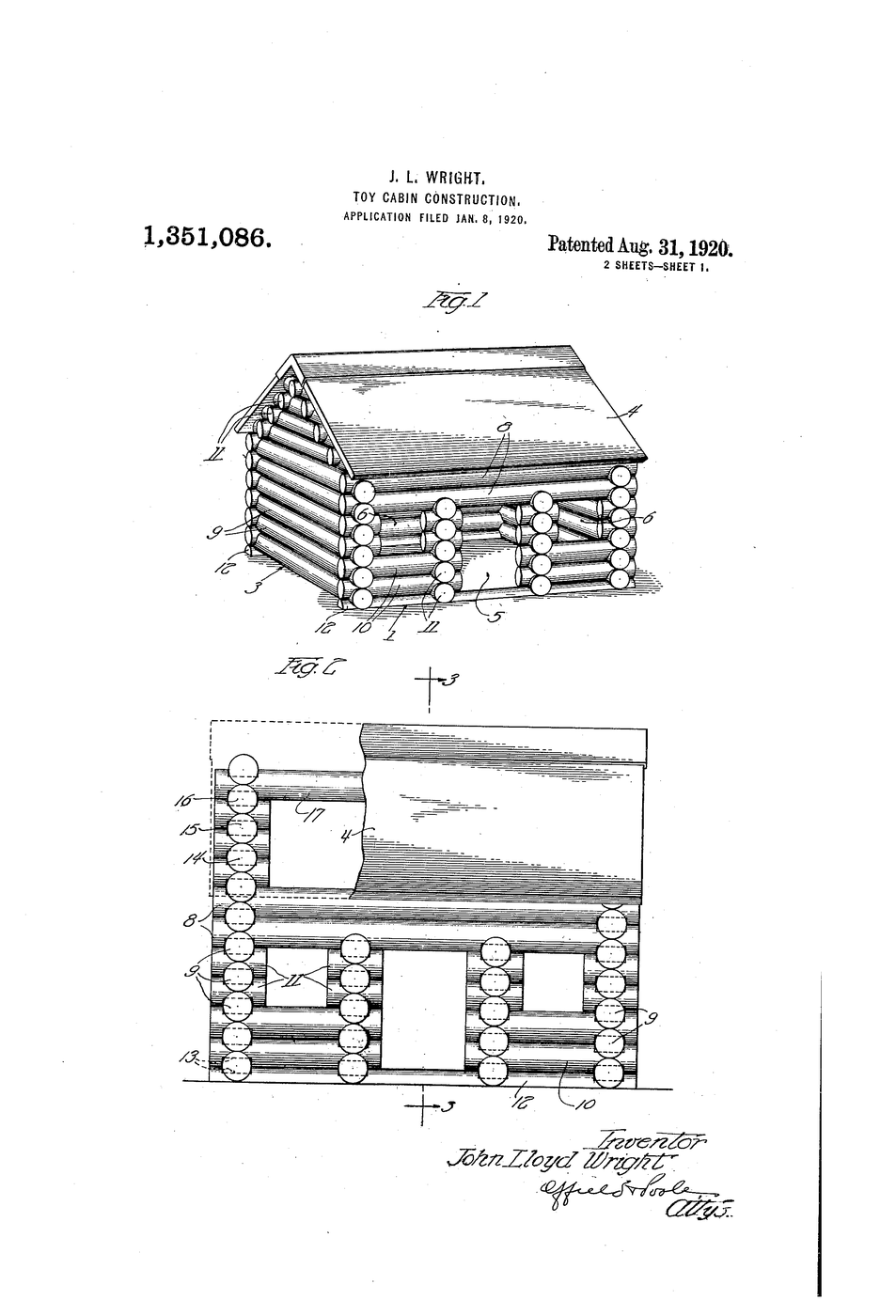
Wright's toy solves it the way real pioneers did: with a NOTCH. Each little log has a squared notch cut near each end. Lay two logs down, then lay two more across them so their notches drop over the first pair, and the four lock together at the corners. Course by course the notched logs nest into each other, and the walls rise square, tight and self-supporting — no glue, no nails, just the notches.
The notch is the whole invention: it turns loose sticks into an interlocking structure that holds itself together — the same joint that built the real log cabin, shrunk to a toy that teaches a child how a building stands up.
US Patent 1,351,086, "Toy Cabin Construction", granted 31 August 1920 to John Lloyd Wright (son of the architect Frank Lloyd Wright).
Talimatlar
Read the claim: notched logs lock at the corners
Read the claim: notched logs lock at the corners
Wright claims short logs with a notch near each end that interlock where they cross, so walls stand without nails or glue. Note: the notch is the joint.
Cut a pile of short logs
Cut a pile of short logs
Cut a stack of equal short lengths from dowel — these are your logs.
Bu adım için malzemeler:
 Ahşap Kavela Çubuğu2 adet
Gerekli aletler:
 Kıl Testere
Cut a squared notch near each end
Cut a squared notch near each end
Near each end, cut a squared notch across the top, about half the log's thickness deep. Half-depth is the key — two notches nesting sit flush.
Gerekli aletler:
 Maket Bıçağı
Lay the first two logs
Lay the first two logs
Lay two logs parallel, notches up, a wall-width apart. These are the bottom of two facing walls.
Cross two logs into the notches
Cross two logs into the notches
Lay two more logs across the ends of the first pair so their end-notches drop into the first logs' notches. The four lock into a square frame that will not slide.
Build up the courses
Build up the courses
Keep crossing pairs of logs, notch into notch. The walls rise square and tight, each course locking the one below — no glue, no nails.
Push the wall
Push the wall
Push the corner sideways. It holds — the interlocked notches stop the logs sliding past each other, so the whole cabin acts as one rigid box.
Leave a doorway and window
Leave a doorway and window
Use shorter logs on some courses to leave a gap for a door and a window. The notched corners still lock even with a hole in the wall.
Add a gabled roof
Add a gabled roof
Step the end-wall logs shorter and shorter to make two triangular gables, then lay roof logs from ridge to eaves. The triangle of the gable makes the roof stiff.
Try it WITHOUT notches
Try it WITHOUT notches
Build the same walls with un-notched logs. They roll and the corners spread and collapse — proof that the notch, not the log, is the invention.
Get the notch depth right
Get the notch depth right
Cut one notch too shallow: that corner lifts and rocks. Too deep and the log is weak. About half the diameter lets two logs nest flush and strong. Precision matters.
Gerekli aletler:
 İletki / Açı Ölçer
See the real cabin in your toy
See the real cabin in your toy
Note that a real log cabin is built exactly this way — saddle-notched logs locking at the corners, no nails. Your toy is the genuine building technique at small scale.
History & Context — the notch that built the frontier
History & Context — the notch that built the frontier
The patent. US 1,351,086, "Toy Cabin Construction", granted 31 August 1920 to John Lloyd Wright. Wright was an architect and the son of Frank Lloyd Wright; he said the idea came from watching the interlocking timber beams of the foundation his father designed for the earthquake-resistant Imperial Hotel in Tokyo. He named the toy for Abraham Lincoln, born in a log cabin, and it has sold continuously for over a century.
The engineering is the corner notch. Real walls fail at the corners, where the direction of the load changes; a smooth stacked log has nothing to stop it sliding or rolling, so the corner spreads and the wall falls (step 10). Cutting a notch a half-diameter deep near each end lets a crossing log drop into the one below and seat flush, so the two are keyed together and cannot slide apart (steps 5-7). Course upon course, this turns a pile of loose sticks into a single rigid box that carries its own weight and resists being pushed over — exactly the saddle notch that real log-cabin builders have used for centuries across Scandinavia, the Alps and the American frontier (step 12). The depth is a genuine design decision: too shallow and the corner rocks, too deep and the log is weakened (step 11).
Where it sits. Lincoln Logs, like the Erector Set and Tinkertoy of the same era, is a construction toy that teaches a real principle by hand — here, that a building's strength lives in its joints, not just its parts. A child who has felt an un-notched wall collapse and a notched one stand has learned something a carpenter, a timber-framer and a structural engineer all rely on. The little notched dowel you cut is the oldest corner joint in building, made playable.
Malzemeler
1- 2 adetYer Tutucu
Gerekli Aletler
3- Yer Tutucu
- Yer Tutucu
- Yer Tutucu
CC0 Kamu Malı
Bu plan CC0 lisansıyla yayınlanmıştır. İzin almadan kopyalayabilir, değiştirebilir, dağıtabilir ve herhangi bir amaçla kullanabilirsiniz.
Planı üzerinden ürün satın alarak Maker'ı destekleyin, böylece Maker Komisyonu Satıcılar tarafından belirlenen komisyonu kazanırlar veya bu Planın yeni bir versiyonunu oluşturun ve gelir paylaşımı için kendi Planınıza bağlantı olarak ekleyin.