

Ice Harvesting
For most of the nineteenth century the cheapest cold on Earth was not manufactured. It was cut off a lake in winter and kept until August, and it was so cheap that it held mechanical refrigeration out of the market for eighty years after Cullen proved cold could be made.
Two problems had to be solved, and neither is obvious.
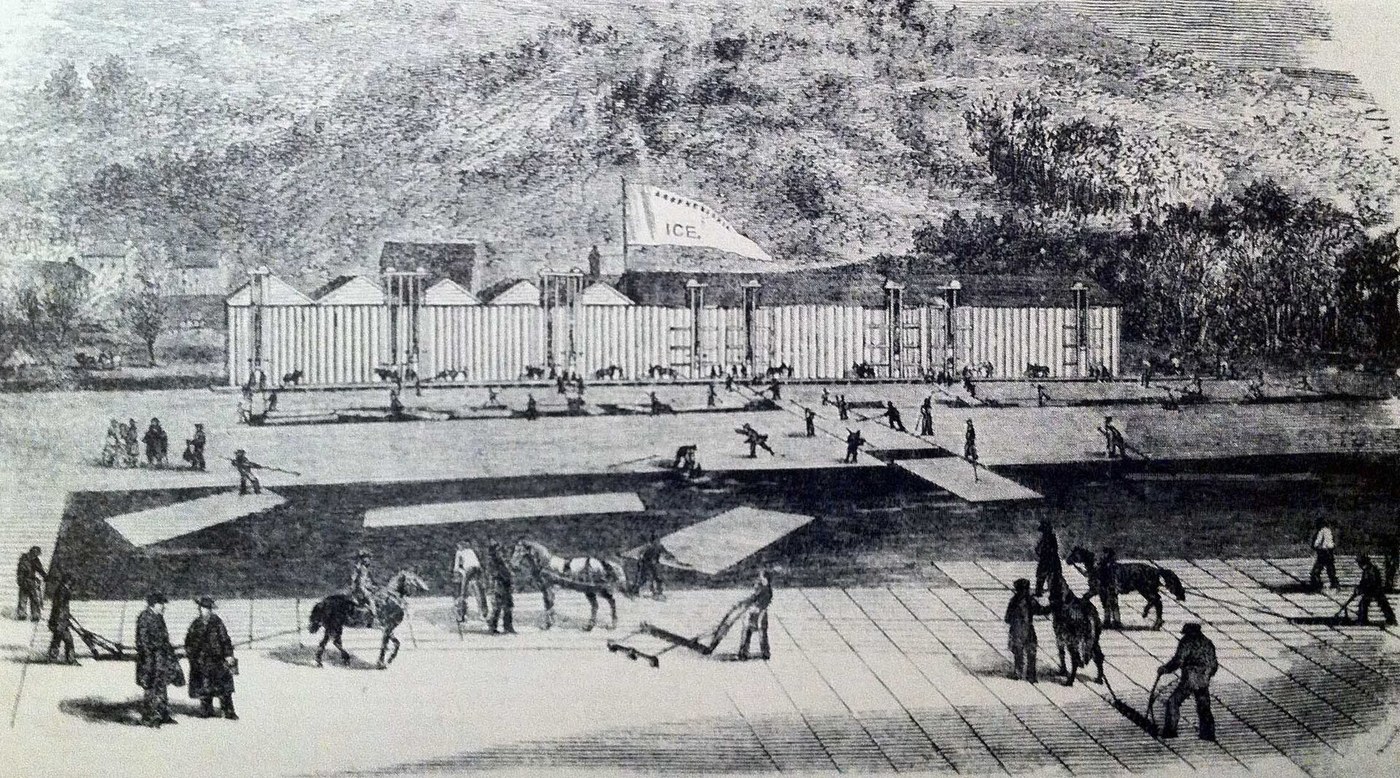
The first is shape. Ice hacked out in irregular lumps stacks badly, and every air gap between lumps is a path for heat. Wyeth's horse-drawn cutter scored the lake in a grid — the groove from one pass guiding the next, then the whole set crossed at right angles — so the harvest came off as uniform rectangular blocks that stack solid with almost no gaps.
The second is surface area. Melting happens at the outside, so a single large mass loses a far smaller fraction of itself than the same ice in small pieces. Stack blocks tightly into a big cube, pack sawdust round the outside, and the outer layer melts and protects everything inside.
Done properly the losses are startlingly low. Ice cut in Massachusetts was sold in Calcutta, having crossed the equator twice in a wooden ship.
Nathaniel Jarvis Wyeth patented the horse-drawn ice cutter in 1825. It cut harvesting costs from about 30 cents a ton to 10 and turned Frederic Tudor's struggling ice trade into an industry.
Talimatlar
Prove that shape beats mass
Prove that shape beats mass
Take the same total weight of ice twice: once as a single block, once crushed. Put each in an identical container at room temperature and weigh the meltwater every 15 minutes.
Expect the crushed ice to be gone while the block is barely started.
Same substance, same mass, same room. The only difference is surface area, and melting happens only at surfaces.
This is why the ice trade cared so much about block size, and why crushed ice exists for drinks and never for storage.
Gerekli aletler:
 Dijital Mutfak Terazisi
Show why regular blocks matter more than neatness
Show why regular blocks matter more than neatness
Freeze water in ice-cube trays and also in a bag, to get irregular lumps. Stack each kind into identical boxes, filling them as full as you can.
Weigh what each box actually holds, then log the melt.
Expect the regular blocks to pack more ice into the same box and to melt more slowly.
Both effects come from the same cause. Air gaps waste volume you paid to ship, and they let heat in around every face. Wyeth's grid was not about tidiness — it was about the two things that decide whether ice survives a voyage.
Test the insulation they actually used
Test the insulation they actually used
Pack identical ice blocks in sawdust, in wool, and bare. Log the melt over a day.
Expect sawdust to perform close to wool — and note what else it is: a waste product of the sawmills, available by the cartload for nothing, that does not rot quickly, and that can be rinsed off the ice at the far end.
The ice trade did not choose the best insulator. It chose the best insulator per dollar delivered to a wharf. That is usually the real engineering question, and it is rarely the same question.
Bu adım için malzemeler:
 Talaş2 kg
Find the square-cube advantage
Find the square-cube advantage
Compare one large block against several small blocks of the same total mass, both packed the same way, and compute the percentage lost per day for each.
Expect the large mass to lose a much smaller fraction.
Volume grows with the cube of size, surface only with the square, so bigger stacks are proportionally better insulated by their own geometry.
Ice houses exploited this ruthlessly: stacks were built as large and as cube-like as the building allowed, because the pile's own bulk was the cheapest insulation available.
Work out the economics that beat the machine
Work out the economics that beat the machine
Do the sum Tudor's competitors faced. Ice cut for 10 cents a ton, losing perhaps half its mass across a long voyage, still lands at a low cost per delivered ton.
Now price a Perkins machine in 1834: a bespoke engine, a skilled operator, ether to replace as it leaks, and no service network anywhere.
Cheaper is not the same as better, and it wins anyway.
This is the single clearest lesson in this batch: a superior technology can lose for decades to an inferior one with better economics, and it only wins when the cheap alternative runs out — which for ice meant cities too large, summers too warm, and lakes too polluted to cut from.
History & Context
History & Context
The patent. Nathaniel Jarvis Wyeth patented a two-bladed horse-drawn ice cutter in 1825. Each pass used the previous groove as its guide, producing perfectly parallel scores; a second set at right angles turned the lake surface into a grid of uniform blocks that could be broken out with bars. Harvesting costs fell from roughly 30 cents to 10 cents per ton.
Tudor had the idea and was failing at it. Frederic Tudor began shipping New England ice to the Caribbean in 1806 and spent years losing money — partly because irregular ice melted away in transit, and partly because he had to teach entire markets what ice was for. Teaming up with Wyeth in 1824 gave him both a supply of good ice at Fresh Pond and the tool that made volume possible; he more than tripled production. Boston became an ice port, shipping to the American South, the Caribbean, and as far as Calcutta.
An industry built on a free raw material. The ice trade's whole cost was labour, transport and insulation — the product itself fell out of the sky. At its height it employed tens of thousands and supported ice houses, insulated railcars and the domestic ice box, which is the ancestor of the appliance in your kitchen and why Americans still call it the icebox.
How it ended. Not by losing a fair contest. Warm winters produced ice famines; growing cities polluted the ponds they cut from, and harvested ice became a genuine public-health problem as awareness of waterborne disease grew. Manufactured ice was clean and available in July regardless of the weather. The trade collapsed within a generation of mechanical plants becoming reliable — but it had already held the field for a hundred years after Cullen and fifty after Perkins.
What survives. The insulated shipping box, the cold store, the ice house, and the whole idea of a cold chain — the notion that a perishable thing can be kept cold continuously from source to consumer — all predate refrigeration machinery. Birdseye's frozen food, later in this batch, is that same chain with a better cold source plugged into one end.
Bağlı Plan Malzemeleri

İlgili Blueprint'ler
Bu blueprint'ler bilgi paylaşır — teknikler, malzemeler veya ilkeler

CC0 Kamu Malı
Bu plan CC0 lisansıyla yayınlanmıştır. İzin almadan kopyalayabilir, değiştirebilir, dağıtabilir ve herhangi bir amaçla kullanabilirsiniz.
Planı üzerinden ürün satın alarak Maker'ı destekleyin, böylece Maker Komisyonu Satıcılar tarafından belirlenen komisyonu kazanırlar veya bu Planın yeni bir versiyonunu oluşturun ve gelir paylaşımı için kendi Planınıza bağlantı olarak ekleyin.