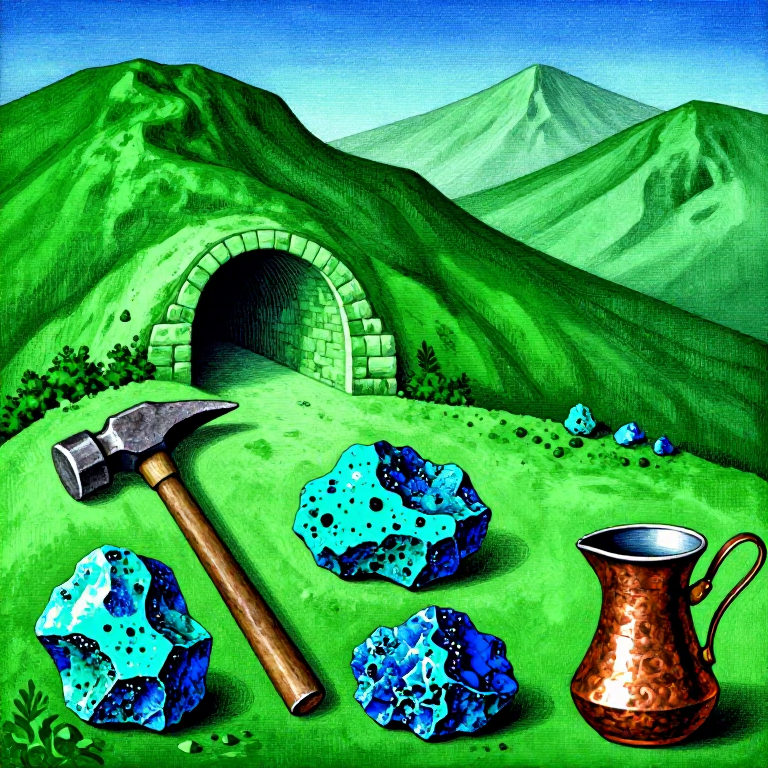
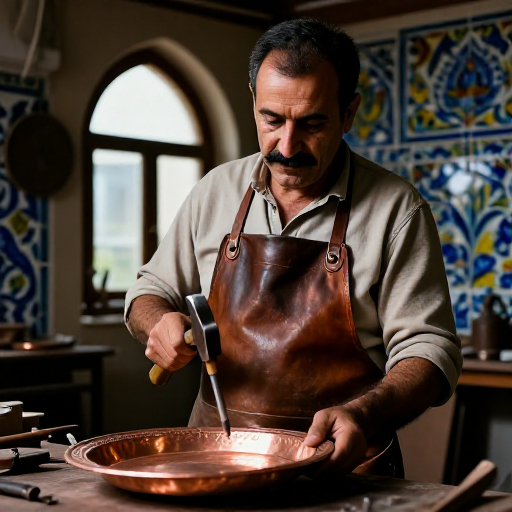

Copper Ore Collection in Anatolia — Natural Copper and Malachite Identification
Інструкції
Recognize copper ore
Recognize copper ore
Copper (Cu) is a transition metal with atomic number 29. It is found in nature in pure form (native copper) or within minerals. The most common copper minerals are malachite (Cu2(CO3)(OH)2, green), azurite (Cu3(CO3)2(OH)2, blue), chalcopyrite (CuFeS2, golden yellow), and cuprite (Cu2O, red). In Anatolia, malachite and native copper are particularly common.
Know the copper regions of Anatolia
Know the copper regions of Anatolia
Turkey''s main copper deposits are found in the Black Sea Region (Murgul, Artvin; Kure, Kastamonu), Southeastern Anatolia (Ergani, Diyarbakir), and Central Anatolia (around Nigde and Aksaray). Prehistoric copper working has been documented through the excavations at Catalhoyuk (Konya) and Cayonu (Diyarbakir). These regions are good starting points for finding surface ore specimens.
Необхідні інструменти ({count})
 Геологічна карта
Check land permits
Check land permits
In Turkey, mining rights belong to the state (Mining Law, No. 3213). Small sample collection for scientific or educational purposes is generally tolerated, but a mining license is required for commercial excavation. Obtain permission from the landowner on private land. Sampling from archaeological sites and protected areas is prohibited.
Look for green and blue staining
Look for green and blue staining
Copper minerals reveal themselves through distinctive colors on surface rocks. Malachite is bright green, azurite is deep blue. These colors form when copper reacts with carbon dioxide and water. Look for this staining in streambeds, rock fractures, and rocks around old mine entrances. Green staining is the strongest indicator of copper presence.
Необхідні інструменти ({count})
 Ручна лупа 10×
Recognize native copper
Recognize native copper
Native copper is a reddish-orange metal with metallic luster. It is typically found as small pieces, sheets, or branching forms within basalt or sandstone. A freshly broken surface is bright copper-colored, while surfaces exposed to air are covered with a green-brown patina. Its hardness is 2.5-3 on the Mohs scale — it can be scratched with a copper coin.
Необхідні інструменти ({count})
 Мідна монета
Preparing the necessary equipment
Preparing the necessary equipment
Before going out for fieldwork, prepare your equipment. A geology hammer, safety goggles, gloves, sample bags, labels and a marker are required. Sunscreen, water and a first aid kit should also be with you. Work in the field with at least two people.
Матеріали для цього кроку:
 Пакети для зразків (із застібкою зіп)20 штук
 Самоклейні етикетки1 пакет
 Перманентний маркер1 штука
Необхідні інструменти ({count})
 Геологічний молоток
 Закриті захисні окуляри
 Шкіряні робочі рукавиці
 Польовий записник
Collect samples
Collect samples
Необхідні інструменти ({count})
 Геологічний молоток (із вістрям)Закриті захисні окуляри
 Слюсарне зубило
Perform the streak test
Perform the streak test
Необхідні інструменти ({count})
 Пластинка для риски (неглазурована порцеляна)
Performing a hardness test
Performing a hardness test
Identify the mineral using the Mohs hardness scale. Malachite has a hardness of 3.5-4 — it can be slightly scratched with a copper coin (3.5). Chalcopyrite has a hardness of 3.5-4. Native copper has a hardness of 2.5-3 — it cannot be scratched with a fingernail (2.5) but a steel knife (5.5) scratches it easily. These tests help you confirm the mineral's identity.
Необхідні інструменти ({count})
 Заготовка ножа з дамаської сталіМідна монета
Label the samples
Label the samples
Матеріали для цього кроку:
 Пакети із застібкою10 штук
Необхідні інструменти ({count})
Перманентний маркерПольовий записникClean the samples
Clean the samples
Матеріали для цього кроку:
 Дистильована вода5 літрів
Необхідні інструменти ({count})
 Жорстка зубна щітка
 Рушник для просушування
Classifying samples
Classifying samples
Group the cleaned samples by mineral type: malachite (green), azurite (blue), chalcopyrite (yellow-metallic), native copper (reddish-metallic), and host rock (copper-bearing rock). For each group, note the average size, color intensity, and estimated copper content. Samples with high copper content feel heavier — copper's density is 8.96 g/cm³.
Необхідні інструменти ({count})
 Лотки для сортування
Store and document samples
Store and document samples
Матеріали для цього кроку:
 Ящики для зберігання3 штук
 Пакетики силікагелю5 штук
Необхідні інструменти ({count})
Польовий записникМатеріали
8- Заповнювач
- 1 пакетЗаповнювач
- 1 штукаЗаповнювач
- 10 штукЗаповнювач
- 5 літрівЗаповнювач
- 3 штукЗаповнювач
- 5 штукЗаповнювач
- Заповнювач
Необхідні інструменти
15- Заповнювач
- Заповнювач
- Заповнювач
- Заповнювач
- Заповнювач
- Заповнювач
- Заповнювач
- Заповнювач
- Заповнювач
- Заповнювач
- Заповнювач
- Заповнювач
- Заповнювач
- Заповнювач
CC0 Суспільне надбання
Це креслення випущено під ліцензією CC0. Ви можете вільно копіювати, змінювати, поширювати та використовувати цю роботу для будь-яких цілей без запиту дозволу.
Підтримайте мейкера, купуючи продукти через його креслення, де він отримує Комісію мейкера встановлену вендорами, або створіть нову ітерацію цього креслення та включіть його як зв'язок у власне креслення для розподілу доходу.