МИСТЕЦТВО
КРАСА ТА ЗДОРОВ'Я
РЕМЕСЛО
КУЛЬТУРА ТА ІСТОРІЯ
РОЗВАГИ
СЕРЕДОВИЩЕ
ЇЖА ТА НАПІЇ
ЗБОРНА ІНЖЕНЕРІЯ
НАУК
СПОРТ
ТЕХНОЛОГІЯ
НОСИМО
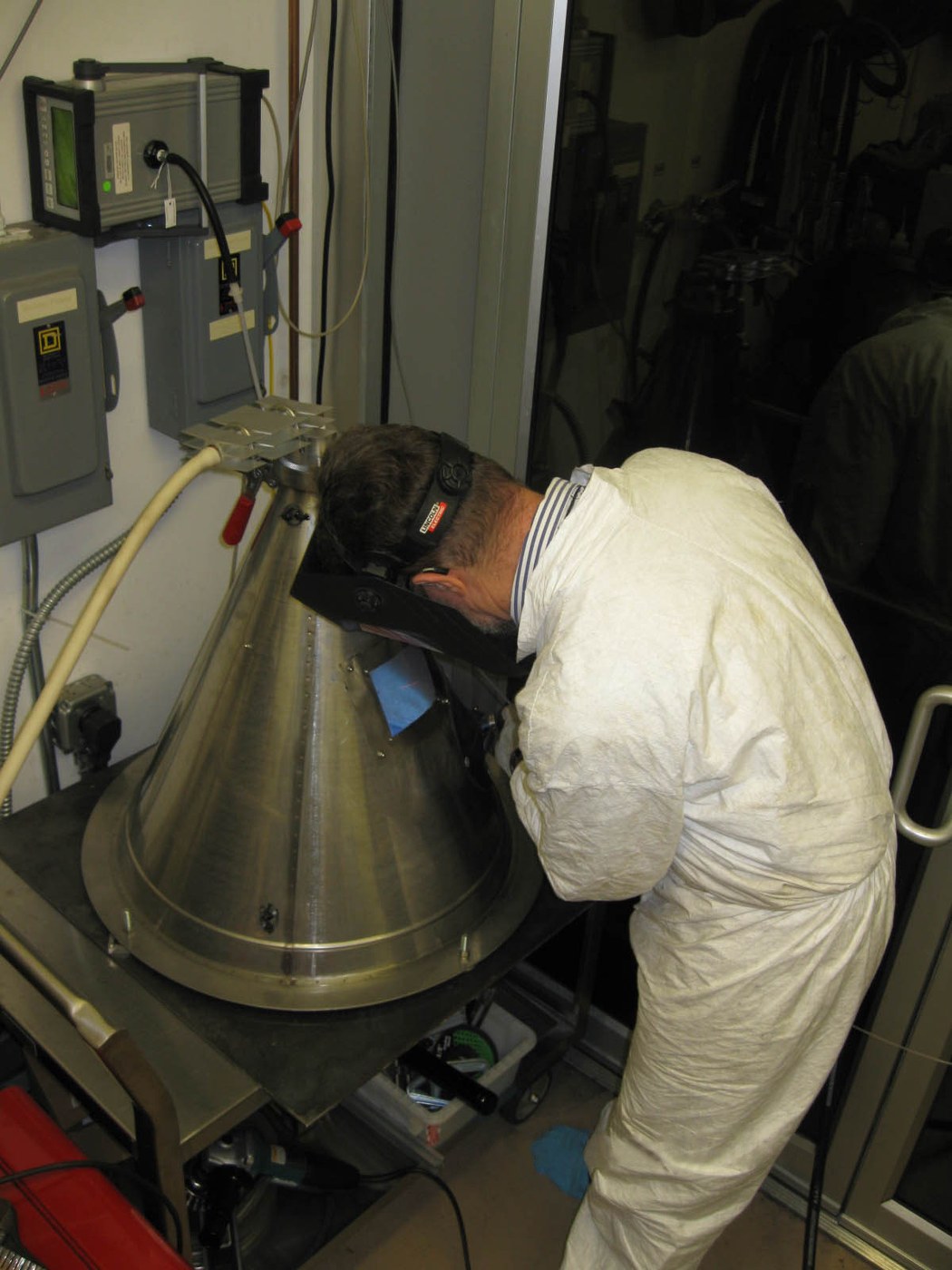


Arc Eye and Fume: Measure the Two Injuries That Arrive After You Finish
Most workshop injuries announce themselves. Welding has two that do not: arc eye, which arrives six to twelve hours after the exposure, and metal fume, whose damage accumulates over years.
Because neither hurts at the time, both are routinely ignored by people who would never put a bare hand on hot stock. Being told this changes nothing. Measuring it does.
This session strikes no arc. You will find the working distance of your own extraction with an incense stick and an anemometer — the distance beyond which it captures nothing — and then check your helmet for the light leaks that let UV past a lens that looks perfectly fine. Both numbers are specific to your bench, and neither is the number most people guess.
Початківець
45 minutes, with no arc struck
Інструкції
1
1
Find the distance at which your extraction stops working
Find the distance at which your extraction stops working
Switch the extraction on and let it come up to speed. Light an incense stick — it gives a thin, visible, cool plume that behaves much like rising fume and costs nothing.
Hold the incense at the hood face and watch where the smoke goes: it should turn and disappear into the hood completely. Now walk it away along the hood axis in 5 cm steps, pausing at each one, and watch. At some distance the plume will stop turning into the hood and start drifting past it, up, or into the room. Write that distance down. That is your working distance, and everything beyond it is unextracted.
Do it three times and take the mean — the plume wanders and one judgement is not a measurement.
If you have an anemometer, take the air speed at the hood face and at each 5 cm step too, and record both columns. If you do not, the incense alone is enough for the main finding.
Then measure the hood mouth and write down its diameter, and find the fan's rated flow on its plate or in its manual. You need all three numbers for step 2.
Most people are surprised, and the surprise runs one way: the working distance is much shorter than they assumed. A hood parked 'over there somewhere' is decoration.
Матеріали для цього кроку:
 Ароматична паличка (джерело диму)3 штук
Необхідні інструменти ({count})
 Ручний анемометр
 Рулетка
 Прозорі захисні окуляри
2
2
Check the measurement against the standard hood relation
Check the measurement against the standard hood relation
Завантаження блокнота Jupyter…
Необхідні інструменти ({count})
 Калькулятор
3
3
Arc eye: an ultraviolet sunburn of the cornea, on a delay
Arc eye: an ultraviolet sunburn of the cornea, on a delay
An arc is an intense ultraviolet source. UV does not trigger the blink reflex and it does not feel hot, so there is nothing at the time to tell you an exposure is happening. The damage is to the outermost layer of the cornea — photokeratitis — and the pain arrives typically six to twelve hours later, which is why so many cases wake people up in the night after an afternoon in the shop.
It usually heals within a day or two as the corneal surface renews itself. That is the reason it gets treated as a nuisance rather than an injury, and the reason people accept repeat exposures they would never accept from anything that hurt at the time.
The exposures that catch people out are almost never the weld they were looking at through a helmet. They are the ones off to the side: a colleague striking an arc across the shop, a reflection off a bright wall or a stainless bench, the moment the helmet is lifted to reposition the work while the arc is still live nearby.
That is why the helmet is not the whole answer. Safety glasses under the helmet, a screen around the bay so other people are not exposed, and a wall that is not a mirror do the work the helmet cannot.
Необхідні інструменти ({count})
 Зварювальна маска з автозатемненнямПрозорі захисні окуляри
 Набір зварювальних скелець і світлофільтрів
4
4
Test your own helmet for the leaks a visual check misses
Test your own helmet for the leaks a visual check misses
Take the helmet into a dark room with a bright lamp — a phone torch will do — and hold the lamp OUTSIDE the shell while you look from inside.
Look for light where there should be none: around the lens gasket, at the cartridge seating, along the headgear pivots, at any crack in the shell. A shell that looks sound in daylight can show a bright line at a stress crack. Any light path is a UV path.
Check the lens itself for scratches, pitting from spatter, and a snugly seated cover lens. A cover lens is consumable — it exists to be destroyed instead of the filter, and a pitted one scatters light into your eyes all day.
If the helmet is auto-darkening, test the switching before you trust it, not during a weld. Most cartridges have a test button; use it. Check the batteries, and check the solar cell is not covered in shop dust. Set the shade number for the process and current you are about to run — the table is printed on the cartridge and in the standard your lens kit was sold against. Do not guess a shade: read it, and note in your book which setting you used for which job, so next time it is a lookup instead of a guess.
Write the date of this check in your notebook. A helmet inspection is a measurement like any other and it stops being evidence after a while.
Необхідні інструменти ({count})
Зварювальна маска з автозатемненнямНабір зварювальних скелець і світлофільтрівПрозорі захисні окуляри5
5
What is in the fume depends entirely on what you are welding
What is in the fume depends entirely on what you are welding
'Welding fume' is not one substance. It is condensed metal vapour from the parent metal, the filler and any coating, plus gases made by the arc from the surrounding air — and which of those matters is decided before you strike.
**Mild steel** gives mostly iron oxide. It is the least bad case and still not a material you want to breathe daily.
**Stainless** gives chromium and nickel compounds. Some of the chromium leaves the arc in the hexavalent form, which is a recognised human carcinogen, and this is the single strongest argument for extraction in a small shop.
**Galvanised steel** gives zinc oxide, which causes metal fume fever: a flu-like episode with fever and aching that comes on some hours after the work and clears in a day or two. It is self-limiting, it is entirely avoidable, and it is a clear signal that you were breathing the plume.
**Anything painted, plated, oiled or previously galvanised** is the case to be most careful about, because you often cannot tell by looking. Grind the coating back well beyond the weld zone first.
Now put step 1's number to work. Keep your head OUT of the plume — the plume rises, so work with your head to one side rather than leaning over it — and move the hood so the arc is inside the working distance you measured, every time you reposition the work. Where extraction cannot reach, that is what the respirator is for; a respirator is the last line, not the first, because it only protects the person wearing it and only while it is sealed to the face.
Необхідні інструменти ({count})
 Повнолицева маска
 Зварювальні рукавиці
 Зварювальний фартух (шкіряний)
 Набір пожежного поста для зварювання
6
6
Compendium: the questions that come up in a real shop
Compendium: the questions that come up in a real shop
**My hood's working distance came out at 15 cm. That is useless.** That is the finding, and it is the common one. Three fixes, cheapest first: add a flange to the hood mouth, move the hood for every repositioning of the work rather than once per job, or get more flow. Step 2 quantifies the first and the third for your own numbers.
**Can I just open the doors?** Cross-draughts are a mixed blessing. They dilute the shop, and they also blow the plume straight past a hood that would otherwise have caught it, and they blow shielding gas off a MIG or TIG weld. If your incense test behaved differently with the door open, you have measured this.
**The fan is rated 500 m3/h — why did my numbers come out worse than that?** A plate rating is free air. Ducting, bends and a loaded filter all cost flow, and a filter that has not been changed can cost most of it. If the measured face velocity is far below what the rating implies, check the filter before buying a bigger fan.
**Why measure with incense instead of just welding and watching?** Because you can watch incense without a helmet, from the side, for as long as you like, at any distance, and you learn the flow field rather than one snapshot. It also costs nothing to repeat after you move anything.
**Is arc eye cumulative?** The episodes heal, but repeated UV exposure to the eye is associated with longer-term harm, and none of it is necessary. Treat each episode as a failure of the setup — a missing screen, a bad shade choice, a helmet lifted too early — and fix the setup rather than the eye.
**Where this goes.** Striking and holding an arc is the sibling rung that this one protects; the fuse rung explains why the welding supply's earth and its current path are not the harmless part of the machine.
Необхідні інструменти ({count})
Зварювальна маска з автозатемненнямПовнолицева маскаМатеріали
1- Заповнювач
Необхідні інструменти
10- Заповнювач
- 1 vendor sell this, none ship to you yetЗаповнювач
- Заповнювач
- Заповнювач
- Заповнювач
- Заповнювач
- Заповнювач
- Зварювальний фартух (шкіряний)10% комісіяЗаповнювач
- Заповнювач
Пов'язані креслення
Ці креслення діляться знаннями — техніки, матеріали або принципи


CC0 Суспільне надбання
Це креслення випущено під ліцензією CC0. Ви можете вільно копіювати, змінювати, поширювати та використовувати цю роботу для будь-яких цілей без запиту дозволу.
Підтримайте мейкера, купуючи продукти через його креслення, де він отримує Комісію мейкера встановлену вендорами, або створіть нову ітерацію цього креслення та включіть його як зв'язок у власне креслення для розподілу доходу.