

Quick-Freezing Food
Freezing food is easy. Freezing it so that it is still worth eating afterwards is the whole problem, and until 1930 almost nobody had solved it.
Frozen food had a deservedly poor reputation: thawed meat wept, vegetables turned to mush, and the flavour was gone. The assumption was that freezing itself ruined food. It does not. Slow freezing ruins food.
Water expands as it freezes, and if it freezes slowly it forms large crystals, because the first crystals to appear keep growing while there is still liquid to feed them. Those crystals are bigger than the cells around them, and they puncture the cell walls. The damage is invisible while frozen and appears the moment you thaw it — the cell contents run out, and that puddle in the tray is the flavour and texture leaving.
Freeze the same food fast and the water has no time to organise. It forms a great many tiny crystals instead, each too small to rupture anything, and the food thaws back to nearly what it was.
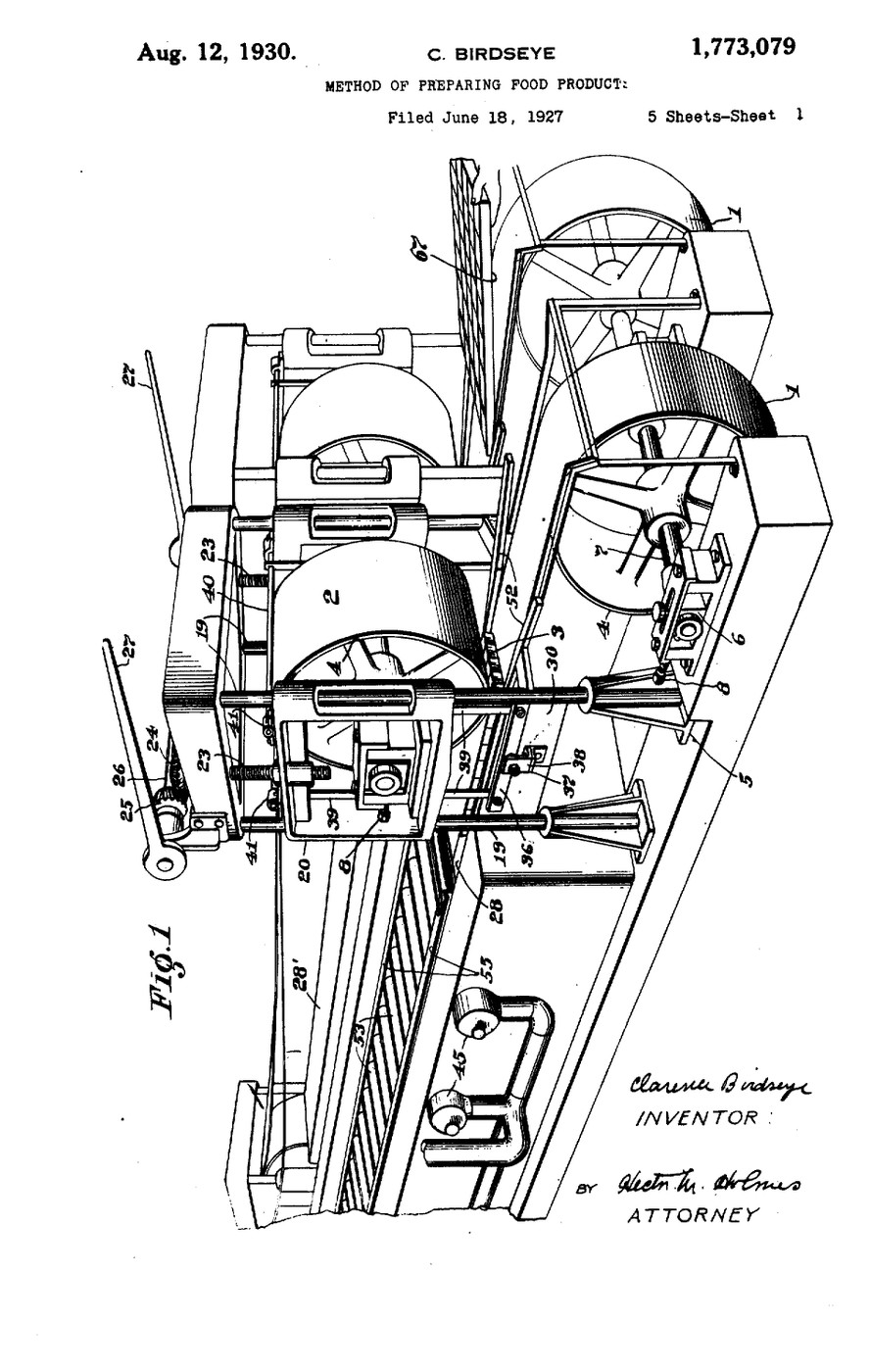
Birdseye's patent states the mechanism outright: slow freezing "disrupts the cells of the animal tissue, with loss of the pristine qualities and flavors".
Clarence Birdseye, US 1,773,079, "Method of Preparing Food Products", filed 18 June 1927, granted 12 August 1930.
Інструкції
Freeze the same food two speeds and compare the puddle
Freeze the same food two speeds and compare the puddle
Take one punnet of strawberries and split it. Freeze half slowly — in a domestic freezer, packed together in a closed tub. Freeze the other half fast — spread in a single layer on a metal tray, uncovered, against the coldest surface you have.
Leave both overnight, then thaw both on plates at room temperature.
Measure the liquid each releases by weight.
Expect the slow-frozen half to lose noticeably more. That liquid is what used to be inside the cells.
Матеріали для цього кроку:
 Свіжа суниця500 г
Необхідні інструменти ({count})
 Цифрові кухонні ваги
Watch the crystals under magnification
Watch the crystals under magnification
Freeze two thin slices of the same potato, one slow and one fast. Snap each while still frozen and look at the fracture face under a loupe or phone macro lens.
Expect the slow-frozen slice to show visible glittering facets; the fast-frozen one to look almost uniform.
You are looking directly at the thing that decides whether frozen food is any good. Everything else in this blueprint is about making the second picture happen.
Find why metal beats air
Find why metal beats air
Put one portion on a metal tray and an identical one on a plate, both in the same freezer, and time how long each takes to freeze solid.
Expect metal to win easily.
Air is a poor conductor — it is what insulates the flask in the previous blueprint. Metal pulls heat out far faster for the same freezer temperature.
Birdseye's patent does exactly this at scale: it presses the package between imperforate metal belts from top and bottom, held between 20°F and below 0°F. He is not using a colder freezer. He is using better contact.
Необхідні інструменти ({count})
 Інфрачервоний термометр
Make thickness the variable
Make thickness the variable
Freeze the same food at 10 mm, 25 mm and 50 mm thick on the same tray. Time each to frozen-through.
Expect the time to grow much faster than the thickness — roughly with its square, because the heat from the middle has to travel out through everything already frozen around it.
This is why commercial quick-freezing packs food thin and flat, and why Birdseye quotes about an hour and a quarter for a two-inch package. A thick block cannot be quick-frozen at any freezer temperature; the middle is always slow-frozen.
Find the damage that freezing speed cannot fix
Find the damage that freezing speed cannot fix
Quick-freeze two portions of green beans: one raw, one blanched for two minutes in boiling water and cooled first. Leave both a month, then cook and taste.
Expect the unblanched beans to be duller and off-flavoured despite being frozen just as fast.
Freezing stops microbes but does not stop enzymes. They keep working slowly for months, degrading colour and flavour. Blanching denatures them first.
Small crystals are necessary and not sufficient — which is why every commercial vegetable line blanches before the freezer, and why home-frozen vegetables so often disappoint even when frozen correctly.
Матеріали для цього кроку:
 Зелена квасоля400 г
History & Context
History & Context
The patent. US 1,773,079, "Method of Preparing Food Products", Clarence Birdseye, filed 18 June 1927, granted 12 August 1930. He filed a family around it the same day and after — US 1,773,080 for animal food, US 1,905,131 for refrigerating apparatus (1933), US 1,998,431 for freezing apparatus (1935).
He learned it in Labrador, from people who already knew. Working as a fur trader in Labrador between 1912 and 1917, Birdseye watched Inuit fishermen pull fish from holes in the ice into air at −40°. The fish froze almost instantly, and months later it tasted fresh. He did not invent freezing food; he worked out why the Arctic version was good and how to reproduce it in a factory in a temperate country. That provenance deserves stating plainly — the observation was Inuit practice, the industrial method was his.
The cold chain had to exist first. Quick-frozen food is useless if it thaws between factory and kitchen, so Birdseye also patented the transport — US 1,527,167, "Heat-insulated shipping container", 1925 — and leased refrigerated railway cars and shop freezer cabinets, because no grocer owned one. He sold the business to what became General Foods in 1929 for $22 million and kept inventing; he holds around 300 patents.
What it changed. Seasonality stopped being a constraint on diet. A vegetable frozen within hours of picking is often nutritionally better than a "fresh" one that has spent a week in transit, which still surprises people. Home freezer ownership, the supermarket freezer aisle and the modern ready meal all descend from this patent.
Honest limits. Quick-freezing preserves; it does not improve. It cannot rescue food that was poor going in, it does nothing about freezer burn — which is dehydration from bad packaging, not a freezing fault — and repeated partial thawing re-runs the slow-freeze damage every cycle. A freezer that defrosts itself is quietly doing this to your food.
Матеріали
2- 500 гЗаповнювач
- 400 гЗаповнювач
Необхідні інструменти
2- Заповнювач
- Заповнювач
Матеріали з пов'язаних креслень

CC0 Суспільне надбання
Це креслення випущено під ліцензією CC0. Ви можете вільно копіювати, змінювати, поширювати та використовувати цю роботу для будь-яких цілей без запиту дозволу.
Підтримайте мейкера, купуючи продукти через його креслення, де він отримує Комісію мейкера встановлену вендорами, або створіть нову ітерацію цього креслення та включіть його як зв'язок у власне креслення для розподілу доходу.