Співпраця
МИСТЕЦТВО
КРАСА ТА ЗДОРОВ'Я
РЕМЕСЛО
КУЛЬТУРА ТА ІСТОРІЯ
РОЗВАГИ
СЕРЕДОВИЩЕ
ЇЖА ТА НАПІЇ
ЗБОРНА ІНЖЕНЕРІЯ
НАУК
СПОРТ
ТЕХНОЛОГІЯ
НОСИМО
Twin Inclined-Wing Dasher Churn: Two Geared Dashers With Up- and Down-Sloping Wings Turn Through Each Other, Flat Wings Between
Buttercup

Створено

Buttercup

11. листопад 2026IE
7
0
0
0
0

Twin Inclined-Wing Dasher Churn: Two Geared Dashers With Up- and Down-Sloping Wings Turn Through Each Other, Flat Wings Between

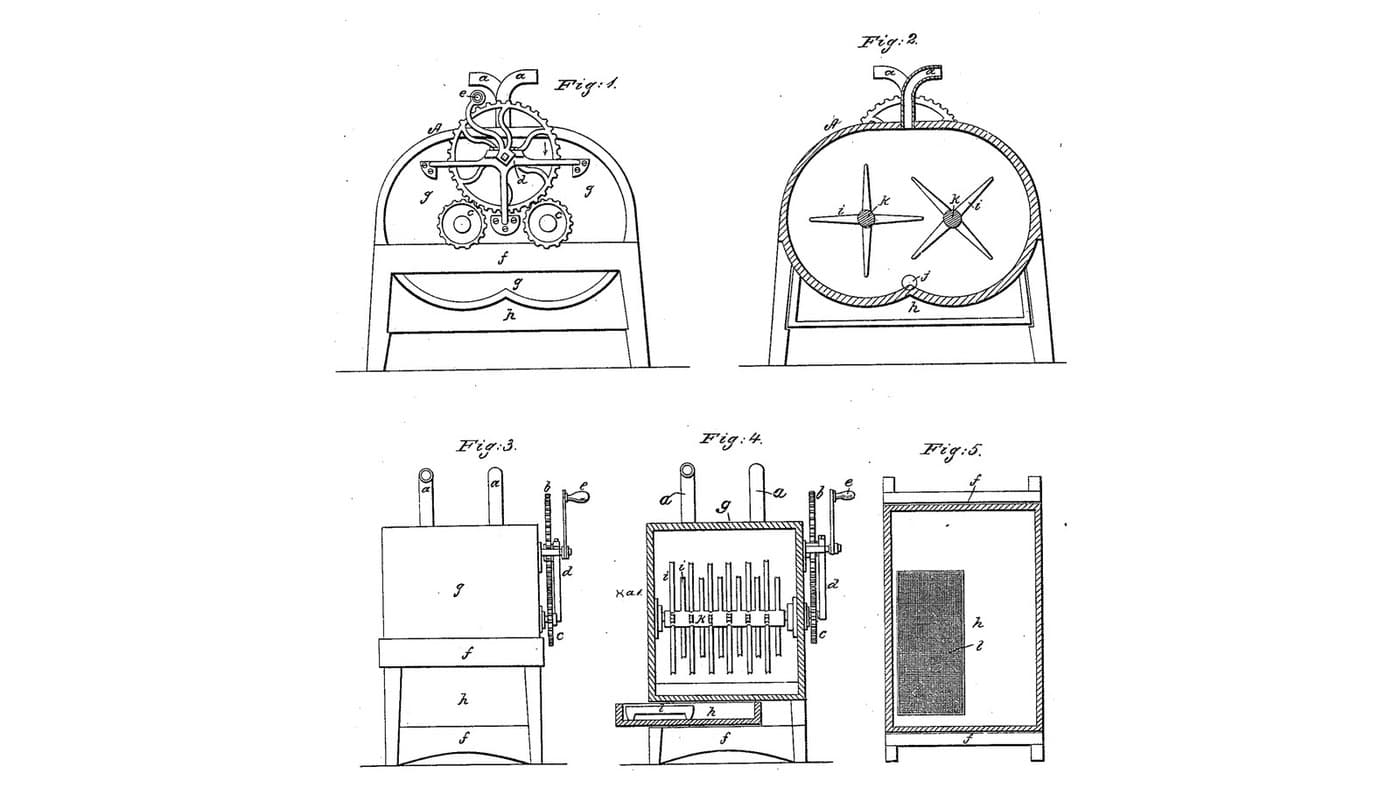
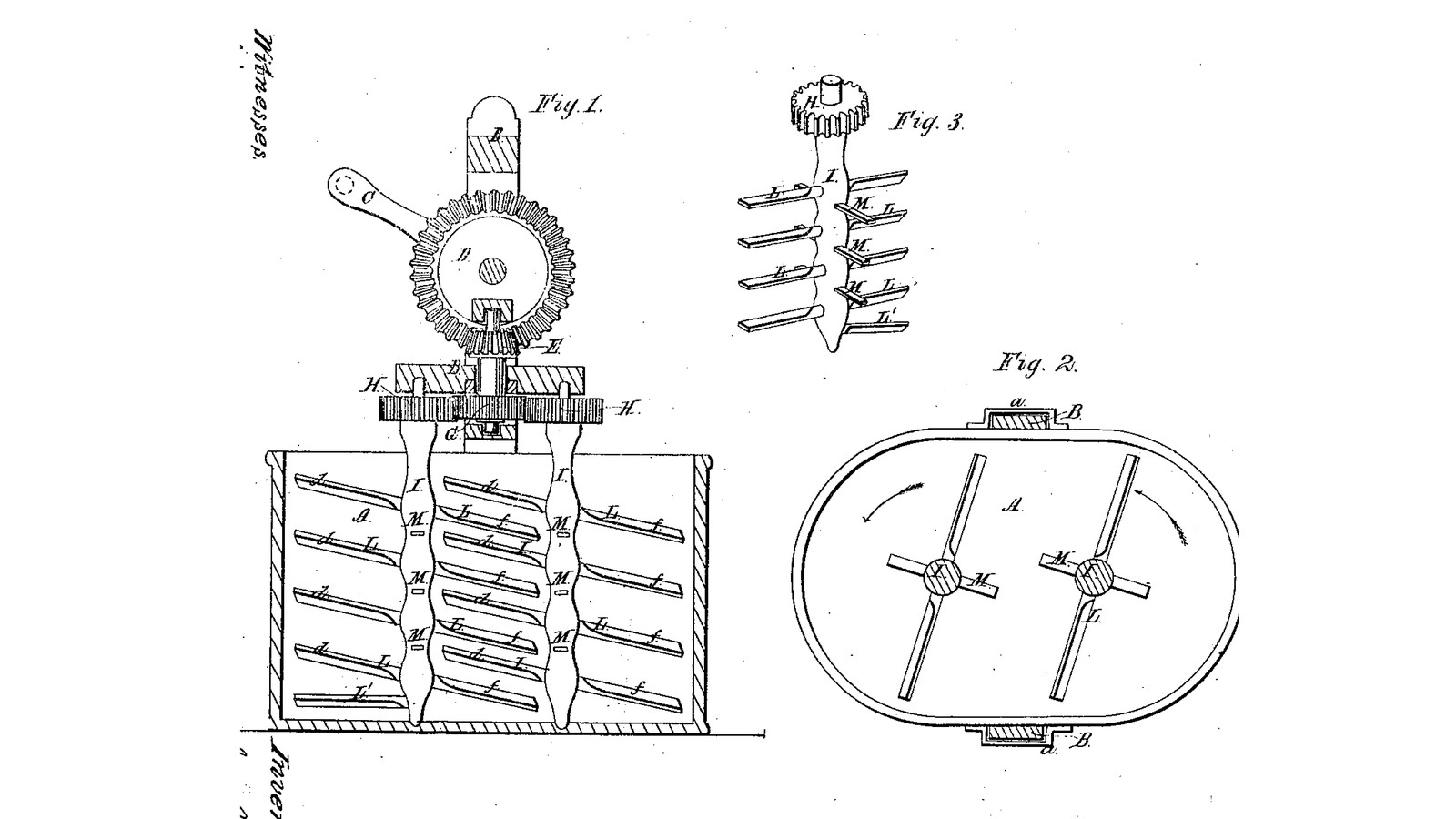
Levi Bissell of North Bergen, New York, received US 29,052, dated 10 July 1860, for a churn with two upright dashers in an oblong body. A crank on a lift-off frame drives both through gears, the same way round, so their wings pass each other in opposite directions in the middle. Each dasher's wings slope up on one side and down on the other, and one dasher's down-sloping wings pass between the other's up-sloping ones, so the cream is driven up and down at once. Flat wings between them check the swirl. The patent gives no sizes; every size here is ours.
Середній
About 3 days

Інструкції

1

Where the wings meet

Завантаження блокнота Jupyter…
2

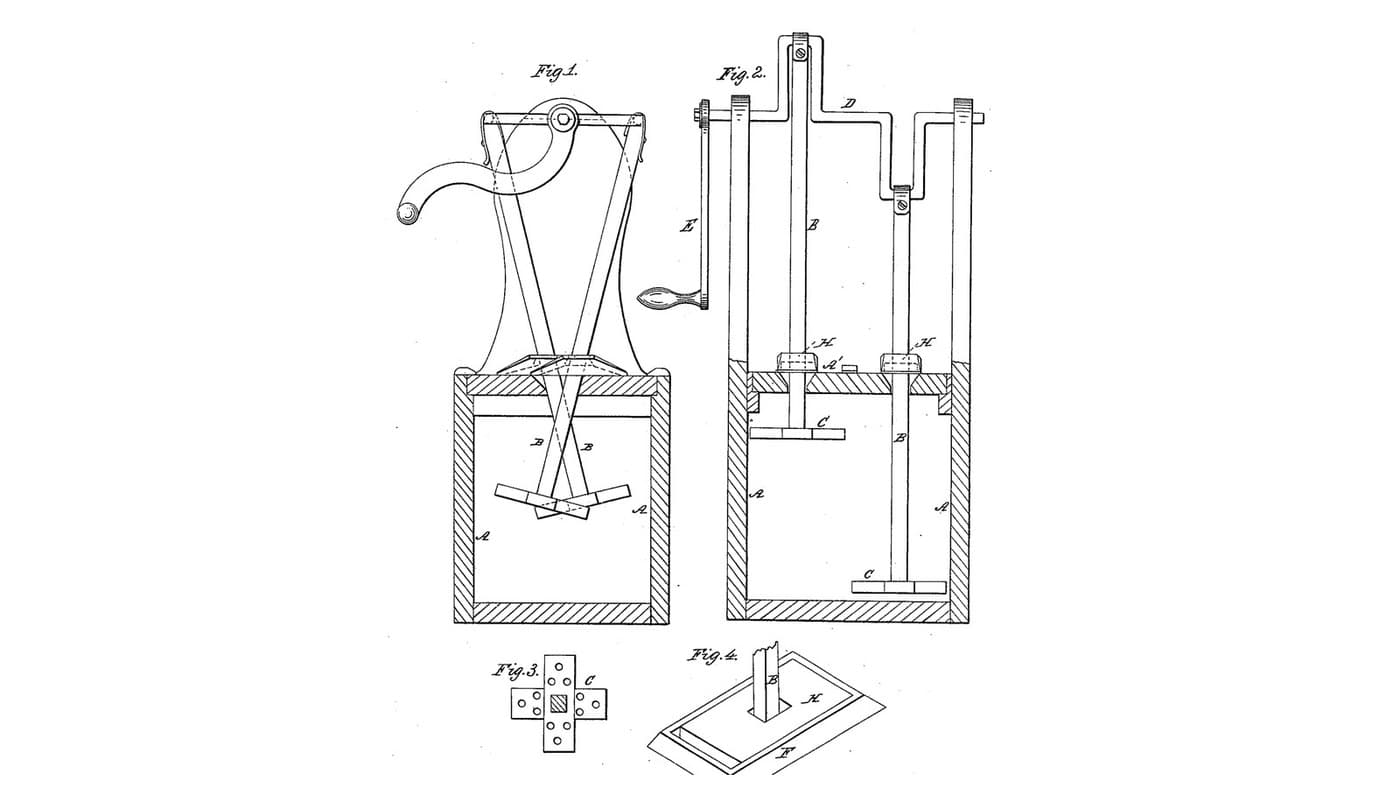
Two shafts turned the same way by one wheel, eight months before

Cornell's two shafts also turn the same way off one wheel, lying flat. Bissell stands them upright and slopes the wings.
3

Read US 29,052

"Thus it will be seen that the downwardly inclined wings move in paths describing broad cones, pointing upward; while the upwardly inclined wings describe cones pointing downward; and as these rapidly alternate, they cut paths through the milk or cream rapidly crossing each other, thereby producing intense and effective agitation of the cream."
4

Body A and sockets a

Draw two 330 mm circles, centres 220 mm apart, joined by straight lines, on 20 mm hardwood glued up wide enough, and cut the floor to it. Rout a groove 1.6 mm wide and 8 mm deep on the 290 mm circles and their joining lines. Cut two strips of 1.5 mm stainless sheet 428 mm high, bend them to the outline, stand them in the groove with silicone sealant, and lap and rivet the joins on the straight sides with sealant between. Glue up a hardwood rim 18 mm thick and 30 mm deep to fit round the top, screwed through the sheet. Screw a hardwood block 60 x 64 x 70 mm to the middle of each long side, 150 mm up, with a 24 mm square socket a down through it, sealing the screw holes.

Матеріали для цього кроку:

Дошка з твердої деревиниДошка з твердої деревини3 штук
Лист нержавкої сталіЛист нержавкої сталі2 штук
Силіконовий герметикСиліконовий герметик1 штука
Витяжні заклепкиВитяжні заклепки12 штук
Столярний клейСтолярний клей1 штука
Шурупи по деревуШурупи по дереву24 штук

Необхідні інструменти ({count})

КомпасКомпас
ЕлектролобзикЕлектролобзик
Ручний фрезерРучний фрезер
Набір стамесок по деревуНабір стамесок по дереву
Ножиці по металуНожиці по металу
Набір заклепувальникаНабір заклепувальника
Акумуляторний дрильАкумуляторний дриль
Набір сверделНабір свердел
Струбцина з напрямноюСтрубцина з напрямною
Набір викрутокНабір викруток
5

Dashers I with wings L and M

Cut two hardwood shafts 28 mm round and 408 mm long; turn the foot of each to 16 mm for 18 mm, and set a 16 mm stainless rod 103 mm long 40 mm into the top, pinned. Cut eight hardwood wings L 250 x 25 x 8 mm and six flat wings M 114 x 24 x 8 mm. Chisel slots through each shaft and drive the wings through, each pinned with a small dowel: the L pairs sloping 20 degrees, all in one plane, at 60, 140, 220 and 300 mm above the floor on one shaft and 100, 180, 260 and 340 mm on the other; the M wings flat, at right angles to the L, midway between them. Screw two hardwood steps 40 mm across, each with a 16.6 mm hole 6 mm deep, to the floor at the two end centres.

Матеріали для цього кроку:

Дошка з твердої деревиниДошка з твердої деревини1 штука
Пруток із нержавкої сталіПруток із нержавкої сталі1 штука
Шканти з твердої деревиниШканти з твердої деревини1 штука
Столярний клейСтолярний клей1 штука
Шурупи по деревуШурупи по дереву4 штук

Необхідні інструменти ({count})

Циркулярний верстатЦиркулярний верстат
Набір стамесок по деревуНабір стамесок по дереву
Акумуляторний дрильАкумуляторний дриль
Набір сверделНабір свердел
Ножівка по металуНожівка по металу
Напилки (ручний напилок)Напилки (ручний напилок)
Слюсарні лещатаСлюсарні лещата
6

Print the cog-wheel G

The cog-wheel G on the upright shaft: 40 teeth, module 2.75, 12 mm thick, 12.4 mm bore. PETG, 0.2 mm layers, 30 % infill, 4 walls.
Файл дизайнуSTLCC0 - Free
7

Print the pinions H (two)

The two pinions H on the dasher shafts, the same size as G: 40 teeth, module 2.75, 16.4 mm bore. Print two. PETG, 0.2 mm layers, 30 % infill, 4 walls.
Файл дизайнуSTLCC0 - Free
8

Print the crown wheel D

The driving wheel D on the crank shaft, a crown wheel of 36 teeth, module 2, 12.4 mm bore. PETG, 0.2 mm layers, 30 % infill, 4 walls.
Файл дизайнуSTLCC0 - Free
9

Print the pinion E

The pinion E on the upright shaft, 12 teeth, module 2, 12.4 mm bore, meshing the crown wheel D. PETG, 0.2 mm layers, 30 % infill, 4 walls.
Файл дизайнуSTLCC0 - Free
10

Frame B, cover, gearing and winch C

Cut a hardwood board 340 x 396 x 25 mm and screw two 22 mm square hardwood standards 302 mm long under the middle of its 340 mm edges to drop into the sockets a. Bore it 16.8 mm over the two dasher shafts and 12.8 mm at the centre. Cut a 12 mm HDPE cover to the body's outside outline with 28 mm holes over the dashers. Stand the dashers in their steps, put on the cover and drop the frame into the sockets. Pin a pinion H on each dasher rod above the board with both wing planes lying along the churn, one dasher's down-sloping wings toward the other's up-sloping ones. Run a 12 mm stainless upright shaft 113 mm long through the centre hole with the wheel G pinned on it meshing both pinions, and the pinion E pinned 60 mm above the board. Screw two hardwood chairs 44 x 30 x 116 mm to the board, bored 12.6 mm across, carry a 12 mm stainless crank shaft in them with the crown wheel D pinned on its end meshing E, and hold it with shaft collars. Pin on a crank C of mild steel flat bar, 88 mm throw, with a hardwood handle.

Матеріали для цього кроку:

Дошка з твердої деревиниДошка з твердої деревини1 штука
Лист ПЕВГЛист ПЕВГ1 штука
Пруток із нержавкої сталіПруток із нержавкої сталі1 штука
Смуга з маловуглецевої сталіСмуга з маловуглецевої сталі1 штука
Shaft CollarShaft Collar2 штук
ШплінтШплінт6 штук
Шканти з твердої деревиниШканти з твердої деревини1 штука
Шурупи по деревуШурупи по дереву12 штук
Столярний клейСтолярний клей1 штука
Філамент PETGФіламент PETG1 штука

Необхідні інструменти ({count})

3D-принтер FDM3D-принтер FDM
Циркулярний верстатЦиркулярний верстат
ЕлектролобзикЕлектролобзик
Набір перових сверделНабір перових свердел
Акумуляторний дрильАкумуляторний дриль
Набір сверделНабір свердел
Ножівка по металуНожівка по металу
Напилки (ручний напилок)Напилки (ручний напилок)
Слюсарні лещатаСлюсарні лещата
Набір викрутокНабір викруток
РулеткаРулетка
11

The build in 3D

FreeCAD model of this build, the body cut open: the floor, sheet wall and rim, the sockets and the lift-off frame, the winch, crown wheel and pinion, the cog-wheel and two pinions, and the two dashers with their sloping wings L and flat wings M passing between each other.
Файл дизайнуBLENDCC0 - Free
12

Churn

Pour about 25 litres of heavy cream at about 15 °C, checked with the thermometer, into the body, about half full; put on the cover and drop in the frame. Turn the winch steadily, timing it. When the butter comes, lift the frame out of its sockets, take off the cover and lift out the dashers. Take out the butter from the ends, pour the buttermilk into a bowl, wash the butter in cold water until it runs clear, salt and weigh it.

Матеріали для цього кроку:

Жирні вершкиЖирні вершки25 l
Крупна морська сільКрупна морська сіль1 штука
ВодаВода1 штука

Необхідні інструменти ({count})

Термометр зі щупом, що лишається в стравіТермометр зі щупом, що лишається в страві

СекундомірСекундомір
Цифрові кухонні вагиЦифрові кухонні ваги
Велика миска з нержавкої сталіВелика миска з нержавкої сталі
13

Troubleshooting

Twin-dasher churn troubleshooting.

Flow

Loading...
14

History and honest limits

**Levi Bissell** of North Bergen, Genesee County, New York, US 29,052, 10 July 1860, "Churn". He claimed "the oppositely inclined sets of dasher wings L, L, following each other on their respective shafts, while those of one dasher alternate and intermatch with those of the other dasher, and the intermediate, horizontal dasher wings M, M". He did not claim two dashers with intermatching wings as such, nor sloping wings alone. He also allowed "feathering" the wings, in one way or in contrary ways; ours are not feathered. His gears were a bevel wheel and pinion; ours are a printed crown wheel and pinion. The patent gives no sizes; every size here is ours.

Матеріали

16

Необхідні інструменти

21

Файли дизайну

5

CC0 Суспільне надбання

Це креслення випущено під ліцензією CC0. Ви можете вільно копіювати, змінювати, поширювати та використовувати цю роботу для будь-яких цілей без запиту дозволу.

Підтримайте мейкера, купуючи продукти через його креслення, де він отримує Комісію мейкера встановлену вендорами, або створіть нову ітерацію цього креслення та включіть його як зв'язок у власне креслення для розподілу доходу.

Обговорення

(0)

Увійти щоб приєднатися до обговорення

Завантаження коментарів...