МИСТЕЦТВО
КРАСА ТА ЗДОРОВ'Я
РЕМЕСЛО
КУЛЬТУРА ТА ІСТОРІЯ
РОЗВАГИ
СЕРЕДОВИЩЕ
ЇЖА ТА НАПІЇ
ЗБОРНА ІНЖЕНЕРІЯ
НАУК
СПОРТ
ТЕХНОЛОГІЯ
НОСИМО

Why a Series String Drifts, and What Balancing Actually Does
Rung 3 found extra pins on the pack connector — C1, C2, C3, C4 — and left them unexplained. This is what they are for.
Cells wired in series carry exactly the same current and there is nothing anyone can do about that. What they do not share is capacity, temperature or age, so they drift apart in state of charge, and a pack must stop at the first cell to hit a limit. The weakest cell sets the pack, the strongest cell never gets used, and without intervention every cycle makes the gap a little wider.
Here you build a four-cell string, deliberately unbalance it, measure exactly how much capacity that costs, and then fit a balancing board and watch it claw the difference back — slowly, and by throwing energy away, because that is the only thing a cheap balancer can do.
Середній
About 4 hours, including a full charge
Інструкції
1
1
Build the string and give it an honest baseline
Build the string and give it an honest baseline
Use the four labelled cells from rung 6 in the four-cell holder. Before anything else, measure each cell **individually and out of the holder**, rested, to three decimal places, and write the four numbers down with the date.
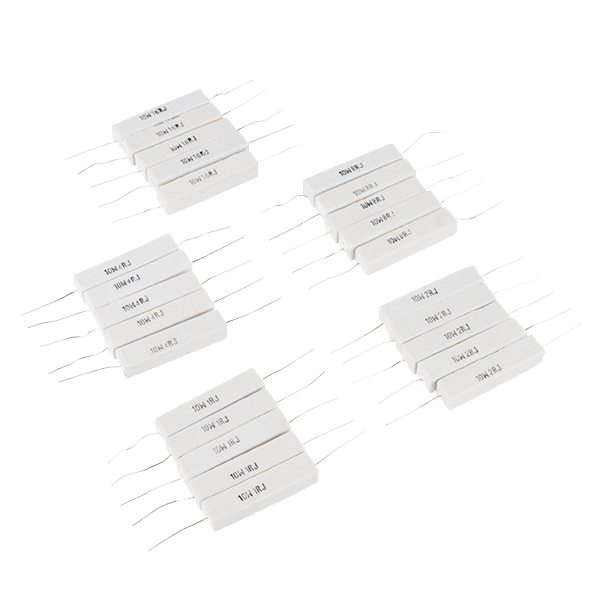
Then measure each cell's actual capacity, one at a time. Charge it to 4.20 V, rest it thirty minutes, then discharge through the power resistor at a steady current, timing until it reaches 3.00 V. Amp-hours is current times hours. It takes four sessions and it is the only way to know what you actually have: the number printed on the wrapper is a rating, not a measurement, and a cell that has been in a drawer for two years will not meet it.
Write the four capacities in your notebook as a table. That table is the input to step 3's arithmetic, and you will compare against it at the end of step 5.
If all four come out within a couple of per cent of each other, deliberately unbalance the string before going on: charge three of them fully and leave the fourth at about 60%. You need a visible effect to measure, and a well-matched string will not give you one in an afternoon.
One cell at a time on the charger. Never charge a series string without per-cell supervision — which is the whole point of this rung and the reason step 5 exists.
Матеріали для цього кроку:
 Літієвий елемент 186504 штук
Необхідні інструменти ({count})
 Тримач на 4 елементи 18650
 Тримач батарейок
 Плата заряджання LiPo
 Цифровий мультиметр — автовибір межі, True RMS
 Power Resistor Kit - 10W (25 pack)
 Набір радіаторів (алюмінієвих)
 Секундомір
 Монітор акумулятора (кулонометр)
 Вимірювальні дроти із затискачами «крокодил»
 Прозорі захисні окуляри
 Лабораторний журнал (з копією)
2
2
Discharge the string and watch the weakest cell end the job
Discharge the string and watch the weakest cell end the job
Wire the four-cell holder in series and bring a thin tap wire out of each cell junction, exactly as in rung 3 step 5. Those taps are how you watch individual cells while the string works.
Discharge the whole string through the power resistor at a steady current — an amp is plenty and keeps the resistor manageable. Every five minutes, read **all four cell voltages in turn** and the string total, and write them in a row.
Stop the moment **any single cell** reaches 3.00 V. Not the string; a cell. This is the point of the whole exercise: the string total will still look perfectly healthy — four cells averaging 3.4 V is a string at 13.6 V, which no total-voltage cut-off would object to — while one cell inside it is already at its floor and being dragged below.
Now look at your rows. The weak cell's voltage separates from the others early and then dives; the strong ones are still on their plateau when you stop. Work out how much charge the string delivered and compare it against the strongest cell's own capacity from step 1. The difference is capacity you own and cannot reach.
Over-discharging a lithium cell below about 2.5 V damages it permanently and makes it dangerous to recharge. Watching the cells rather than the total is not caution, it is the only correct way to run a string.
Необхідні інструменти ({count})
Тримач на 4 елементи 18650Power Resistor Kit - 10W (25 pack)Набір радіаторів (алюмінієвих)Цифровий мультиметр — автовибір межі, True RMS МультиметрСекундомірВимірювальні дроти із затискачами «крокодил»
 Монтажний провідПрозорі захисні окуляриЛабораторний журнал (з копією)
3
3
The arithmetic of drift
The arithmetic of drift
Завантаження блокнота Jupyter…
4
4
Build one balancing channel by hand
Build one balancing channel by hand
Before fitting a board that does it invisibly, build one channel so you can see what it does. A passive balancer is genuinely this simple.
Across one cell, put a **100 Ω resistor in series with a logic-level MOSFET**, drain to the cell's positive, source to the cell's negative. Drive the gate from a comparator that turns on whenever that cell exceeds the reference — 4.15 V is a sensible threshold, set with the potentiometer and checked against the meter. Use a 1 W or larger resistor: step 3 computed 0.18 W, and a quarter-watt part running at most of its rating in a closed pack is a bad idea.
Test it on the bench supply first, with no cell involved: sweep the supply up through the threshold and confirm the MOSFET turns on and the resistor starts drawing its 42 mA. Measure the current rather than assuming it; a MOSFET that is not fully on is a heater.
Now put it on the cell that runs high in your string and charge the string gently. That cell should stop climbing while the others catch up. You will feel the resistor get warm, and that warmth is the energy you are deliberately destroying — passive balancing does not move charge from a full cell to an empty one, it burns the difference.
Four of these, one per cell, is a complete passive balancer. Which is, very nearly, what is on the board in the next step.
Матеріали для цього кроку:
Power Resistor Kit - 10W (25 pack)1 штука Набір резисторів 1/4 Вт1 штукаМонтажний провід1 штука
Необхідні інструменти ({count})
 Макетна плата
 Набір проводів Dupont (тато-мама)
 Логічний MOSFET IRLZ44N
 Подвійний компаратор LM393
 Лінійний потенціометр 10 кілоом
 Лабораторне джерело живленняЦифровий мультиметр — автовибір межі, True RMS
 Інфрачервоний термометр
 Паяльна станція з паяльником
 Інструмент для знімання ізоляціїПрозорі захисні окуляри
5
5
Fit a real BMS and measure what it bought you
Fit a real BMS and measure what it bought you
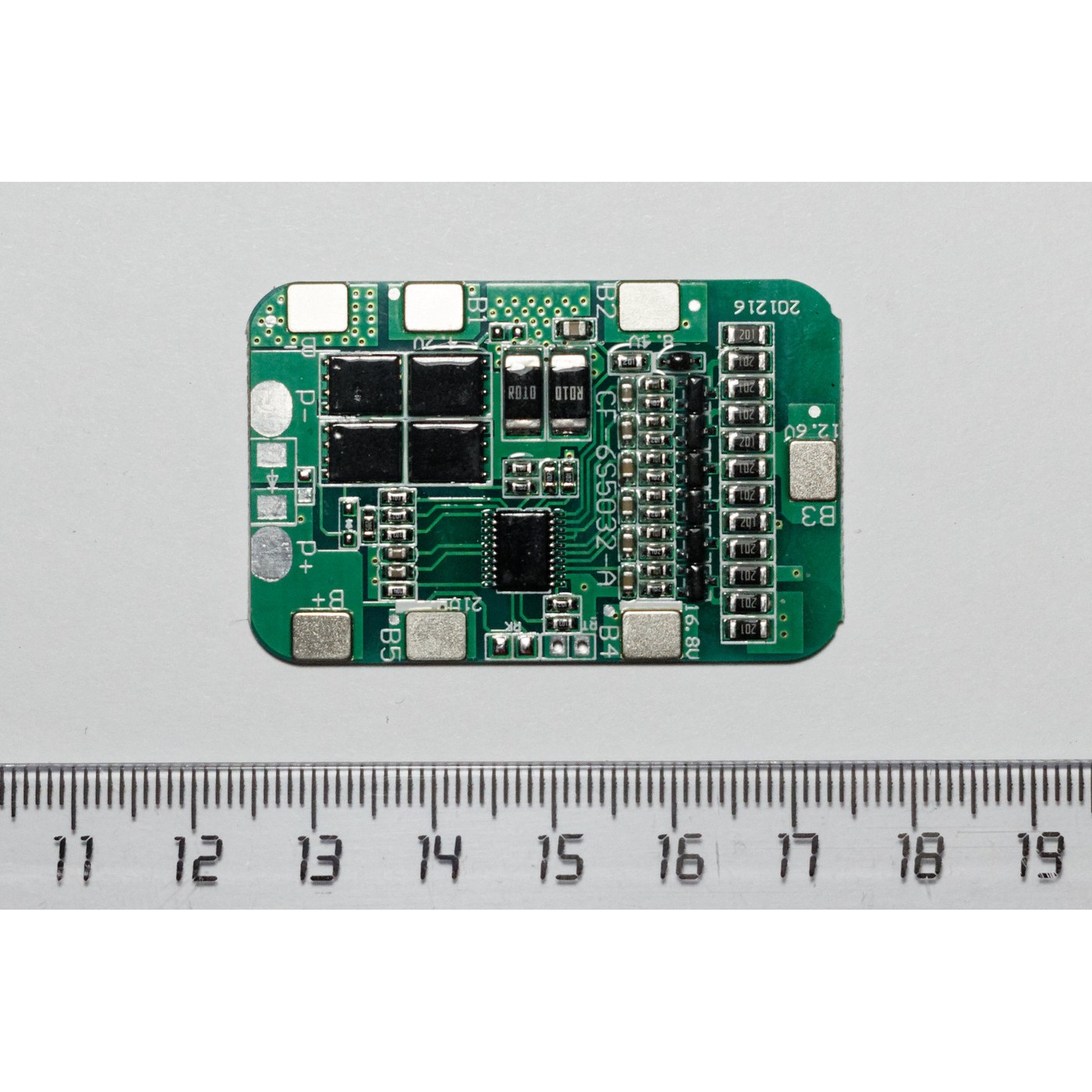
The green board in the photograph on this page is a 4S battery management system, and it is the commodity version of everything in steps 2 and 4. Its terminal strip takes **B−, then one wire per cell junction, then B+** — the same taps as the pack connector in rung 3.
Wire it carefully and in order, from B− upwards. Getting a balance lead onto the wrong junction reverses a cell input, and the board will not survive it. Measure each wire against B− with the meter before you plug the connector in, and confirm the voltages step up cell by cell. Do that check every time.
What the board is doing, in three jobs:
- **Overcharge protection** — it disconnects if any cell passes about 4.25 V.
- **Over-discharge protection** — it disconnects if any cell falls below about 2.5 V. This is the protection you were providing by hand with the meter in step 2.
- **Balancing** — the small resistors along one edge, doing what you built in step 4.
Charge the string with the board fitted and watch the four cell voltages converge over several hours. Put the infrared thermometer on the balance resistors while it works; they will be the warmest things on the board and that is correct.
Then repeat the step 2 discharge and compare the delivered amp-hours with the first run. That difference is the answer to the question this rung asks, measured on your own bench.
A BMS protects cells. It cannot repair them: a cell whose capacity has genuinely collapsed will still limit the pack, and no amount of balancing will change that. Replacing one cell in an old pack with a new one makes the mismatch worse, not better.
Матеріали для цього кроку:
Монтажний провід1 штукаНеобхідні інструменти ({count})
 Плата BMSТримач на 4 елементи 18650Цифровий мультиметр — автовибір межі, True RMSІнфрачервоний термометрПлата заряджання LiPoPower Resistor Kit - 10W (25 pack)Набір радіаторів (алюмінієвих)Паяльна станція з паяльником
 Припій 63/37 із каніфольним флюсом
 Паяльний флюсІнструмент для знімання ізоляції
 Пінцет із гострими губкамиПрозорі захисні окуляриЛабораторний журнал (з копією)
6
6
History and context
History and context
**Attribution, stated honestly.** There is no single patent for cell balancing and none is asserted here. The problem is arithmetic — identical current, different capacity — and it was recognised as soon as anyone put cells in series, which is to say in 1800 with Volta's pile. What changed with lithium-ion is the *consequence*: a nickel cell that is overcharged vents and gets hot, while a lithium cell that is overcharged can do what rung 9 describes. Balancing stopped being an efficiency measure and became a safety requirement.
That is why the pack connector grew cell taps and why every lithium pack sold today has a protection board inside it, while a nickel-cadmium pack of the same era had nothing but cells and a thermistor.
**Passive against active.** Everything here is *passive* balancing: bleed the high cells down and waste the difference. *Active* balancers move charge from the high cell to the low one through an inductor or a transformer, so nothing is thrown away, and they are correspondingly more expensive and more complex. For a four-cell tool pack the passive version is right; for a car pack with a hundred cells in series it stops being right, because the energy you would throw away scales with the string.
**Honest limits.** Passive balancing is slow, as step 3 showed: 300 mAh of imbalance takes seven hours of bleeding. It only works at the top of the charge, where the voltage curve is steep enough to tell the cells apart — on the flat plateau of rung 4 a 50 mV difference could be almost any difference in state of charge. And it cannot fix a mismatch that is growing faster than it can bleed, which is what an ageing pack eventually becomes.
Матеріали
4- Літієвий елемент 1865010% комісія4 штукЗаповнювач
- Power Resistor Kit - 10W (25 pack)10% комісія1 штука$5.60
- 1 штукаЗаповнювач
- 2 штукЗаповнювач
Необхідні інструменти
26- Заповнювач
- Тримач батарейок10% комісіяMagento Legacy Storeships internationallyЗаповнювач
- Плата заряджання LiPo10% комісіяЗаповнювач
- Power Resistor Kit - 10W (25 pack)10% комісія$5.60
- Набір радіаторів (алюмінієвих)10% комісіяЗаповнювач
- Заповнювач
- Монітор акумулятора (кулонометр)10% комісіяЗаповнювач
- Заповнювач
- Лабораторний журнал (з копією)10% комісіяЗаповнювач
- Заповнювач
- Заповнювач
- Макетна плата10% комісіяMagento Legacy Storeships internationallyЗаповнювач
- Заповнювач
- Заповнювач
- Заповнювач
- Заповнювач
- Заповнювач
- Заповнювач
- Паяльна станція з паяльником10% комісіяЗаповнювач
- Заповнювач
- Плата BMS10% комісіяЗаповнювач
- Заповнювач
- Паяльний флюс10% комісіяЗаповнювач
- Заповнювач
Орієнтовна сума
Те, що купив майстер. Матеріали без ціни ви купуєте там, де знайдете.
Пов'язані креслення
Ці креслення діляться знаннями — техніки, матеріали або принципи

One Can, Many Tools: The 18650 and the Safety Devices in Its Cap
від Volt
електроніка
13
0
0
0
0
0
The Pack as a Part: Contacts, Keying and the Third Wire
від Emma
Енергія
8
0
0
0
0
0
Power: Why It Works on USB and Dies on a Battery
від Volt
електроніка
24
0
0
0
0
0
Knowing When To Stop: Finding the Peak That Says Full
від Volt
електроніка
15
0
0
0
0
0
CC0 Суспільне надбання
Це креслення випущено під ліцензією CC0. Ви можете вільно копіювати, змінювати, поширювати та використовувати цю роботу для будь-яких цілей без запиту дозволу.
Підтримайте мейкера, купуючи продукти через його креслення, де він отримує Комісію мейкера встановлену вендорами, або створіть нову ітерацію цього креслення та включіть його як зв'язок у власне креслення для розподілу доходу.