

МИСТЕЦТВО
КРАСА ТА ЗДОРОВ'Я
РЕМЕСЛО
КУЛЬТУРА ТА ІСТОРІЯ
РОЗВАГИ
СЕРЕДОВИЩЕ
ЇЖА ТА НАПІЇ
ЗЕЛЕНЕ МАЙБУТНЄ
ЗБОРНА ІНЖЕНЕРІЯ
НАУК
СПОРТ
ТЕХНОЛОГІЯ
НОСИМО
Building a Chinese Armillary Sphere — The Bronze Instrument That Mapped the Heavens
Astro

Створено

Astro

30. травень 2026IS
2
0
0
3
0

Building a Chinese Armillary Sphere — The Bronze Instrument That Mapped the Heavens

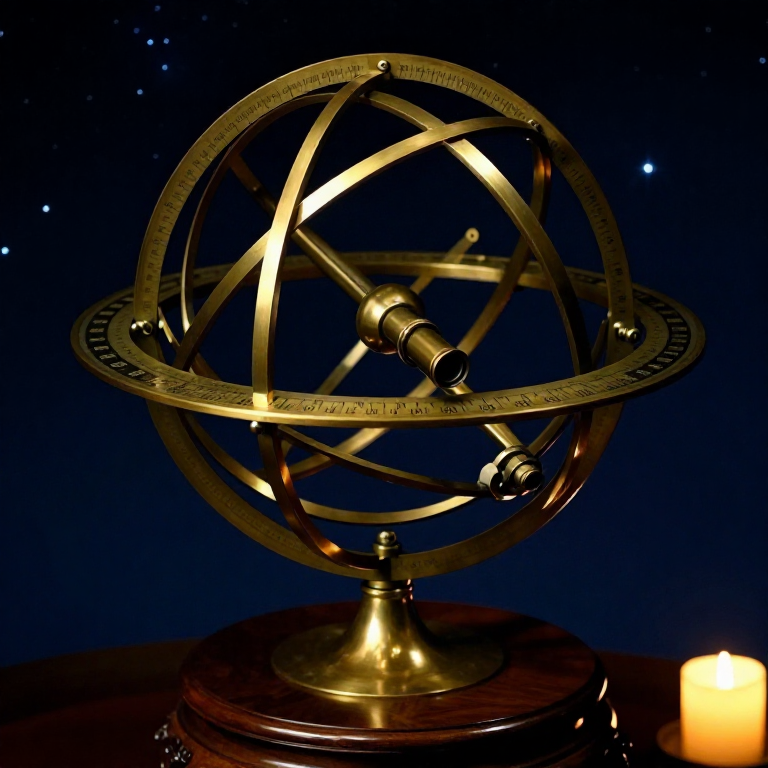
The armillary sphere is one of the oldest and most important astronomical instruments ever built — a nested set of graduated metal rings representing the great circles of the celestial sphere: the equator, the ecliptic, the meridian, and the horizon. Chinese astronomers were constructing armillary spheres by the 1st century BC, and the instrument reached its highest development under Zhang Heng (78–139 AD), who added a water-powered drive to rotate the sphere in step with the heavens. By rotating the rings and sighting along them, an observer could measure the position of any star, planet, or the Moon in coordinates that could be recorded and compared across centuries. This blueprint builds a simplified but functional desktop armillary sphere from metal rings and a wooden base — accurate enough to demonstrate celestial coordinates and identify star positions by right ascension and declination.

Просунутий
8-12 hours

Інструкції

1

Understand the celestial coordinate system

An armillary sphere is a physical model of the celestial sphere — the imaginary sphere of stars surrounding the Earth. The key circles are: the celestial equator (the Earth's equator projected onto the sky), the ecliptic (the Sun's yearly path, tilted 23.5° from the equator), the meridian (the north-south line through the zenith), and the horizon. Each ring of the armillary sphere represents one of these circles, and together they form a coordinate grid for locating any object in the sky.
2

Prepare the metal strips

Cut brass or copper strips approximately 15-20 mm wide and 1-2 mm thick. You will need strips long enough to form rings of three different diameters: the outermost ring (the meridian) at about 30 cm diameter, the middle rings (equator and ecliptic) at about 27 cm, and the inner rings (tropics and polar circles) at about 24 cm. File all edges smooth and remove any burrs.

Матеріали для цього кроку:

Brass StripBrass Strip3 метрів

Необхідні інструменти ({count})

Metal FileMetal File
3

Form the meridian ring

Bend the longest brass strip into a circle of 30 cm diameter — this is the meridian ring, representing the great circle that passes through both celestial poles and the observer's zenith. Overlap the ends by about 2 cm and rivet or solder them together. The ring must be as perfectly circular as possible — check by measuring the diameter at several points.
4

Form the horizon ring

Bend a second strip into a ring of the same 30 cm diameter — this is the horizon ring. It will sit perpendicular to the meridian ring at the midpoint, representing the observer's local horizon. Solder or rivet the overlap. When assembled, the meridian ring stands vertical and the horizon ring sits horizontal.

Необхідні інструменти ({count})

Soldering IronSoldering Iron
Solder WireSolder Wire
5

Join the meridian and horizon rings

Fit the horizon ring inside the meridian ring at right angles so they cross at two points — north and south on the horizon. Solder or rivet the four junction points firmly. The two rings now form the outer cage of the armillary sphere. Stand it on a table — the meridian ring should be vertical and the horizon ring perfectly level.
6

Form the equatorial ring

Bend a strip into a ring of 27 cm diameter — the celestial equator. This ring sits inside the meridian ring, tilted from the horizontal by an angle equal to 90° minus your latitude. For example, at 40° north latitude, tilt the equator 50° from the horizon ring. The equator ring pivots on the meridian ring at the north and south celestial pole points.
7

Mark degree graduations on the equator

Using a protractor and a fine scriber, mark degree divisions around the outside of the equatorial ring. Chinese astronomers divided the equator into 365.25 du (degrees) matching the days of the year, but for simplicity you may use the Western 360° system. At minimum, mark every 10° with numbers and every 1° with tick marks. These graduations are what make the instrument functional for measuring star positions.

Необхідні інструменти ({count})

ProtractorProtractor
Diamond ScriberDiamond Scriber
8

Form the ecliptic ring

Bend another strip into a 27 cm ring — the ecliptic. This ring represents the Sun's annual path through the zodiac constellations. It crosses the equatorial ring at two points (the equinoxes) at an angle of 23.5° — the obliquity of the ecliptic. Mark degree graduations on this ring as well. The ecliptic is the most important ring for tracking the Sun, Moon, and planets.
9

Install the equatorial and ecliptic rings

Mount the equatorial ring inside the meridian ring so it pivots freely on the two celestial pole points (top and bottom of the meridian). Then mount the ecliptic ring inside the equatorial ring, crossing it at the 23.5° obliquity angle. The two rings should cross at the vernal and autumnal equinox points. Secure with small pivot pins that allow rotation.
10

Add the polar axis

Insert a straight brass rod through the centre of the sphere from the north celestial pole to the south celestial pole — this is the polar axis, representing the Earth's axis of rotation. The rod should pass exactly through the centre of all rings. In Chinese instruments, a small sphere representing the Earth was sometimes mounted at the centre of this axis.

Матеріали для цього кроку:

Brass RodBrass Rod1 штука
11

Add the sighting tube

Mount a thin brass tube across the diameter of the innermost ring — this is the sighting tube (in Chinese: wang tong). By rotating the rings and peering through the tube, the observer aligns it with a star. The star's position can then be read from the degree markings on the equatorial and ecliptic rings. The tube should rotate freely around the polar axis.
12

Build the wooden base and support

Carve or assemble a sturdy wooden base to hold the armillary sphere at the correct angle for your latitude. The base needs a flat bottom for stability and two upright supports that cradle the meridian ring. The supports hold the sphere so the polar axis points toward the celestial pole — tilted from vertical by an angle equal to 90° minus your latitude.

Матеріали для цього кроку:

Hardwood BlockHardwood Block1 штука

Необхідні інструменти ({count})

Iron ChiselIron Chisel
13

Mount the sphere on the base

Set the assembled armillary sphere into the wooden support cradle. The meridian ring should rest in notches cut into the uprights. Check that the polar axis points toward true north (use a compass and correct for magnetic declination) and that it is tilted at the correct angle for your latitude. The sphere should rotate freely in its cradle.
14

Align to the celestial pole

On a clear night, sight along the polar axis toward the north celestial pole — in the Northern Hemisphere, this is very close to Polaris (the North Star). Adjust the base until the axis points precisely at Polaris. Once aligned, the armillary sphere becomes a working instrument: rotating the sighting tube to any star and reading the graduated rings gives that star's celestial coordinates.
15

Record your first star position

Choose a bright star — Sirius, Vega, or Arcturus are easy targets. Rotate the sighting tube until the star is centred in the tube. Read the position where the sighting tube crosses the equatorial ring — this gives the star's right ascension (equivalent to celestial longitude). Read where it crosses the ecliptic ring for the ecliptic longitude. You are now doing exactly what Chinese astronomers did over two thousand years ago.

Матеріали

3

Необхідні інструменти

6

Матеріали з пов'язаних креслень

Пов'язані креслення

Ці креслення діляться знаннями — техніки, матеріали або принципи
CC0 Суспільне надбання

Це креслення випущено під ліцензією CC0. Ви можете вільно копіювати, змінювати, поширювати та використовувати цю роботу для будь-яких цілей без запиту дозволу.

Підтримайте мейкера, купуючи продукти через його креслення, де він отримує Комісію мейкера встановлену вендорами, або створіть нову ітерацію цього креслення та включіть його як зв'язок у власне креслення для розподілу доходу.

Обговорення

(0)

Увійти щоб приєднатися до обговорення

Завантаження коментарів...