МИСТЕЦТВО
КРАСА ТА ЗДОРОВ'Я
РЕМЕСЛО
КУЛЬТУРА ТА ІСТОРІЯ
РОЗВАГИ
СЕРЕДОВИЩЕ
ЇЖА ТА НАПІЇ
ЗБОРНА ІНЖЕНЕРІЯ
НАУК
СПОРТ
ТЕХНОЛОГІЯ
НОСИМО
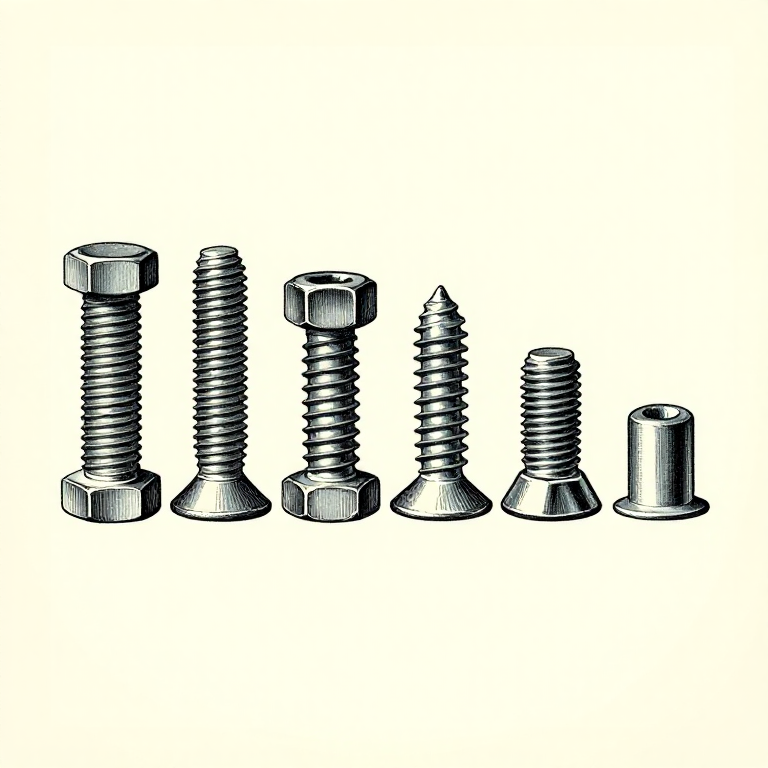


Choosing the Fastener: Screw, Bolt, Stud, Rivet
The fastener is usually chosen last and by whatever is in the drawer, which is why so many assemblies come apart. The choice is actually a short one, and it turns on a single question: how many times will this joint be taken apart?
Never — then a rivet or a weld is stronger, cheaper and lighter. Occasionally — a bolt and nut. Often — a stud, or a threaded insert, so the thread being worn is in a part you can replace.
The second question is what the joint is resisting: a fastener holding two plates from sliding is doing a completely different job from one holding them from pulling apart, and the right answer differs.
Початківець
2 hours
Інструкції
1
1
Bolt, screw, stud, setscrew — the words mean specific things
Bolt, screw, stud, setscrew — the words mean specific things
A BOLT passes through both parts and takes a NUT on the far side. A machine SCREW threads into a tapped hole in the far part, with no nut. A SETSCREW (or fully-threaded bolt) is threaded along its whole length; a bolt proper has a plain shank under the head.
That plain shank matters. It is stronger in shear than a thread, and it gives the top part a smooth surface to be located by. For a joint carrying sideways load, the shank should pass through the clearance hole and the thread should start beyond it.
A STUD is threaded at both ends and screwed permanently into the lower part. It exists so that repeated assembly wears the NUT rather than the tapped hole — the reason engine blocks and other repeatedly-opened joints use them.
Необхідні інструменти ({count})
 Набір шестигранних болтів
 Машинні гвинти
 Набір гайок і шайб
 Штангенциркуль
2
2
Shear or tension: what the joint is actually resisting
Shear or tension: what the joint is actually resisting
A joint in TENSION pulls the fastener along its length — a lid bolted onto a pressure vessel. A joint in SHEAR tries to slide the parts across each other — a bracket bolted to a wall carrying a load below it.
Most bolted joints are designed to work by FRICTION, not by the bolt taking shear directly: the bolt clamps the parts hard enough that friction between them carries the sideways load, and the bolt itself is loaded only in tension. This is why a properly tightened joint is far stronger than a loose one with the same bolt.
Where the bolt really must take shear, its plain shank should be in the joint line and it should be a close fit in the hole. A thread sitting in the shear plane concentrates the load in the thread roots and is where fatigue failures start.
Матеріали для цього кроку:
 Лист маловуглецевої сталі2 штук
Необхідні інструменти ({count})
Набір шестигранних болтів Набір гайкових ключів
 Динамометричний ключ
3
3
When a rivet is the better answer
When a rivet is the better answer
A rivet is a permanent fastener formed in place: a soft pin put through both parts and then upset — hammered or squeezed — so it swells to fill the hole and forms a second head.
It has real advantages over a bolt. It cannot vibrate loose, it is lighter, it fills its hole completely so it takes shear properly, and it costs a fraction as much. The Viking riveted cauldron, chain mail and Roman scale armour published here all depend on exactly this.
The cost is that removing one means drilling it out. So a rivet is right wherever the joint is genuinely permanent and wrong wherever access will ever be needed — and 'we will never need to open this' is a claim worth testing before committing to it.
Матеріали для цього кроку:
 Алюмінієвий лист1 штука
Необхідні інструменти ({count})
 Клепальний набір
 Клепальний молоток
 Набір свердел
 Прозорі захисні окуляри
4
4
The head, the drive, and the material
The head, the drive, and the material
HEX heads take the most torque and need side clearance for a spanner. Socket cap heads take nearly as much in a much smaller space and need only access from above. Countersunk heads sit flush. Pan and button heads sit on the surface and suit thin material.
For the drive: hex socket and Torx transmit far more torque than a slot or a Phillips and are much harder to damage. A Phillips head is designed to cam out under load, which was useful with early power tools and is a nuisance now. Use slotted screws only where appearance demands it.
Match the material to the environment. Stainless will not rust but galls badly against itself when tightened — use a lubricant or anti-seize. Plain steel is stronger and cheaper but must be protected. Never put a steel fastener into aluminium outdoors without isolating it: the two corrode each other galvanically and the aluminium loses.
Необхідні інструменти ({count})
 Набір шестигранних ключів
 Набір викрутокНабір шестигранних болтівМашинні гвинти
Матеріали
2- Заповнювач
- 1 штукаЗаповнювач
Необхідні інструменти
12- Заповнювач
- Заповнювач
- Заповнювач
- Заповнювач
- Заповнювач
- Заповнювач
- Заповнювач
- Заповнювач
- Заповнювач
- Заповнювач
- Заповнювач
- Заповнювач
Пов'язані креслення
Ці креслення діляться знаннями — техніки, матеріали або принципи
CC0 Суспільне надбання
Це креслення випущено під ліцензією CC0. Ви можете вільно копіювати, змінювати, поширювати та використовувати цю роботу для будь-яких цілей без запиту дозволу.
Підтримайте мейкера, купуючи продукти через його креслення, де він отримує Комісію мейкера встановлену вендорами, або створіть нову ітерацію цього креслення та включіть його як зв'язок у власне креслення для розподілу доходу.