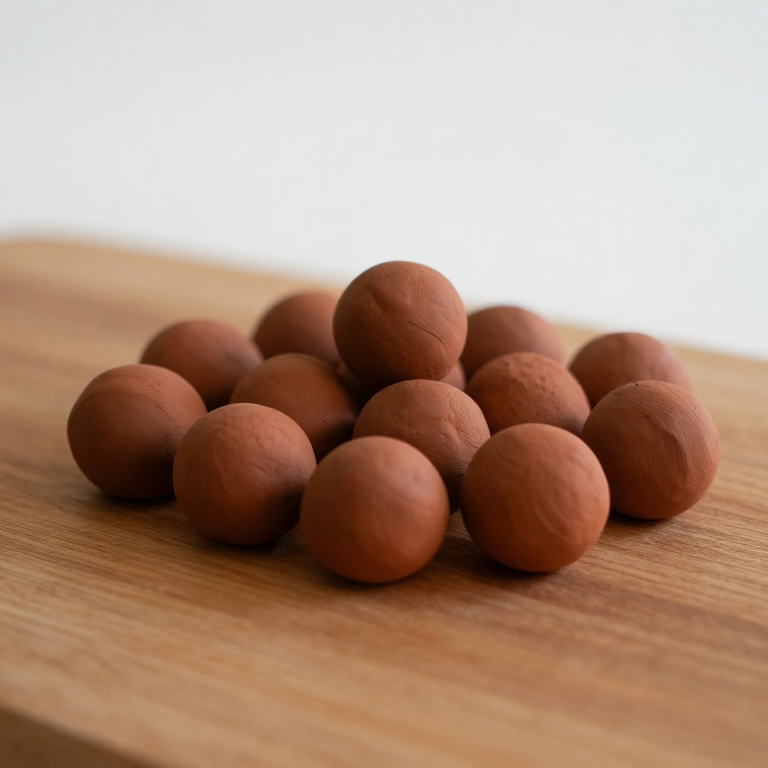
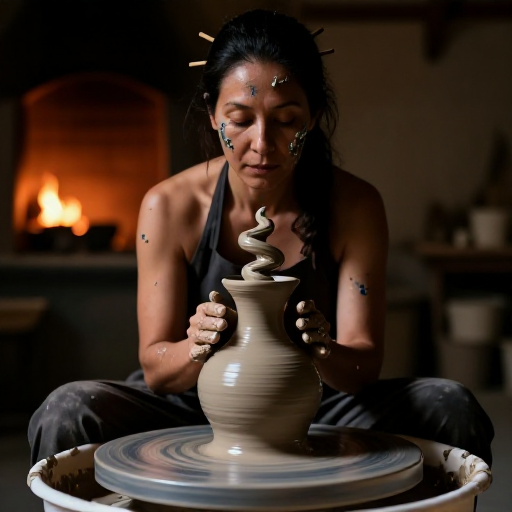

Clay Marbles
The cheapest toy in the ancient world, and one of the hardest small things to make well. A marble has to be round — not roughly round, actually round — or it will not run true, and a marble that curves is no use in a game decided by aim.
Rolling a ball between two palms gets you close and then stops. The trick that gets the rest of the way is rolling the ball between two flat boards: the ball turns on a constantly changing axis, so every high spot is knocked down in turn and the shape converges on a sphere on its own.
Fire them hard. An underfired marble chips on the first collision, and marbles exist to be collided.
Інструкції
Wedge the clay thoroughly
Wedge the clay thoroughly
Wedge a fist of clay until it is uniform, and cut it through with a wire to check for air pockets. An air bubble in a solid ball is the classic reason a piece bursts in the kiln.
Матеріали для цього кроку:
 Глина1 кг
Cut equal pieces
Cut equal pieces
Roll a coil about 16 mm thick and cut it into equal lengths. Equal blanks give equal marbles, which matters in a game where they are matched against each other.
Weigh a few blanks
Weigh a few blanks
Weigh five blanks and check they are within a gram of each other. Adjust the coil thickness rather than trying to fix it later.
Необхідні інструменти ({count})
 Цифрові ваги
Round each blank between the palms
Round each blank between the palms
Roll each piece between your palms in circles until it is roughly spherical. This gets you to about ninety per cent and no further — palms are not flat and they follow the shape they are given.
Finish between two flat boards
Finish between two flat boards
Put the ball between two flat boards and move the top one in circles with light pressure. The ball rolls on a constantly changing axis, so every high point gets flattened in turn and the shape converges on a true sphere. This is the whole technique.
Test the roundness by rolling
Test the roundness by rolling
Roll each marble down a sloping board. A true one runs straight; an untrue one veers, every time, in the same direction. Fix it now while it is soft.
Decorate before drying if you want
Decorate before drying if you want
Roll a marble lightly on a textured surface, or press in a spiral of coloured slip. Keep the surface smooth — a raised decoration wears off in play and unbalances the ball.
Dry slowly and turn them
Dry slowly and turn them
Dry the marbles on a rack for several days, turning them daily. A ball drying on one spot dries unevenly there and comes out slightly flat on that side.
Check them bone dry before firing
Check them bone dry before firing
Hold one to your cheek. If it feels cool, it still holds water. A solid ball with water still in it can explode in the kiln and damage everything around it.
Fire them in a shallow dish
Fire them in a shallow dish
Fire the marbles sitting in a shallow bisque dish or on a bed of sand so they cannot roll off the shelf. Loose spheres on a flat shelf move as the kiln heats.
Fire hot enough to be tough
Fire hot enough to be tough
Fire to the top of your clay's range rather than a low bisque. Marbles are struck against each other constantly, and a soft-fired marble chips on the first good hit.
Test one to destruction
Test one to destruction
Take one marble and knock it hard against another, repeatedly, until something chips. Knowing what your marbles survive is worth losing one to find out.
Match them into a playing set
Match them into a playing set
Sort the finished marbles by diameter with a caliper and keep the matched ones together. Mixed sizes make an unfair game — a bigger marble knocks a smaller one out of a ring more easily.
Необхідні інструменти ({count})
 Лінійка
Mark a ring and play
Mark a ring and play
Draw a circle about a metre across, put the target marbles inside it and flick your shooter from outside the line. Marbles knocked out are won. The rules vary everywhere; the ring is the constant.
History & Context
History & Context
Everywhere, and very old. Small clay and stone balls turn up on archaeological sites across the world, from the ancient Near East through Egypt, Greece and Rome and on into the medieval and early modern periods. Clay is the obvious material: it is free, it needs no lathe, and the firing that makes a pot makes a marble at the same time.
The interpretation problem. A small fired clay ball is not necessarily a toy. Excavated spheres have been read as gaming pieces, sling shot, counting tokens, loom weight blanks and pot-making waste. Without a context that shows how they were used — found in a group by a hearth, or with a board, or in a child's grave — the object alone does not settle it. Any confident claim that a particular find is a marble deserves a second look.
Why the two-board trick works. Rolling a ball between two flat surfaces means it cannot keep the same axis of rotation for long. Whatever point is highest gets pressed down as it comes round, and repeating that thousands of times drives the shape toward a sphere without anybody having to measure anything. The same principle is used industrially: ball bearings are finished by lapping balls between rotating grooved plates.
Then glass and industry. Marbles were made in stone and clay by hand for millennia. German glassmakers made them individually with marble scissors in the nineteenth century, and around 1900 American machine production made cheap glass marbles universal — which is when the clay marble, along with hand-made everything else, stopped being the ordinary thing and became the historic one.
Пов'язані креслення
Ці креслення діляться знаннями — техніки, матеріали або принципи
CC0 Суспільне надбання
Це креслення випущено під ліцензією CC0. Ви можете вільно копіювати, змінювати, поширювати та використовувати цю роботу для будь-яких цілей без запиту дозволу.
Підтримайте мейкера, купуючи продукти через його креслення, де він отримує Комісію мейкера встановлену вендорами, або створіть нову ітерацію цього креслення та включіть його як зв'язок у власне креслення для розподілу доходу.