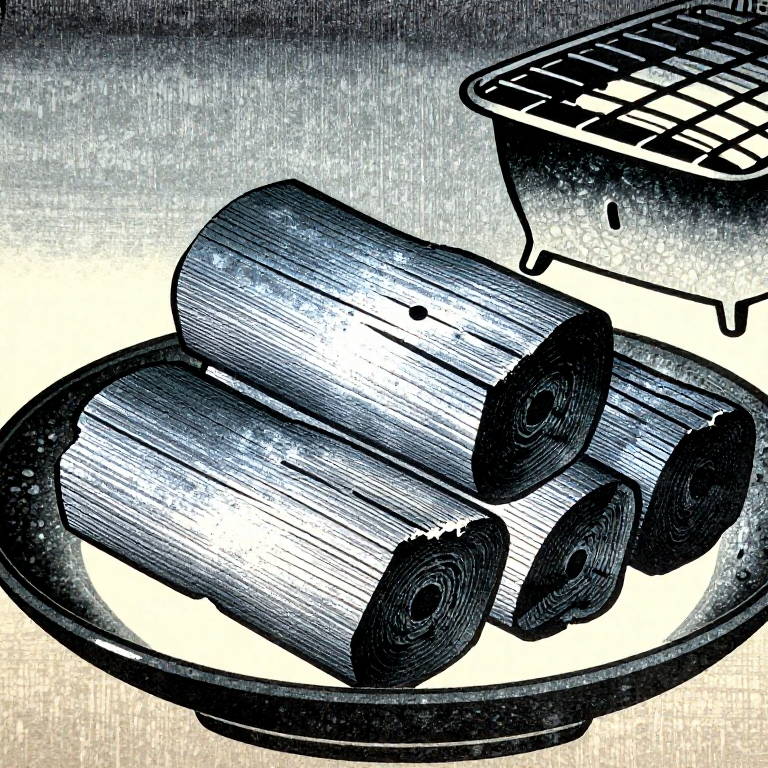


Making Binchotan White Charcoal in a Kiln — Japanese Activated Charcoal
Інструкції
Load and Seal the Kiln
Load and Seal the Kiln
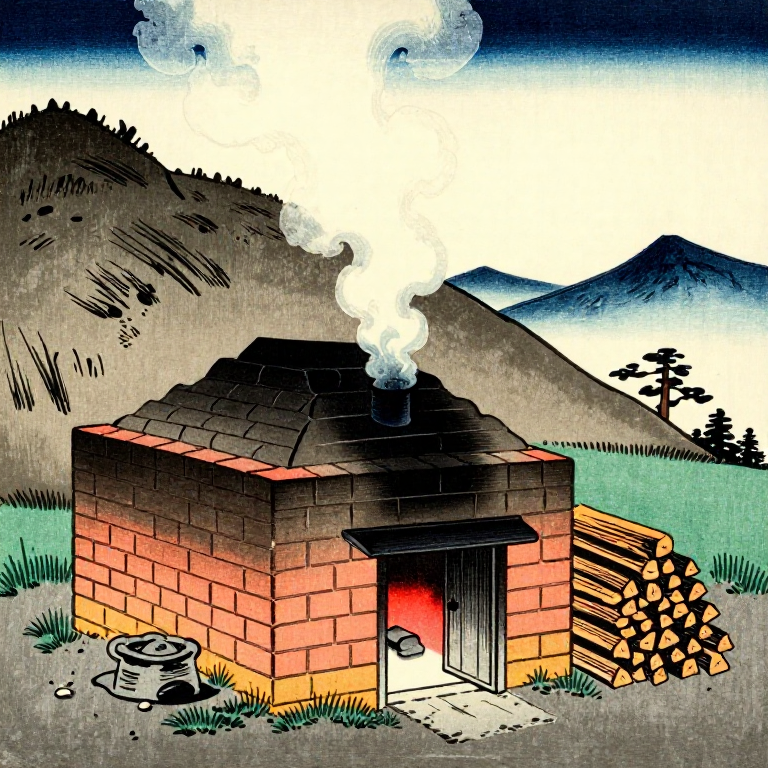
Stack split hardwood logs vertically inside the kiln, packing them tightly with minimal air gaps. The logs should be uniformly sized (approximately 5-8cm diameter) and seasoned for at least 6 months. Ubame oak is the traditional wood because of its extreme density (specific gravity approximately 0.9), which produces charcoal dense enough to sink in water. Stack a small amount of kindling at the kiln entrance for ignition. Seal the kiln door with bricks and clay mortar, leaving only the primary air inlet at the bottom and the flue vent at the top open. The kiln is essentially a sealed chamber where the oxygen supply can be precisely controlled.
Матеріали для цього кроку:
 Дрова50-100 kg of split logs кг
 Відрізок ясеневої колоди30-50 kg кг
 Сухе листя та розпалas needed штука
Необхідні інструменти ({count})
 Деревне вугілля, подрібнене
 Залізні граблі
 Лопата
 Термостійкі рукавиці
Carbonize at Low Temperature
Carbonize at Low Temperature
Light the kindling and begin the carbonization process. For the first 2-3 days, the kiln runs at relatively low temperature (300-500 degrees C) as moisture is driven off and volatile compounds are released. Thick white smoke exits the flue — this is mostly water vapour and tars. Control the burn rate by adjusting the air inlet: more air speeds the process but risks uneven carbonization. The smoke changes from white (wet) to blue-grey (dry) as the moisture phase ends. This slow, controlled phase ensures the wood carbonizes uniformly rather than burning to ash. Monitor the smoke colour, volume, and smell continuously — sudden changes indicate problems requiring air adjustment.
Raise to Extreme Temperature
Raise to Extreme Temperature
After 3-4 days when the smoke becomes thin and nearly transparent (indicating carbonization is nearly complete), fully open the air inlets to raise the kiln temperature to 1000-1200 degrees C. This extreme heat is what distinguishes binchotan from regular charcoal (which is carbonized at 400-700 degrees C). At these temperatures, residual tars and volatile compounds are burned away, and the carbon structure reorganizes into a more ordered, harder form. The kiln interior glows white-hot. This high-temperature phase lasts 12-24 hours. The charcoal inside transitions from dull black to incandescent, and the exit smoke is nearly invisible — just heat shimmer.
Extract and Smother the Charcoal
Extract and Smother the Charcoal
This is the critical step that makes binchotan unique. Using a long iron rake, rapidly pull the glowing white-hot charcoal pieces out of the kiln and immediately bury them in a pre-prepared bed of fine ash and sand mixture (called suna-keshi). The ash mixture cuts off oxygen instantly, stopping combustion while the charcoal is still at extreme temperature. This rapid cooling under exclusion of air produces the characteristic silvery-white ash coating on the charcoal surface (hence the name white charcoal or shiro-zumi). Ordinary charcoal is cooled slowly inside a sealed kiln (black charcoal or kuro-zumi) — the rapid extraction and smothering is what gives binchotan its distinctive properties.
Grade and Test the Binchotan
Grade and Test the Binchotan
Allow the smothered charcoal to cool completely in the ash bed (several hours). Brush off the loose ash to reveal the metallic grey surface. High-quality binchotan has several distinctive properties: it rings with a clear, metallic sound when two pieces are struck together (similar to clinking porcelain); it is dense enough to sink in water; the fracture surface shows a glassy, conchoidal break rather than a fibrous wood structure; and it is hard enough to scratch glass. Binchotan burns at a lower temperature than black charcoal but maintains steady heat for hours without smoke, odour, or flare-ups, making it ideal for grilling delicate foods like yakitori and unagi. It also adsorbs impurities from water due to its microporous structure, acting as a natural water filter.
Матеріали
5- 50-100 kg of split logs кгЗаповнювач
- 30-50 kg кгЗаповнювач
- as needed штукаЗаповнювач
- 50-100 kg of split logs штукаЗаповнювач
- as needed штукаЗаповнювач
Необхідні інструменти
7- Заповнювач
- Заповнювач
- Заповнювач
- Заповнювач
- Заповнювач
- Заповнювач
- Заповнювач
CC0 Суспільне надбання
Це креслення випущено під ліцензією CC0. Ви можете вільно копіювати, змінювати, поширювати та використовувати цю роботу для будь-яких цілей без запиту дозволу.
Підтримайте мейкера, купуючи продукти через його креслення, де він отримує Комісію мейкера встановлену вендорами, або створіть нову ітерацію цього креслення та включіть його як зв'язок у власне креслення для розподілу доходу.