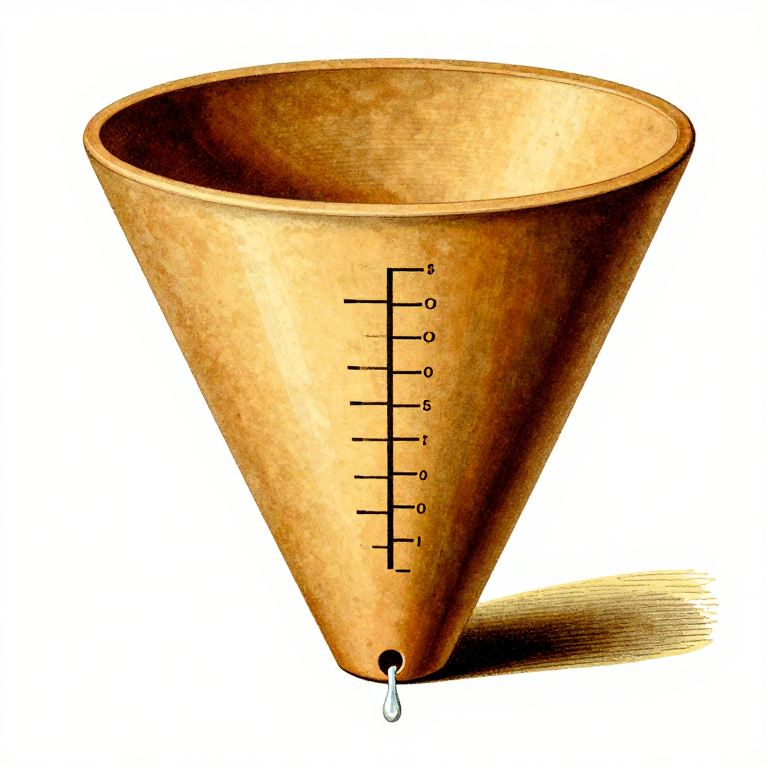


Egyptian Water Clock — Constructing a Simple Water Clock (Clepsydra)
Інструкції
Select and Prepare the Vessel
Select and Prepare the Vessel
Choose a ceramic or clay vessel approximately 20-30 cm tall with a wide mouth. Ideally, the vessel should be slightly conical (wider at the top than the bottom), which helps compensate for the decreasing flow rate as the water level drops — a wider top means more water volume per unit of height at higher levels, partially offsetting the slower flow caused by lower pressure head. The famous Karnak clepsydra (now in the Cairo Museum) is a truncated cone carved from alabaster, approximately 35 cm tall with interior hour markings. Ensure the vessel is watertight — repair any cracks with beeswax or clay slip. The interior surface should be smooth so water level markings can be clearly seen.
Матеріали для цього кроку:
 Глина1 штука
 Мідь1, approx 3-5 mm inner diameter mm
 Водостійкий герметикsmall amount штука
 Водаsufficient to fill the vessel штука
Необхідні інструменти ({count})
 Ручний дриль
 Лінійка
 Алмазна креслярка
 Секундомір
Create the Drain Hole
Create the Drain Hole
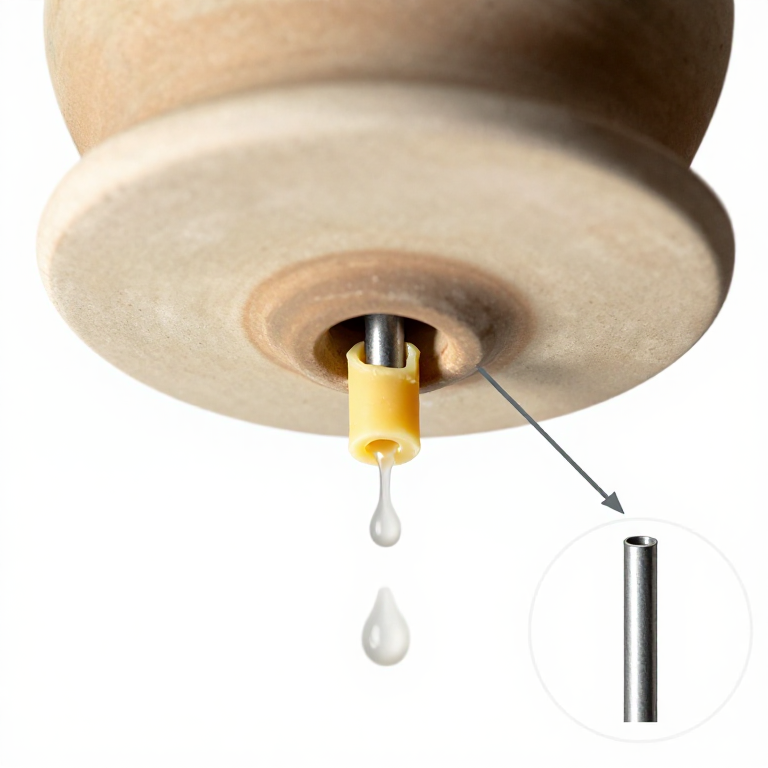
Carefully drill a small hole (approximately 3-5 mm diameter) in the center of the vessel's base. The hole size is critical — too large and the water drains too quickly; too small and the water barely flows, with surface tension potentially blocking the outlet entirely. Insert a small metal or ceramic tube into the hole and seal around it with beeswax to prevent leaking around the edges. The drain rate depends on the hole diameter, the water head (height of water above the hole), and the viscosity of the water. Torricelli's law states that the outflow velocity equals the square root of 2gh, where g is gravitational acceleration and h is the water height — meaning the flow rate decreases as the vessel empties, which is the primary source of timekeeping error in outflow clepsydras.
Calibrate the Time Markings
Calibrate the Time Markings
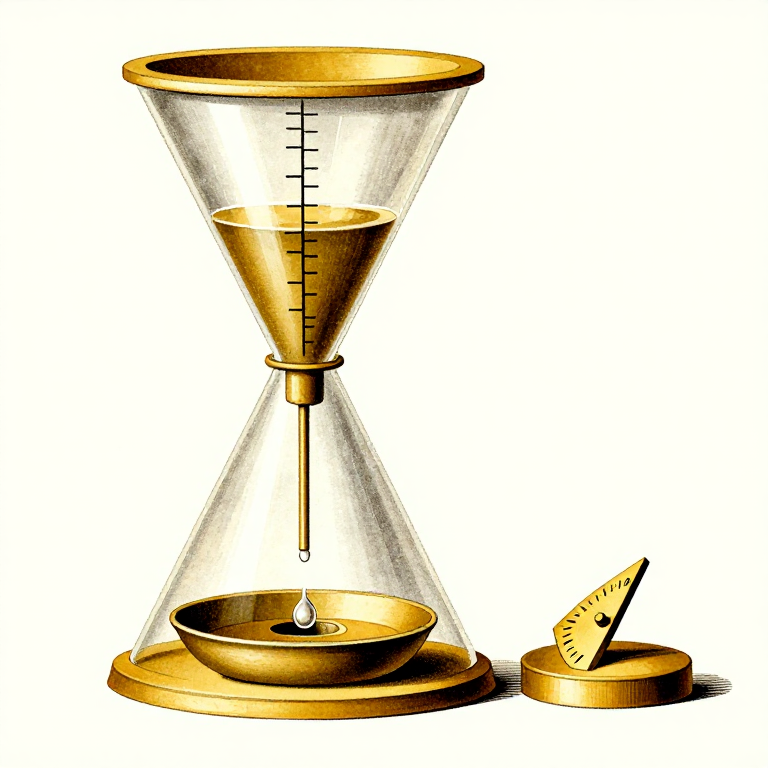
Fill the vessel to the brim with water and use a reference clock to mark the water level at regular intervals (for example, every 15 or 30 minutes). Mark each level on the interior wall with a scriber, waterproof paint, or small pegs. Because the flow rate decreases as the water level falls (due to reduced hydrostatic pressure), the markings will NOT be equally spaced — they will be closer together at the bottom of the vessel, where the water drains more slowly. This non-linear spacing is exactly what appears on the Karnak clepsydra and is the empirical Egyptian solution to the variable-rate drainage problem. For the most practical clock, calibrate for the number of hours you wish to measure in a single fill.
Account for Seasonal Hour Variations
Account for Seasonal Hour Variations
Ancient Egyptians divided both day and night into 12 hours each, but since day and night lengths change with the seasons, their hours were not fixed — summer daylight hours were longer than winter ones. The Karnak clepsydra has 12 different sets of hour markings on its interior, one for each month of the year, reflecting the changing hour lengths throughout the seasons. For a simplified clock, a single set of equal-interval markings suffices. If creating a historically accurate replica, research the latitude-dependent day/night length ratios for each month and create separate graduation scales. This seasonal adjustment represents a sophisticated astronomical awareness by the ancient Egyptians, linking timekeeping to celestial observation.
Test and Refine the Water Clock
Test and Refine the Water Clock
Fill the vessel completely and allow it to drain while comparing the water level against the calibration marks using a reference clock. If the markings are not accurate, adjust them or modify the drain hole size. Factors that affect accuracy include water temperature (which affects viscosity — cold water flows more slowly than warm), algae or mineral deposits partially clogging the drain hole over time, and evaporation in hot, dry climates. Clean the drain hole regularly and use fresh water for best accuracy. Despite these limitations, Egyptian water clocks could achieve accuracy within 15-20 minutes over a 12-hour period, sufficient for scheduling temple rituals, work shifts, and astronomical observations. The clepsydra remained the primary timekeeping instrument throughout the ancient Mediterranean world until the development of mechanical clocks in medieval Europe.
Матеріали
6- 1 штукаЗаповнювач
- 1, approx 3-5 mm inner diameter mmЗаповнювач
- sufficient to fill the vessel штукаЗаповнювач
- 1, approx 3-5 mm inner diameter штукаЗаповнювач
- small amount штукаЗаповнювач
- 1 штукаЗаповнювач
Необхідні інструменти
6- Заповнювач
- Заповнювач
- Заповнювач
- Заповнювач
- Заповнювач
- Заповнювач
CC0 Суспільне надбання
Це креслення випущено під ліцензією CC0. Ви можете вільно копіювати, змінювати, поширювати та використовувати цю роботу для будь-яких цілей без запиту дозволу.
Підтримайте мейкера, купуючи продукти через його креслення, де він отримує Комісію мейкера встановлену вендорами, або створіть нову ітерацію цього креслення та включіть його як зв'язок у власне креслення для розподілу доходу.