МИСТЕЦТВО
КРАСА ТА ЗДОРОВ'Я
РЕМЕСЛО
КУЛЬТУРА ТА ІСТОРІЯ
РОЗВАГИ
СЕРЕДОВИЩЕ
ЇЖА ТА НАПІЇ
ЗЕЛЕНЕ МАЙБУТНЄ
ЗБОРНА ІНЖЕНЕРІЯ
НАУК
СПОРТ
ТЕХНОЛОГІЯ
НОСИМО
Extracting Silver by Cupellation — Separating Noble Metal from Lead Ore
Peter

Створено

Peter

01. травень 2026SE
0
0
0
0
0

Extracting Silver by Cupellation — Separating Noble Metal from Lead Ore

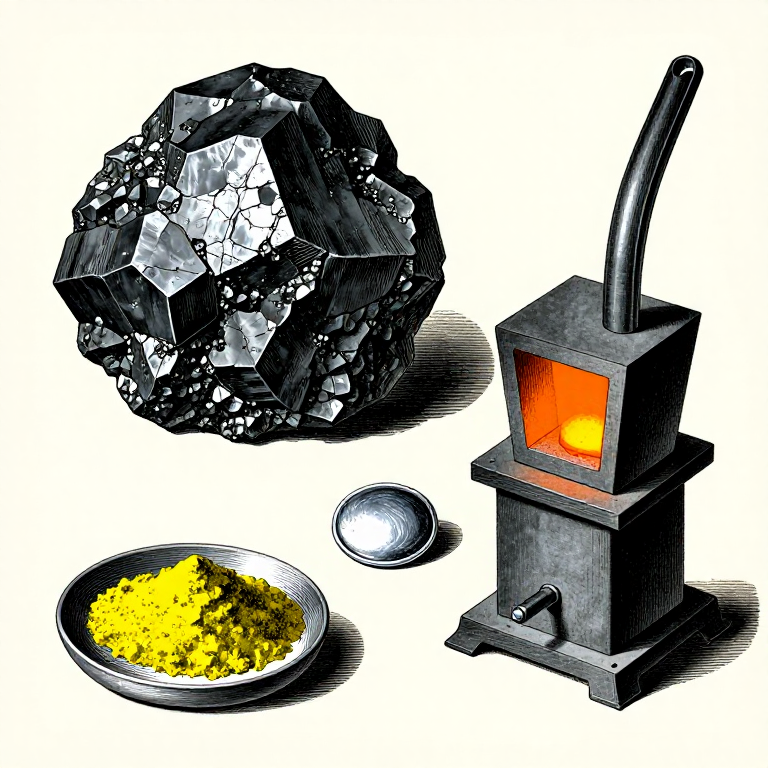
Silver (Ag, element 47, from Latin argentum) has been prized since at least 4000 BCE. Unlike gold, silver rarely occurs as a native metal in useful quantities. The vast majority of ancient silver was extracted from galena (lead sulfide, PbS), which typically contains 0.1–1% silver as a substitutional impurity in the crystal lattice. The process of separating silver from lead is called cupellation — one of the oldest metallurgical techniques, practiced in Anatolia by 3000 BCE and perfected by the Laurion mines near Athens, whose silver funded the Athenian navy that defeated Persia at Salamis in 480 BCE.

Cupellation exploits the different oxidation behaviors of lead and silver. When a lead-silver alloy is heated to approximately 1000 °C in an open, shallow dish called a cupel (made from bone ash or compressed calcium phosphite), air oxidizes the lead to litharge (PbO), a yellow liquid that is absorbed into the porous cupel or skimmed off. Silver, being a noble metal, does not oxidize under these conditions and remains as a molten bead — pure, bright, and gleaming — sitting on the cupel surface.

HAZARD: Lead is a cumulative neurotoxin. Lead fumes and lead oxide dust cause irreversible neurological damage, kidney failure, and anemia. All lead work must be performed outdoors with respiratory protection and lead-rated gloves. Never eat, drink, or smoke near lead operations. All equipment that contacts lead is permanently contaminated.

This blueprint assumes you have already smelted lead from galena using the process described in Peter's 'Extracting Lead from Galena' blueprint. The crude lead ingot produced there is the starting material for cupellation.

Просунутий
4-6 hours

Інструкції

1

Understand silver chemistry and cupellation principles

Silver (Ag, element 47) is a transition metal with a density of 10.49 g/cm³, a melting point of 961.78 °C, and the highest electrical and thermal conductivity of any element. It is a noble metal — meaning it resists oxidation in air at moderate temperatures — but it is less noble than gold: silver tarnishes in sulfur-bearing atmospheres, forming silver sulfide (Ag₂S, black tarnish).

Cupellation works because lead and silver behave differently when heated in air at approximately 1000 °C. Lead oxidizes readily: 2Pb + O₂ → 2PbO (litharge). PbO has a melting point of 888 °C, so at 1000 °C it is a yellow liquid that either absorbs into the porous bone-ash cupel or flows to the rim. Silver, however, does not oxidize under these conditions — its oxide (Ag₂O) is thermodynamically unstable above approximately 230 °C and decomposes back to metal. So the lead is progressively removed as PbO while pure silver remains.

CRITICAL SAFETY: Lead fumes are a severe cumulative neurotoxin causing irreversible brain damage. All work must be done outdoors with adequate ventilation. Wear a respirator rated for lead fumes (P100 minimum), lead-rated gloves, and eye protection. Wash hands and face thoroughly after any lead contact. Never bring lead-contaminated clothing indoors.

2

Understand the history of cupellation

Cupellation is among the earliest examples of applied chemistry. The process was developed in Anatolia (modern Turkey) around 3000 BCE, where metalworkers discovered that heating argentiferous lead in an oxidizing environment caused the lead to vanish, leaving behind a bright bead of silver. The earliest known cupellation furnaces were found at Habuba Kabira in Syria and date to approximately 3500 BCE.

The technology reached its peak in classical antiquity at the Laurion mines near Athens, where massive cupellation operations produced the silver that financed the Athenian empire. The Romans later industrialized the process across their empire, from Spain (Rio Tinto) to Britain (Mendip Hills). Medieval assayers refined the technique for precisely determining the silver content of ores and coinage — the word 'assay' itself derives from the French essai, meaning 'test.'

The same basic principle is still used today in fire assaying — the standard laboratory method for determining precious metal content in ore samples. Despite thousands of years of advancement, no better method exists for separating silver from lead at small scale.

3

Prepare the cupel from bone ash

A cupel is a small, shallow, porous dish that absorbs molten lead oxide during cupellation. Traditional cupels are made from bone ash — calcined animal bone ground to a fine powder. Bone ash is approximately 80% calcium phosphate (Ca₃(PO₄)₂) with residual calcium carbonate. Its porosity allows it to absorb litharge like a sponge while remaining structurally intact at temperatures up to approximately 1100 °C.

To make a cupel: obtain clean, dry, calcined bone meal (available from ceramic suppliers or prepared by calcining clean animal bones at 700–800 °C until white). Mix the bone ash with approximately 5% water by weight to form a barely damp powder. Pack this firmly into a mold — a shallow cup shape approximately 5 cm in diameter and 2 cm deep works well. A section of pipe pressed into a flat surface makes an adequate mold. Press hard to compact the ash — insufficient compaction results in a cupel that crumbles during heating.

Allow the cupel to dry completely at room temperature for at least 24 hours, then fire it gently in a kiln or over coals to remove residual moisture. The finished cupel should be hard, white, and slightly porous to the touch.

Матеріали для цього кроку:

Bone Ash (calcium phosphite powder)Bone Ash (calcium phosphite powder)200 grams
Clean WaterClean Water50 мл

Необхідні інструменти ({count})

Mortar and PestleMortar and Pestle
Cupel Mold (pipe section)Cupel Mold (pipe section)
4

Obtain argentiferous lead (silver-bearing lead)

The starting material for cupellation is lead that contains dissolved silver. In historical practice, this was crude lead smelted from galena (PbS) ore — most galena naturally contains between 0.01% and 1% silver by weight, with exceptionally rich ores reaching 2–3%. Peter's 'Extracting Lead from Galena' blueprint produces this crude lead.

The silver content of galena varies enormously by deposit. Argentiferous galena typically forms in hydrothermal vein deposits associated with volcanic activity. Major historical silver-producing galena deposits include Laurion (Greece), Potosí (Bolivia), Freiberg (Germany), and Broken Hill (Australia). If your galena source is unknown, assume low silver content — significant silver recovery requires processing substantial quantities of lead.

For learning the cupellation technique, you can simulate argentiferous lead by melting clean lead and stirring in a small amount of silver (e.g., a piece of sterling silver jewelry — 92.5% Ag). This ensures visible silver recovery and teaches the technique before committing to processing uncertain ore.

Матеріали для цього кроку:

Crude Lead Ingot (from galena smelting)Crude Lead Ingot (from galena smelting)500 grams
5

Set up the cupellation furnace outdoors

Cupellation requires sustained temperatures of approximately 960–1050 °C with continuous air flow across the molten lead surface. A small charcoal furnace with a forced-air supply (bellows or electric blower) is adequate. The cupel sits inside the furnace on a stable, flat, refractory surface.

Build or position the furnace outdoors in a well-ventilated area, upwind of people and animals. Lead fumes rise vertically, so work in an open space with no overhead shelter that could trap fumes. The work area must be on a non-flammable surface (bare earth, concrete, or firebrick) with no combustible materials within 3 meters.

Position the bellows or blower to direct air across the top of the cupel at a low angle — the air must contact the molten lead surface to oxidize it, but too much direct blast will chill the metal or splash it. The optimal air flow is a gentle, steady breeze across the cupel surface, not a concentrated jet.

Матеріали для цього кроку:

Charcoal (hardwood lump)Charcoal (hardwood lump)5 кг

Необхідні інструменти ({count})

Charcoal Furnace (small)Charcoal Furnace (small)
Bellows (hand-operated)Bellows (hand-operated)
FirebrickFirebrick
6

Don full protective equipment

MANDATORY BEFORE HEATING ANY LEAD. Put on: a respirator rated for lead fumes and particulates (P100 filter minimum; a full-face respirator with combination organic vapor/P100 cartridges is strongly recommended), heat-resistant leather gauntlet gloves over nitrile inner gloves (double protection against both heat and lead contact), safety goggles or face shield rated for splash protection, a long-sleeved cotton or leather apron, and closed-toe boots.

Lead oxide (litharge) is a fine yellow powder that contaminates surfaces and becomes airborne easily. Once on skin or clothing, it is difficult to remove completely. Designate the cupellation work area as a contaminated zone — do not eat, drink, or touch your face while working. Keep a dedicated pair of shoes for lead work that never enters your living space.

Have a bucket of clean water nearby for cooling tongs and for emergency splash treatment. Lead at cupellation temperatures (approximately 1000 °C) causes instant, severe burns on contact with skin.

Необхідні інструменти ({count})

P100 RespiratorP100 Respirator
Leather Gauntlet GlovesLeather Gauntlet Gloves
Safety GogglesSafety Goggles
Leather ApronLeather Apron
7

Pre-heat the cupel in the furnace

Place the dry bone-ash cupel into the furnace and heat it gradually to operating temperature (approximately 950–1000 °C). Rapid heating can crack the cupel due to thermal shock or steam expansion from residual moisture. Raise the temperature over 20–30 minutes, starting with a small fire and gradually increasing the charcoal bed and air supply.

The cupel will glow dull orange at approximately 900 °C and bright orange at 1000 °C. At this temperature, the bone ash is sintered but still porous — it will readily absorb molten litharge. If the cupel cracks during pre-heating, remove it carefully with tongs and use a replacement. A cracked cupel cannot absorb litharge evenly and may leak molten lead.

While the cupel heats, ensure the furnace maintains a stable temperature. Add charcoal as needed and maintain a steady, gentle air flow. The temperature must remain above silver's melting point (961.78 °C) throughout the entire cupellation process.

Необхідні інструменти ({count})

Crucible Tongs (long-handled)Crucible Tongs (long-handled)
8

Place the lead charge onto the hot cupel

Using long-handled tongs, carefully place the crude lead ingot onto the center of the glowing cupel. The lead (melting point 327.46 °C) will melt almost immediately on contact with the 1000 °C surface, spreading into a flat, shimmering pool. If the ingot is too large for one cupel, cut or break it into smaller pieces and process in batches.

As soon as the lead melts, you will observe the surface begin to change. Oxidation starts immediately: the bright metallic surface develops a yellowish film of litharge (PbO). With steady air flow, this film continuously forms and is absorbed into the porous cupel beneath, exposing fresh lead surface for further oxidation.

The process is self-regulating within limits: the exothermic oxidation of lead to litharge releases heat (the reaction 2Pb + O₂ → 2PbO releases 219 kJ/mol), which helps maintain the temperature. However, you must monitor the furnace to keep it in the correct range — too hot and the litharge evaporates as toxic fumes rather than absorbing; too cold and the lead solidifies.

Необхідні інструменти ({count})

Crucible Tongs (long-handled)Crucible Tongs (long-handled)
9

Maintain oxidizing conditions during cupellation

Cupellation is essentially controlled, slow oxidation of lead. Maintain steady, gentle air flow across the molten metal surface. The air provides the oxygen needed for the reaction. Without sufficient air, oxidation stalls and the process stops. With too much air, the temperature drops or the lead spatters.

Watch the surface of the molten pool. Active cupellation shows a continuously rippling, iridescent surface as litharge forms and flows toward the edges of the cupel. The litharge appears as a yellow-to-reddish liquid that migrates outward and absorbs into the bone ash, leaving a dark ring on the cupel that expands over time. This ring of absorbed litharge is called the litharge halo.

The process takes 30 minutes to several hours depending on the amount of lead. A 500-gram charge of lead will take approximately 2–3 hours to cupel completely. Do not rush it — maintain steady conditions and let the chemistry work. Add charcoal as needed to maintain temperature, but avoid placing charcoal directly over the cupel where falling ash could contaminate the silver.

Необхідні інструменти ({count})

Bellows (hand-operated)Bellows (hand-operated)
10

Watch for the 'brightening' — silver reveals itself

As the lead is progressively oxidized and absorbed, the volume of molten metal on the cupel steadily decreases. The pool shrinks from a wide disc to a small, trembling droplet. As the last traces of lead oxidize away, the remaining metal undergoes a dramatic transformation called brightening (also called blick in German assaying terminology).

The brightening is unmistakable: the dull, iridescent surface of the lead-silver alloy suddenly flashes to a brilliant, mirror-like silver surface as the last lead oxide clears. The bead appears to flash or pulse with light. This moment — observed and described identically by metallurgists for 5,000 years — signals that cupellation is complete. The remaining bead is essentially pure silver.

As soon as brightening occurs, reduce the air supply to prevent overheating the now-small silver bead. Silver at this temperature (above its melting point of 961.78 °C) absorbs oxygen from the air, which is released explosively on cooling ('spitting') — a phenomenon that can scatter tiny silver droplets. Reducing the air supply minimizes oxygen absorption.

11

Remove and cool the silver bead

Using long-handled tongs, carefully lift the cupel from the furnace and place it on a flat, fireproof surface to cool. Do not attempt to remove the silver bead while it is still molten — at these temperatures, molten silver will adhere to tongs and can splash. Let the cupel and silver cool naturally for 15–20 minutes until the silver solidifies and the cupel can be handled with gloves.

Once cool, the silver bead can be separated from the cupel by gently tapping the inverted cupel. The bead will be a small, rounded button with a bright metallic surface. The bottom of the bead (which contacted the cupel) may show a matte texture from the bone ash impression. The cupel itself will be discolored yellow-brown from absorbed litharge and is now saturated with lead oxide — it cannot be reused and must be disposed of as lead-contaminated waste.

The silver bead from cupelling 500 grams of galena-derived lead will typically weigh between 0.5 and 5 grams, depending on the ore's silver content. Even a tiny bead is a genuine achievement — you have performed one of humanity's oldest chemical separations.

Необхідні інструменти ({count})

Crucible Tongs (long-handled)Crucible Tongs (long-handled)
12

Assess purity and clean the silver

Silver produced by a single cupellation is typically 95–98% pure. The main impurity is residual lead (1–3%) that was not fully oxidized. Other trace metals that may survive cupellation include gold (which is even more noble than silver) and small amounts of bismuth and copper.

Visual assessment: pure silver has a brilliant white metallic luster, distinctly different from the bluish-grey of lead. If the bead appears grey or dull, it still contains significant lead and should be re-cupelled on a fresh cupel. Multiple cupellations can achieve purities above 99.5%.

The surface can be cleaned by briefly immersing the bead in dilute nitric acid (approximately 10% HNO₃), which dissolves any surface lead oxide or tarnish without attacking the silver significantly at low concentrations. Rinse in clean water and dry. Handle the silver bead with clean gloves — fingerprints will tarnish the surface through sulfide formation.

Необхідні інструменти ({count})

Hand Lens (10x)Hand Lens (10x)
Glass Sample Vial (50ml)Glass Sample Vial (50ml)
13

Dispose of lead-contaminated materials safely

All materials that contacted lead during this process are permanently contaminated and must be handled as hazardous waste. This includes: used cupels (saturated with lead oxide), any charcoal ash from the furnace area, gloves that contacted lead or litharge, tongs and tools used for handling lead, and clothing worn during the process.

Used cupels contain concentrated lead oxide and should be sealed in a labeled container and disposed of through your local hazardous waste facility. Do not dump them in regular trash, compost, or soil — lead does not degrade and will contaminate groundwater. In many jurisdictions, improper disposal of lead waste carries significant legal penalties.

Clean all tools thoroughly with soap and water after use. Wipe down surfaces in the work area with damp cloths (never sweep lead dust dry — it becomes airborne). Wash work clothes separately from household laundry using hot water and detergent. Shower thoroughly after any lead work session.

14

Document the result and understand historical context

Weigh the silver bead on a precision scale and record the weight alongside the weight of lead processed. The ratio (silver recovered ÷ lead processed × 100) gives the silver content of your lead as a percentage. For comparison, the galena from Laurion, which funded the Athenian golden age, contained approximately 0.1% silver — meaning 1 kilogram of lead yielded about 1 gram of silver. The richest historical ores (Potosí, Bolivia) reached 1–3%.

This ratio is exactly what ancient and medieval assayers measured when evaluating ore deposits and testing coin purity. The cupel assay was the gold standard (literally) for monetary verification for over 2,000 years. When a medieval mint master said a coin was '925 fine,' that number came from weighing a cupellation bead against the original sample — the same technique you have just performed.

Store the silver bead in a labeled specimen vial. Your silver was extracted from the earth using the same chemistry that built civilizations — from the drachma of Athens to the denarius of Rome to the Joachimsthaler of Bohemia (the origin of the word 'dollar').

Необхідні інструменти ({count})

Glass Sample Vial (50ml)Glass Sample Vial (50ml)

Матеріали

4

Необхідні інструменти

12

CC0 Суспільне надбання

Це креслення випущено під ліцензією CC0. Ви можете вільно копіювати, змінювати, поширювати та використовувати цю роботу для будь-яких цілей без запиту дозволу.

Підтримайте мейкера, купуючи продукти через його креслення, де він отримує Комісію мейкера встановлену вендорами, або створіть нову ітерацію цього креслення та включіть його як зв'язок у власне креслення для розподілу доходу.

Обговорення

(0)

Увійти щоб приєднатися до обговорення

Завантаження коментарів...