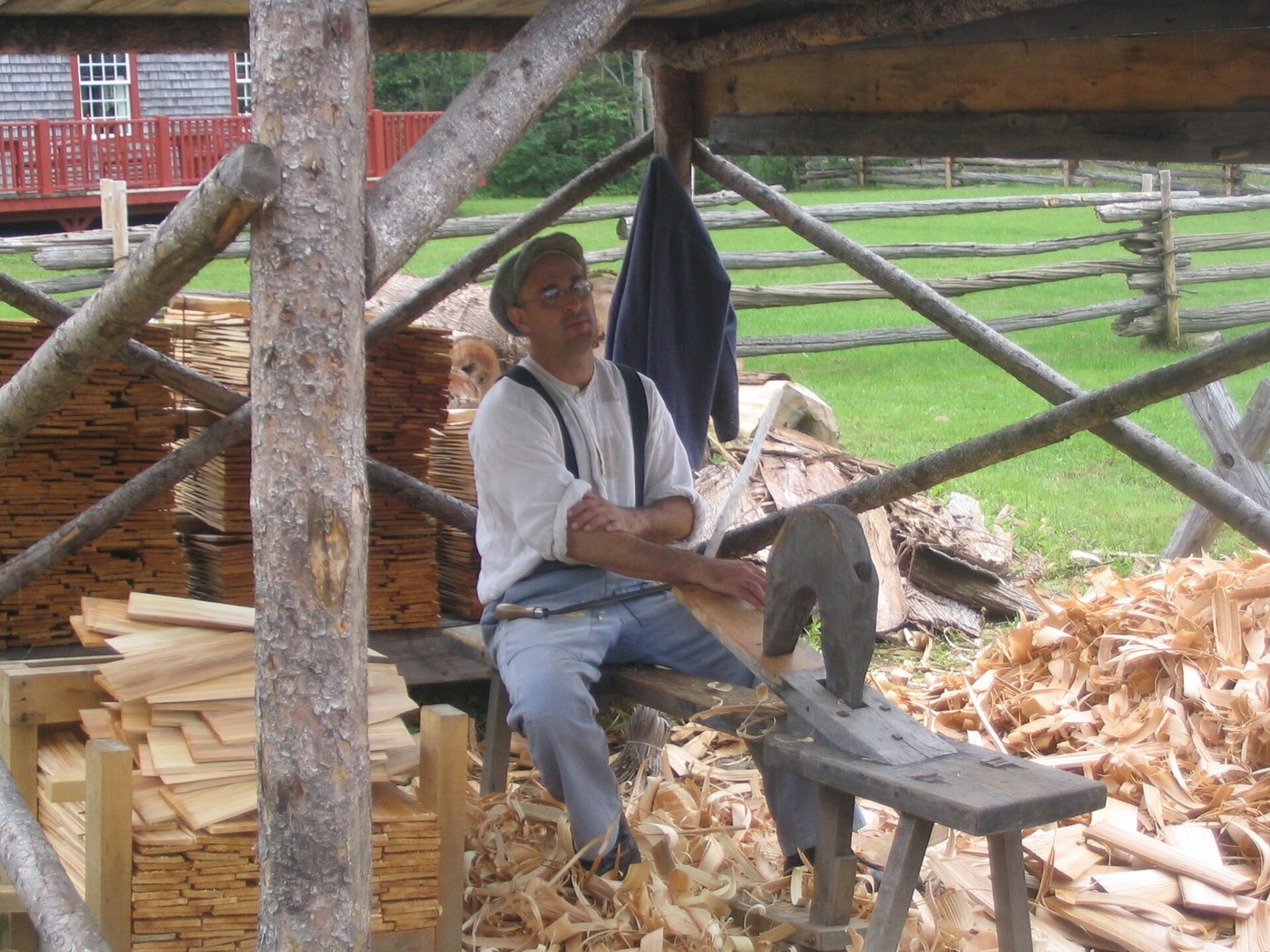


Froe and Riving
Інструкції
Split and saw the same log, then break both
Split and saw the same log, then break both
Prove the strength claim rather than repeating it.
- Split one piece from a straight-grained log with the froe.
- Saw a second piece to the same dimensions.
- Look along each for grain run-out, then break both across your knee or over a support.
Матеріали для цього кроку:
 Колун-фро (froe)1 штука
 Дошка з білого дуба1 board
Split in halves, never in slices
Split in halves, never in slices
The order of splitting decides whether you get even pieces.
- Split the log through the centre into halves.
- Split each half into halves again.
- Keep halving. Do NOT slice a piece off the side.
Матеріали для цього кроку:
 Різьбярська киянка1 штука
Steer a wandering split
Steer a wandering split
The froe is a lever, and that is how you correct a split that is running out.
- Start the froe with the club and stop striking once it is buried.
- Lever the handle to open the split ahead of the blade.
- If it starts running toward one side, lever harder on the THICKER side.
Rive shingles and test them
Rive shingles and test them
Make the classic riven product and see why it sheds water.
- Rive thin tapered boards from a straight-grained bolt.
- Look at the face — the split follows the annual rings.
- Stand one at a slope and pour water down it.
History and context
History and context
Riving is older than sawing for structural purposes and stayed dominant for anything that needed strength or weather resistance until powered sawmills made sawn timber cheap. Viking ships were built of riven oak planks, not sawn ones, which is a large part of why they could be so thin and so light and still work in the North Atlantic.
The whole coppice economy ran on it. Hazel, ash, chestnut and oak cut on rotation were riven green — which splits far more easily than seasoned wood — into hurdles, fence pales, barrel staves, basket splints, ladder rungs, chair parts and thatching spars. A bodger working in the woods could turn standing timber into chair legs without ever moving a log to a mill.
Barrel staves are the demanding case. A cask must hold liquid under pressure with no glue and no sealant, and it can only do that if every stave is riven so no fibre is cut through — a sawn stave leaks along the severed fibres. Coopering remains a riving trade for exactly this reason, and wine and whisky barrels are still made from split oak.
What it costs: yield. Riving follows the grain, so a twisted or knotty log gives very little usable material, and you cannot rive to a dimension — you rive and then trim to size with a drawknife. Sawing wins on yield and on using imperfect timber, which is precisely why it took over once power was cheap.
Матеріали
3- 1 штукаЗаповнювач
- 1 boardЗаповнювач
- 1 штукаЗаповнювач
Пов'язані креслення
Ці креслення діляться знаннями — техніки, матеріали або принципи
CC0 Суспільне надбання
Це креслення випущено під ліцензією CC0. Ви можете вільно копіювати, змінювати, поширювати та використовувати цю роботу для будь-яких цілей без запиту дозволу.
Підтримайте мейкера, купуючи продукти через його креслення, де він отримує Комісію мейкера встановлену вендорами, або створіть нову ітерацію цього креслення та включіть його як зв'язок у власне креслення для розподілу доходу.