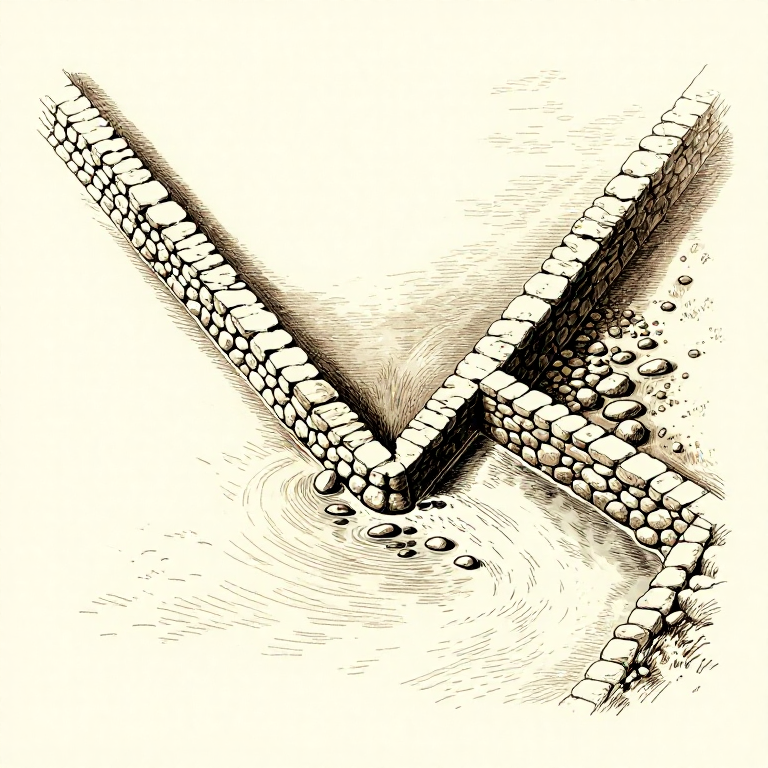


Constructing a Stone Fish Weir — River Channel Trap
Інструкції
Survey and Plan the Weir
Survey and Plan the Weir
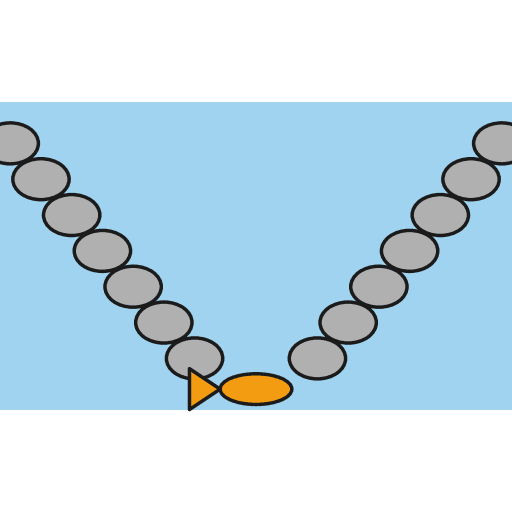
Choose a location where the river is shallow (knee-deep or less at normal flow), with a firm gravel or stone bottom. Tidal flats and river shallows near spawning runs are ideal. The weir will be V-shaped (or funnel-shaped) with the open end facing upstream and the narrow apex pointing downstream. The arms of the V should span most of the river width, leaving only the narrow apex opening as a passage for fish. Survey the riverbed at low water to plan the wall alignment. The apex should lead into a natural pool, a deepened area, or a constructed stone enclosure where fish collect.
Матеріали для цього кроку:
 Брук200+ штука
Необхідні інструменти ({count})
 Знаряддя для копання (камінь, ріг або палиця)
Build the Weir Walls
Build the Weir Walls
Start building at the apex (downstream point) and work outward along both arms of the V. Stack stones to form a wall 30-60 cm high — tall enough that fish cannot jump over, but low enough that the current flows through naturally. Larger stones form the base, with smaller stones filling gaps. The wall does not need to be watertight — water should flow through while fish are blocked. Angle each arm of the V at roughly 30-45 degrees from the centreline, creating a gradually narrowing funnel. At the apex, the opening should be just wide enough for one or two fish to pass through at a time — about 30-50 cm.
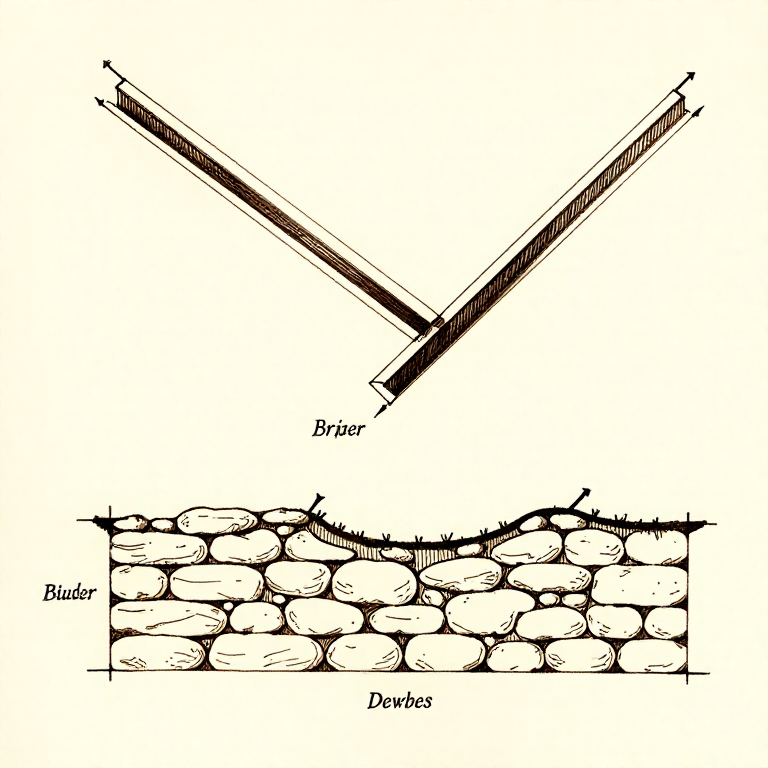
Матеріали для цього кроку:
Брук100+ штукаConstruct the Holding Pool
Construct the Holding Pool
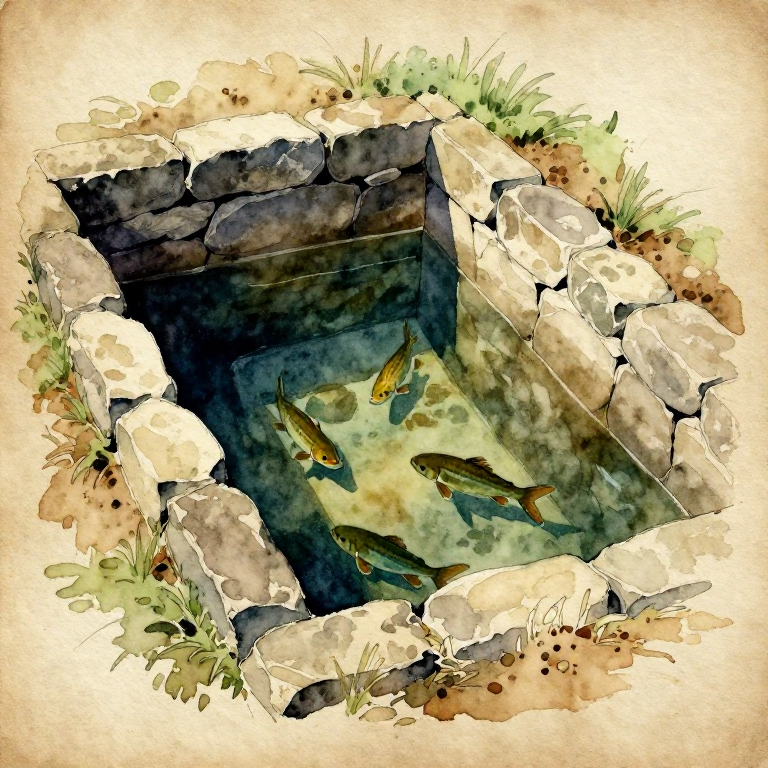
At the apex of the V, build a small stone enclosure or holding pool — a circular or rectangular pen approximately 1-2 metres across and deep enough that fish cannot easily escape. The entrance to the pool should be narrow and may include a short inward-angled passage that fish can swim into but have difficulty finding the exit (similar to the funnel entrance of a wicker trap). If a natural deep pool exists at the apex, simply wall off the downstream side to prevent fish from escaping once they pass through the apex opening.
Матеріали для цього кроку:
Брук50+ штукаAdjust for Water Conditions
Adjust for Water Conditions
Test the weir during normal water flow. Fish should be guided by the V-shaped walls toward the apex as they swim upstream. If fish find gaps to escape through, add more stones to close the openings. The weir walls should be high enough to remain effective during typical water levels but will be overtopped during flood events — this is normal and actually benefits the ecosystem by allowing unrestricted fish passage during high water. In tidal areas, the weir works on the falling tide: fish that entered the shallows at high tide are trapped behind the walls as the water recedes, collecting in the holding pool.
Harvesting and Maintenance
Harvesting and Maintenance
Check the holding pool daily, especially during fish migration runs. Fish can be removed by hand, with a net, or with a basket scoop. A well-placed weir on a productive river can yield dozens of fish per day during peak runs, far exceeding what a single fisher could catch with hook and line. Maintain the weir by replacing stones dislodged by floods and clearing debris (branches, leaves) that accumulates against the walls. Stone fish weirs are essentially permanent structures — the Budj Bim aquaculture system in Victoria, Australia, includes stone weirs and channels that have been continuously managed for at least 6,600 years, making it one of the oldest known aquaculture systems in the world.
Матеріали для цього кроку:
Брукas needed штукаМатеріали
3- 200+ штукаЗаповнювач
- several hundred, from fist-sized to head-sized штукаЗаповнювач
- 20-30 pieces штукаЗаповнювач
Необхідні інструменти
1За цим кресленням виготовляють
CC0 Суспільне надбання
Це креслення випущено під ліцензією CC0. Ви можете вільно копіювати, змінювати, поширювати та використовувати цю роботу для будь-яких цілей без запиту дозволу.
Підтримайте мейкера, купуючи продукти через його креслення, де він отримує Комісію мейкера встановлену вендорами, або створіть нову ітерацію цього креслення та включіть його як зв'язок у власне креслення для розподілу доходу.