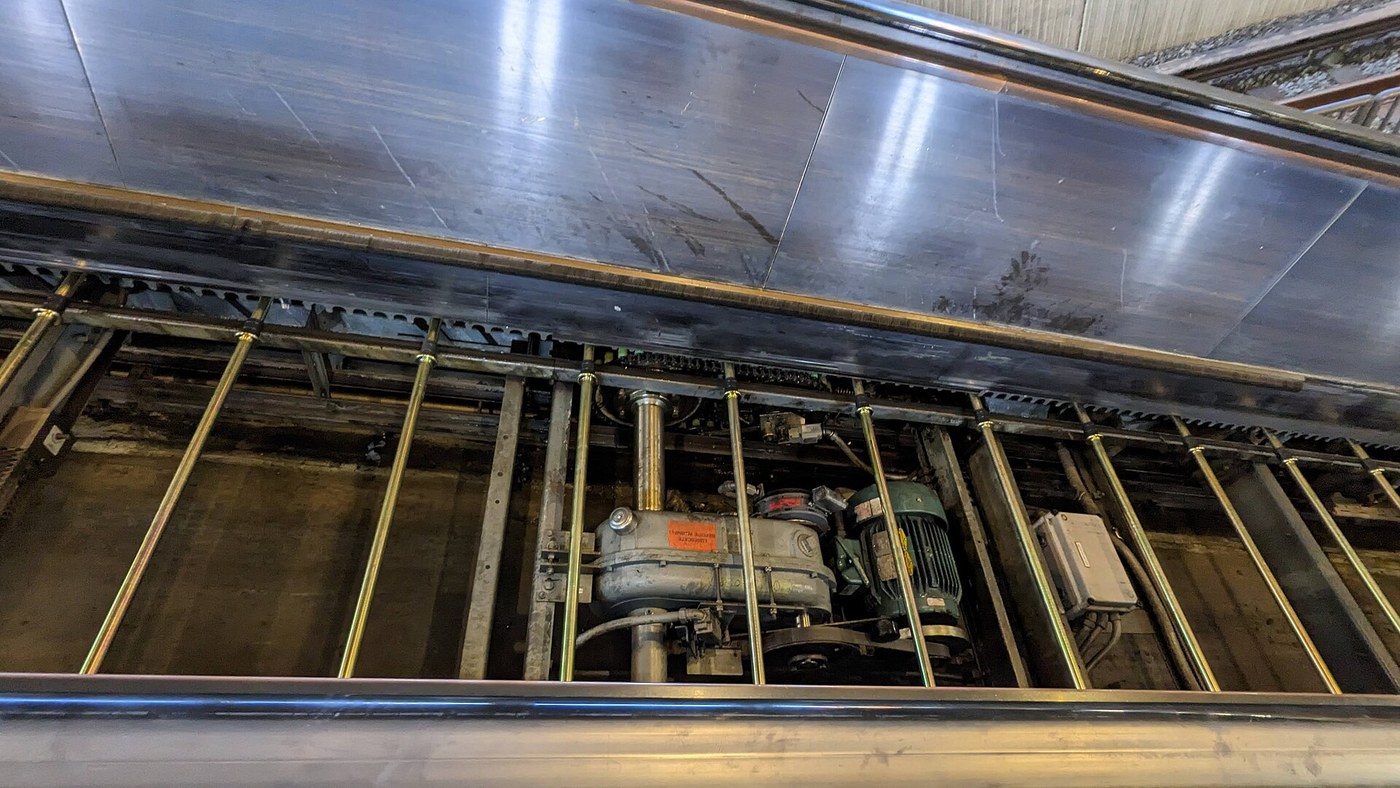


Reno Escalator
A lift carries a batch and then goes back empty. Half its working life is spent returning for the next load, and everybody waits. For a department store or a railway station that is the wrong machine entirely.
An escalator never goes back empty, because it never stops. It is a continuous belt: the loaded side climbs, the empty side returns underneath, and the two are the same loop. Throughput stops depending on how fast the machine travels and starts depending only on how densely people stand on it.
Jesse Reno's US Patent 470,918, "Endless Conveyor or Elevator", granted 15 March 1892, had no steps at all — it was a moving ramp with cleats, installed as a ride at Coney Island in 1896. The flat-topped step came from a different inventor, and the two designs merged into the machine we use.
Інструкції
Moving machinery with entry and exit points traps things
Moving machinery with entry and exit points traps things
Model at bench scale only, keep fingers away from the comb plates where the belt disappears, and fit a guard before running it.
Read US 470,918 and note the absence of steps
Read US 470,918 and note the absence of steps
Reno claims an endless conveyor — an inclined moving belt with cleats for grip. Flat horizontal steps are not in this patent.
Compare throughput on paper against a lift
Compare throughput on paper against a lift
Work out people per hour for a lift of capacity 10 with a 60-second round trip, then for a belt carrying one person per metre at half a metre per second. The gap is enormous.
Build a rigid inclined truss
Build a rigid inclined truss
Make a frame at about 30 degrees. It carries the whole load and any flex shows up as the chain jumping its sprockets.
Матеріали для цього кроку:
 Дошка з твердої деревини2 штук
Необхідні інструменти ({count})
 Ручна пилка
Fit sprockets top and bottom on a common chain loop
Fit sprockets top and bottom on a common chain loop
Run a chain around a driven sprocket at the top and an idler at the bottom. The loop is continuous — that is the whole architecture.
Матеріали для цього кроку:
 Роликовий ланцюг2 метрів
Tension the chain with an adjustable idler
Tension the chain with an adjustable idler
Make the bottom sprocket position adjustable. A slack chain climbs its sprocket teeth and skips under load, which is the classic failure.
Build Reno's version first: a cleated belt
Build Reno's version first: a cleated belt
Fit a continuous belt with transverse cleats. Run it and put a weight on. It works — and it is uncomfortable, because your feet are on a slope.
Note exactly why the incline is the problem
Note exactly why the incline is the problem
Standing on a 30-degree ramp means constantly resisting a downhill component of your weight. The step exists to give a level surface, not for looks.
Now build steps on two rollers each
Now build steps on two rollers each
Attach a tread to the chain with two wheels running in two separate tracks. Their vertical offset is what sets the tread's angle.
Shape the two tracks so the tread stays level
Shape the two tracks so the tread stays level
Space the tracks so the tread is horizontal on the incline and folds flat at the ends. The tread does not know it is level — the track geometry forces it.
Flatten the tracks at top and bottom landings
Flatten the tracks at top and bottom landings
Converge the tracks so consecutive treads come flush and form a flat platform. This is why an escalator has a level stretch at each end.
Fit comb plates where the treads disappear
Fit comb plates where the treads disappear
Add a fixed comb whose teeth mesh into grooves in the tread. It bridges the gap so nothing can be drawn into the mechanism.
Run the handrail from the same drive
Run the handrail from the same drive
Drive a handrail loop off the main shaft at the same surface speed. A handrail that creeps out of step is worse than none.
Measure the actual throughput of your model
Measure the actual throughput of your model
Time how many counters cross per minute at a given belt speed. Note that doubling speed does NOT double throughput — spacing between riders does.
Compendium — two inventors, one machine
Compendium — two inventors, one machine
The patent. US 470,918, "Endless Conveyor or Elevator", granted 15 March 1892 to Jesse W. Reno. His design was an inclined moving belt with cleats — no steps — rising at about 25 degrees. The first working installation was a novelty ride on the Old Iron Pier at Coney Island in 1896, which carried some 75,000 passengers in a fortnight. It was entertainment before it was infrastructure.
The other inventor. George H. Wheeler patented a design with flat, level steps and a moving handrail in 1892 as well; those patents were bought by Charles Seeberger, who built a stepped machine with the Otis Elevator Company and coined the trade name "Escalator" — from the Latin scala, a ladder, plus the ending of "elevator". Otis later acquired Reno's rights too, and the modern machine is a combination: Reno's continuous inclined conveyor with Wheeler and Seeberger's level steps. Crediting either man alone gets it wrong. "Escalator" was a registered trademark and was ruled generic in 1950, which is why it is now an ordinary noun.
Why the steps stay flat. Each step carries two sets of wheels running in two separate tracks at different spacings. Where the tracks are offset the step is held horizontal; where they converge at the landings consecutive steps come flush and form a flat platform. Nothing senses or corrects the angle — it is pure geometry, and that is why an escalator has no controls for it and cannot get it wrong.
Throughput, not speed. The reason escalators displaced lifts in stations and stores is that capacity is continuous: no waiting, no empty return trip, no batching. Capacity depends on step width and how densely people stand, far more than on belt speed — which is why running one faster barely helps and why the standing-versus-walking argument on the London Underground is really an argument about packing density. The same logic recurs whenever a batch process is replaced by a continuous one, and this patent is one of its clearest illustrations.
Матеріали
2- 2 штукЗаповнювач
- 2 метрівЗаповнювач
Необхідні інструменти
1- Заповнювач
Пов'язані креслення
Ці креслення діляться знаннями — техніки, матеріали або принципи

CC0 Суспільне надбання
Це креслення випущено під ліцензією CC0. Ви можете вільно копіювати, змінювати, поширювати та використовувати цю роботу для будь-яких цілей без запиту дозволу.
Підтримайте мейкера, купуючи продукти через його креслення, де він отримує Комісію мейкера встановлену вендорами, або створіть нову ітерацію цього креслення та включіть його як зв'язок у власне креслення для розподілу доходу.