

Bog Iron — Collecting Bog Ore from Peatlands and Marshes
Інструкції
Understand what bog iron ore is
Understand what bog iron ore is
Bog iron ore (meadow ore, bog limonite) is a naturally occurring oxide and hydroxide of iron(III), mainly goethite (FeOOH) with an admixture of lepidocrocite and ferrihydrite. It forms in a bog environment when groundwater rich in dissolved iron(II) ions — derived from weathering of soil minerals, e.g. pyrite and feldspars — flows to the surface in wetland zones. In the acidic, oxygen-poor peatland environment, iron bacteria, primarily Gallionella ferruginea and Leptothrix ochracea, oxidize Fe2+ ions to Fe3+, which precipitate as insoluble iron oxides. This process occurs in a soil layer at a depth of 20-60 cm. The iron content in bog iron ore is typically 30-60% Fe, which makes it a useful smelting raw material. Bog iron ore was the main source of iron in medieval Poland, Scandinavia and northern Europe until the XIII-XIV century, when deep deposits of iron ore began to be exploited.
Understand the historical significance of bog iron ore in Poland
Understand the historical significance of bog iron ore in Poland
Bog iron ore was the foundation of iron production in Polish lands from the Iron Age (ca. 700 BCE) through the Middle Ages. The Swietokrzyski region (around Nowa Slupia) was one of the most important iron smelting centers in Europe — archaeologists discovered thousands of bloomery furnaces there from the Roman period (1st-4th century CE). Vikings and Slavs built bloomery furnaces specifically for smelting bog iron. A unique feature of bog iron is its renewability — deposits regenerate within 20-30 years due to continuous activity of iron bacteria, making it a self-renewing resource. Exploitation of bog iron in Poland declined in the 14th-15th centuries when deep mining made richer deposits of hematite and magnetite accessible.
Identify iron-rich peatland
Identify iron-rich peatland
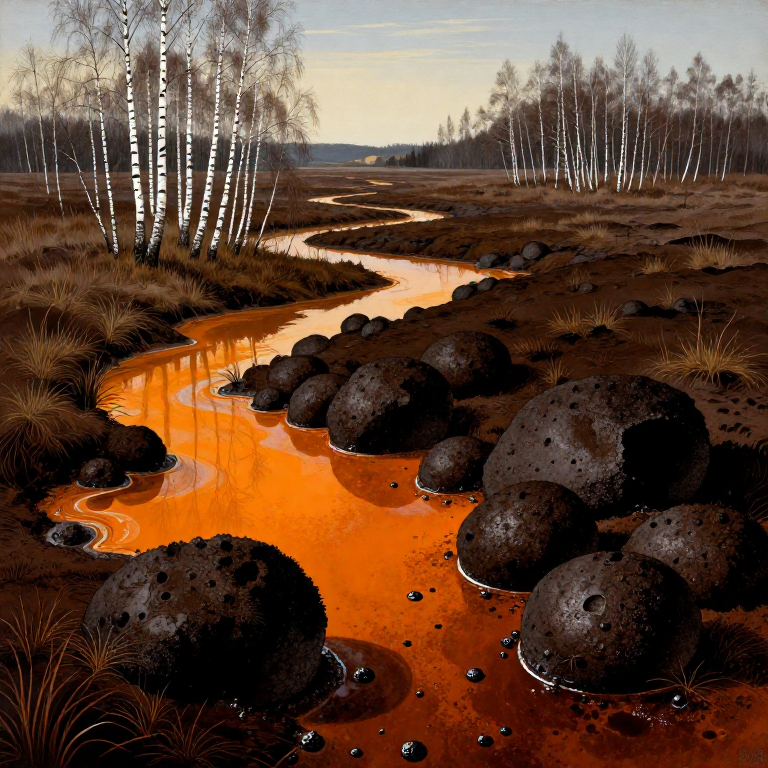
Peatlands and wetlands containing bog ore can be recognized by several characteristic signs. The first and easiest to notice is the color of the water — water in ditches and drainage channels has a rust color, from orange to dark brown, indicating a high content of dissolved iron. On the water surface, a rainbow-like, opalescent floating layer is often visible — this is not oil or petroleum, but a thin iron oxide film. It can be distinguished from oil-based contamination by a simple test: iron produces a brittle, lamellated membrane that breaks into pieces when touched with a stick, while oil flows and merges back together. Bog ore often occurs in Masovia, Podlasie, Pomerania, in Greater Poland and in Kuyavia — in lowland areas with high groundwater levels and acidic peat substrate.
Необхідні інструменти ({count})
 Topographic Map of Local Wetlands
 Waterproof Boots (Wellington)
Prepare equipment for prospecting and extraction
Prepare equipment for prospecting and extraction
Необхідні інструменти ({count})
 Steel Probing Rod (100cm x 12mm)
 Spade
Spade 20-Liter Bucket
 Knee-High Rubber Boots
 Heavy-Duty Work Gloves
Probe the soil in search of ore
Probe the soil in search of ore
Необхідні інструменти ({count})
Steel Probing Rod (100cm x 12mm)Excavate the bog iron ore
Excavate the bog iron ore
Матеріали для цього кроку:
 Raw Bog Iron Nodules (as harvested)20 kilogram
Необхідні інструменти ({count})
Spade20-Liter BucketHeavy-Duty Work GlovesWash the ore to remove peat and mud
Wash the ore to remove peat and mud
Матеріали для цього кроку:
 Distilled Water (1 Liter)40 літрів
Необхідні інструменти ({count})
 Wire Brush
 Coarse Sieve (5-10mm mesh)
 Washing Basin
Break up larger lumps
Break up larger lumps
Larger lumps and blocks of bog ore should be broken into smaller pieces 2-5 cm in diameter. Smaller fragments dry faster and are roasted more evenly in the furnace. Use a hammer or stone on a hard surface (flat rock, wooden log). Bog ore is relatively brittle and breaks easily — it is a porous, spongy material, not solid stone. When breaking, pay attention to the content: good ore has a uniform, rust-brown color on the break. If the interior is light gray or white, it may be clay or sandstone, not iron ore. Discard such pieces. Lumps with distinct metallic shine or dark brown, hard core are the most valuable — this is pure goethite with the highest iron content.
Необхідні інструменти ({count})
 Hammer (2 kg)
 Flat Stone Anvil
Air-dry the ore
Air-dry the ore
Необхідні інструменти ({count})
 Wooden Drying Board (1m x 1m)
Roasting ore in a fire (roasting)
Roasting ore in a fire (roasting)
Roasting (calcination) is a key stage in preparing bog ore for smelting. The goal is to remove chemically bound water, burn off organic matter, and transform goethite (FeOOH) into hematite (Fe2O3), which is easier to reduce in a bloomery furnace. Build a fire with dry wood (preferably hardwood — oak, beech, hornbeam) and ignite it. When the wood turns into a bed of coals, spread ore pieces on a layer of coals, alternating one layer of ore with one layer of wood. Maintain the fire for 3-6 hours at a temperature of 300-500 degrees Celsius. The ore will change color from brownish-yellow to dark red or dark brown — this indicates the conversion of goethite to hematite. After the fire dies out and cools down (minimum 12 hours), collect the roasted ore. It will be noticeably lighter — it will have lost 10-15% of its mass in the form of water and organic matter.
Матеріали для цього кроку:
 Hardwood Firewood30 kilogram
 Dried Bog Iron Ore15 kilogram
Необхідні інструменти ({count})
 Fire Pit
 Long-Handled Fire Tongs
 Heat-Resistant Gloves
Assess the quality of roasted ore
Assess the quality of roasted ore
Необхідні інструменти ({count})
 Weighing Scale
 Unglazed Ceramic Tile (for streak test)
Store the ore for further processing
Store the ore for further processing
Матеріали для цього кроку:
 Jute Storage Sack2 штук
Необхідні інструменти ({count})
 Wooden Storage Crate
Матеріали
5- 20 kilogramЗаповнювач
- 40 літрівЗаповнювач
- 30 kilogramЗаповнювач
- 15 kilogramЗаповнювач
- 2 штукЗаповнювач
Необхідні інструменти
20- Заповнювач
- Заповнювач
- Заповнювач
- Заповнювач
- Заповнювач
- Заповнювач
- Заповнювач
- Заповнювач
- Заповнювач
- Заповнювач
- Заповнювач
- Заповнювач
- Заповнювач
- Заповнювач
- Заповнювач
- Заповнювач
- Заповнювач
- Заповнювач
- Заповнювач
- Заповнювач
CC0 Суспільне надбання
Це креслення випущено під ліцензією CC0. Ви можете вільно копіювати, змінювати, поширювати та використовувати цю роботу для будь-яких цілей без запиту дозволу.
Підтримайте мейкера, купуючи продукти через його креслення, де він отримує Комісію мейкера встановлену вендорами, або створіть нову ітерацію цього креслення та включіть його як зв'язок у власне креслення для розподілу доходу.