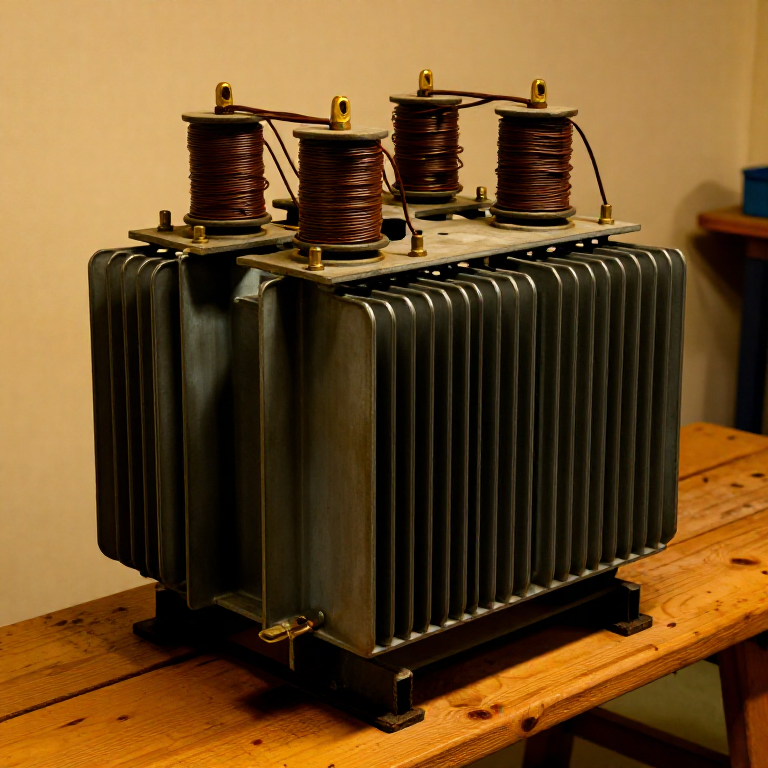


Stanley Transformer
Power lost in a cable is I²R — proportional to the SQUARE of the current. Halve the current and you lose a quarter as much. Since power is voltage times current, you can carry the same power at a tenth the current if you raise the voltage tenfold, and lose a hundredth as much heat in the wire.
That is the entire argument for alternating current, and it needs one device: something that changes voltage. Two coils sharing an iron core do it. A changing current in one induces a voltage in the other, and the ratio of turns sets the ratio of voltages. Nothing moves and nothing is connected between the two sides.
William Stanley built the first practical commercial system with it, lighting Great Barrington, Massachusetts in 1886. His patent is titled simply "Induction-coil" — US Patent 349,611, granted 21 September 1886.
Інструкції
Step DOWN only, and never touch the mains
Step DOWN only, and never touch the mains
Build this to reduce a low bench voltage further. A step-up transformer produces genuinely dangerous voltages from a harmless supply — do not build one on this bench.
Do the loss arithmetic before building anything
Do the loss arithmetic before building anything
Work out I²R for 10 kW delivered at 100 V and at 10,000 V through the same cable. The high-voltage case loses one ten-thousandth as much. That number is why transformers exist.
Read US 349,611 and note the adjustable gap
Read US 349,611 and note the adjustable gap
Stanley claims an annular core whose confronting ends are separated by a VARIABLE gap. Adjusting the gap adjusts the magnetic circuit — a tuning control built into the iron.
Cut a closed core from thin iron laminations
Cut a closed core from thin iron laminations
Stack insulated sheets into a closed rectangular ring. Closed, so nearly all the flux from one winding threads the other.
Матеріали для цього кроку:
 Mild Steel Sheet2 аркушів
Необхідні інструменти ({count})
 Metal File
Insulate every lamination from its neighbours
Insulate every lamination from its neighbours
Varnish or paper between sheets. Laminations break up eddy current paths; touching sheets behave as a solid core and the transformer runs hot and inefficient.
Wind the primary and count every turn
Wind the primary and count every turn
Wind a known number of turns — say 200 — and record it exactly. The turns ratio IS the voltage ratio, so an uncounted winding is an unknown transformer.
Матеріали для цього кроку:
 Enamelled Copper Wire60 метрів
Wind a secondary of a different, counted number
Wind a secondary of a different, counted number
Wind 50 turns for a 4:1 step-down. Keep it insulated from the primary — the two circuits share no electrical connection at all.
Apply AC and measure both voltages
Apply AC and measure both voltages
Feed low-voltage AC to the primary and measure the secondary. The ratio should match your turns ratio closely. Record the discrepancy.
Необхідні інструменти ({count})
 Multimeter
Now try DC and watch nothing happen
Now try DC and watch nothing happen
Apply a steady DC voltage. The secondary reads zero except for a pulse at switch-on and switch-off. Only a CHANGING flux induces voltage — this is why Edison's DC could not be transformed.
Measure current on both sides under load
Measure current on both sides under load
Load the secondary and measure both currents. Current goes UP as voltage goes down, in inverse ratio — the transformer trades one for the other, it does not create power.
Compute the efficiency
Compute the efficiency
Compare input and output power. A decent transformer exceeds 95 %, and it does so with no moving parts whatsoever — one of the most efficient machines ever built.
Introduce a gap in the core and re-measure
Introduce a gap in the core and re-measure
Slip a shim between the core halves. Output falls, because flux now leaks across the gap instead of linking the secondary. This is Stanley's adjustable gap, used deliberately.
Wire two loads in PARALLEL across the secondary
Wire two loads in PARALLEL across the secondary
Connect two lamps side by side and remove one. The other stays lit at full brightness. Stanley's system put consumers in parallel — the reason one house switching off does not dim the street.
Feel the core after running loaded
Feel the core after running loaded
It is warm. That heat is hysteresis and residual eddy current loss in the iron — the price of using a magnetic circuit, and the reason core material matters so much.
Compendium — the device that made AC worth having
Compendium — the device that made AC worth having
The patent. US 349,611, "Induction-coil", granted 21 September 1886 to William Stanley, Jr. of Great Barrington, Massachusetts. Working for Westinghouse, Stanley built the first practical AC distribution system that year, lighting shops along Main Street in Great Barrington from a generator through step-up and step-down transformers. He did not invent the transformer outright — Lucien Gaulard and John Dixon Gibbs had demonstrated one in 1881, and the Hungarian team of Zipernowsky, Bláthy and Déri patented the closed-core parallel-connected design in 1885. Stanley's contribution was the practical, manufacturable form and the working system around it.
Why voltage transformation is the whole game. Resistive loss in a conductor is I²R. Transmitting a given power P at voltage V requires current I = P/V, so loss falls with the SQUARE of any voltage increase. Raising transmission voltage by a factor of ten cuts losses by a factor of a hundred. Direct current could not be transformed — a steady current produces a steady flux, and a steady flux induces nothing — so DC had to be generated near its point of use, which is why Edison's stations served a radius of about a mile. Alternating current with transformers can be generated anywhere and consumed anywhere.
What the device actually does and does not do. Two windings on a shared magnetic circuit exchange energy through flux, not through a connection: the ratio of turns sets the ratio of voltages, and the currents move in the inverse ratio. Power out is power in, less losses. It cannot amplify, it cannot work on DC, and it is one of the most efficient machines ever made — large units exceed 99 % — precisely because nothing in it moves.
Parallel, not series. An equally important choice was connecting consumers in parallel across a secondary rather than in series along a loop. In series, every load affects every other and one failure breaks the circuit; in parallel, each sees the same voltage and can be switched independently. Combined with Tesla's induction motor of 1888, the transformer completed the alternating-current system, and the grid outside your window is still built on these two patents.
Матеріали
2- 2 аркушівЗаповнювач
- 60 метрівЗаповнювач
Необхідні інструменти
2- Заповнювач
- Заповнювач
Пов'язані креслення
Ці креслення діляться знаннями — техніки, матеріали або принципи


CC0 Суспільне надбання
Це креслення випущено під ліцензією CC0. Ви можете вільно копіювати, змінювати, поширювати та використовувати цю роботу для будь-яких цілей без запиту дозволу.
Підтримайте мейкера, купуючи продукти через його креслення, де він отримує Комісію мейкера встановлену вендорами, або створіть нову ітерацію цього креслення та включіть його як зв'язок у власне креслення для розподілу доходу.