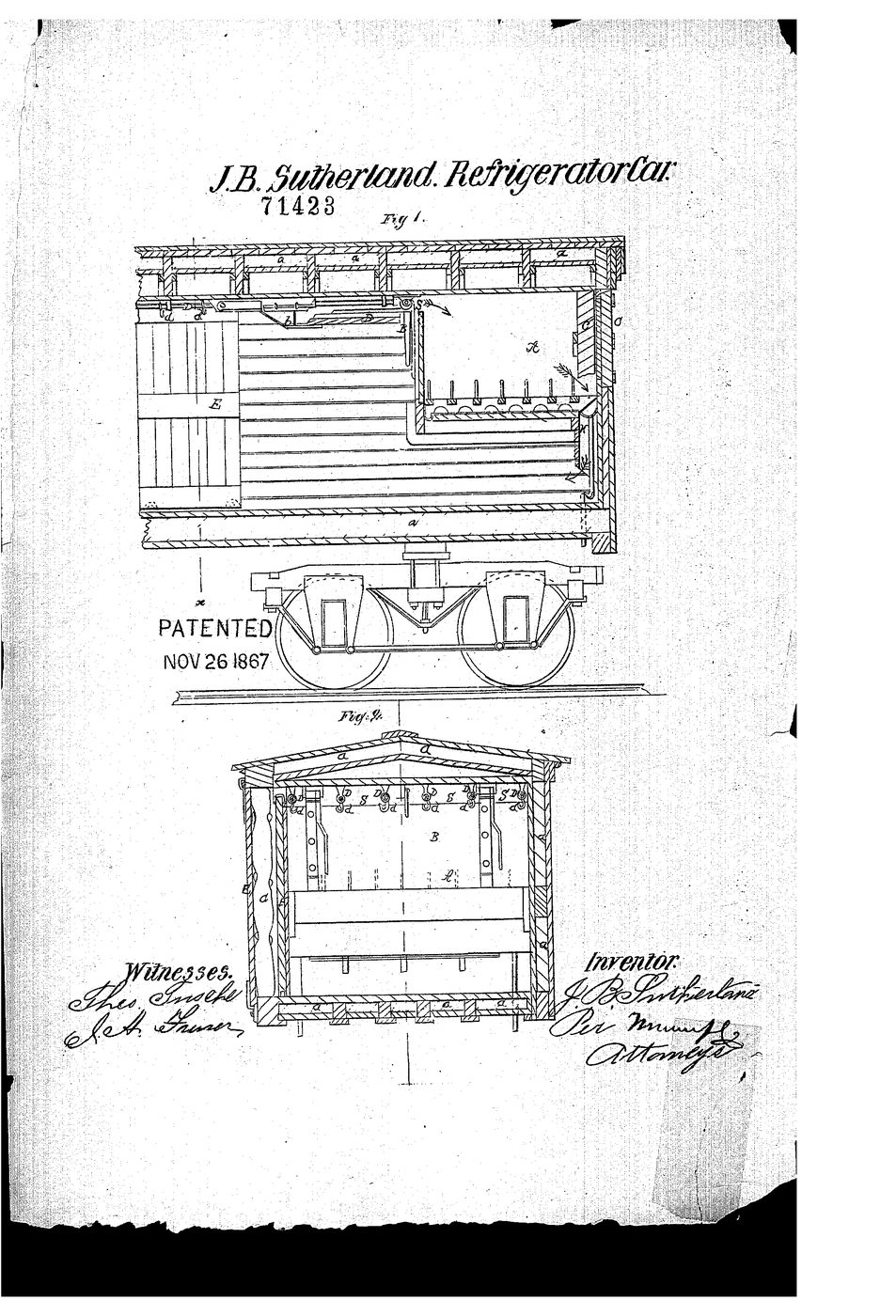


Refrigerator Car
Before refrigerated rail, meat and fruit could only travel as far as they could stay fresh — a day, maybe two. Cities ate what grew nearby, and livestock was walked to the city alive to be slaughtered at the end of the journey.
Sutherland's refrigerator car is an insulated wagon that keeps itself cold by moving its own air. Its walls, roof and floor are doubled, with the cavity packed with sawdust or felt. An ice-chest stands at each end of the car.
The key is the circuit, not the ice. Warm air rises off the cargo, is led into the ice-chests, gives up its heat to the ice, and returns — cooled and heavier — into the body of the car. The ice does not merely sit there chilling its neighbours; the whole car is a convection loop that runs itself with no pump and no power.
US Patent 71,423, "Improved refrigerator-car", granted 26 November 1867 to J. B. Sutherland of Detroit, Michigan.
Інструкції
Read the claim: it is a circuit, not a cool box
Read the claim: it is a circuit, not a cool box
Sutherland claims double walls, roof and floor, an ice-chest at each end, and warm air conducted through the chests and returned cooled to the car. Write down all three.
Build the control car — a plain single-wall box
Build the control car — a plain single-wall box
Cut and tape a closed cardboard box about 250 × 120 × 120 mm with a lift-off lid. Single wall, no insulation. This is what you are trying to beat.
Матеріали для цього кроку:
 Аркуші гофрокартону2 аркушів
Необхідні інструменти ({count})
 Макетний ніж
 Малярна стрічка
Build the second box with a double wall
Build the second box with a double wall
Make a second box the same size, then build an outer skin about 20 mm larger all round — walls, roof and floor. Leave the cavity empty for now.
Матеріали для цього кроку:
Аркуші гофрокартону3 аркушівНеобхідні інструменти ({count})
Макетний ніжPack the cavity
Pack the cavity
Fill the whole cavity with cotton wool, firmly but not crushed. Sutherland specified sawdust or felt — the point is trapped still air, which is what actually blocks the heat.
Матеріали для цього кроку:
 Вата гігроскопічна1 пакет
Make two ice-chests, one at each end
Make two ice-chests, one at each end
Fit a small open-topped card tray hard against each end wall inside the insulated box. These are the ice-chests — ends, not middle.
Матеріали для цього кроку:
Аркуші гофрокартону1 аркушНеобхідні інструменти ({count})
Макетний ніжCut the air passages
Cut the air passages
Cut a slot high on the inner face of each chest and another low beneath it. Warm air enters at the top, cold air falls out at the bottom. That pair of slots is the whole invention.
Необхідні інструменти ({count})
Макетний ніжLoad equal ice into both boxes
Load equal ice into both boxes
Put the same number of ice cubes in each: loose in the middle of the plain box, and split between the two end chests in the insulated one.
Матеріали для цього кроку:
 Набір форм для льоду1 набір
Record the starting temperature
Record the starting temperature
Stand a thermometer in the middle of each box, clear of the ice. Close both lids and note both readings and the time.
Необхідні інструменти ({count})
 Термометр для холодного зберігання
Read both every 5 minutes for half an hour
Read both every 5 minutes for half an hour
Take both temperatures every 5 minutes. Keep the lids shut between readings. Tabulate: time, plain box, insulated box.
Необхідні інструменти ({count})
 Секундомір
Find the circulation with a paper streamer
Find the circulation with a paper streamer
Tape a thin paper streamer over the low slot of one chest. It drifts out into the car: cold air is falling out of the chest, exactly as claimed.
Необхідні інструменти ({count})
Малярна стрічкаBlock the slots and watch it stall
Block the slots and watch it stall
Tape both chests shut so the ice can only chill through the card. Read again after 10 minutes — the box warms, though the ice is untouched. No circuit, no cooling.
Необхідні інструменти ({count})
Термометр для холодного зберіганняTest why the ice goes at the ends
Test why the ice goes at the ends
Re-open the slots but move all the ice into one chest. The far end stays measurably warmer — two chests keep the whole load evenly cold.
Необхідні інструменти ({count})
Термометр для холодного зберіганняPlot both curves
Plot both curves
Plot temperature against time for both boxes. The insulated car should sit lower and, more importantly, stay lower — that gap is the shelf life of the cargo.
History & Context — the car that moved the slaughterhouse
History & Context — the car that moved the slaughterhouse
The patent. US 71,423, "Improved refrigerator-car", granted 26 November 1867 to J. B. Sutherland of Detroit, Michigan. The specification describes doubled walls, roof and floor with the spaces filled with sawdust or felt, and an ice-chest at each end holding around 800 pounds of ice apiece. Its central claim is the air path: warmed air is conducted through the ice-chests and, thus cooled, returned to the body of the car.
Why the ends matter. A block of ice sitting in the middle of a wagon cools what touches it and little else. Sutherland's chests are placed at both ends and slotted top and bottom, so the whole car becomes a convection loop — warm air in high, cold air out low, continuously, driven by nothing but the density difference between warm and cold air (steps 10-12). It is a heat engine with no moving parts, and it is why a car full of meat stayed cold rather than just the crate nearest the ice.
Insulation is trapped air. Sawdust and felt are not cold; they are simply good at holding air still. Still air conducts heat poorly, so a cavity full of it slows the leak inward. Your cotton wool did the same job for the same reason (step 4) — and the plain box in step 2 shows how quickly the ice is wasted without it.
What it changed. Refrigerated rail turned regional food into national food. Within a decade or so of Sutherland's grant the dressed-beef trade was taking hold: instead of walking cattle hundreds of miles to be slaughtered at the city — losing weight and animals the whole way — the meat was cut where the cattle were and the meat rode the rails. Gustavus Swift built a business on that logic in the late 1870s using a design by engineer Andrew Chase. Fruit went the same way, and so eventually did the idea that a household could eat things grown a continent away in the wrong season.
Honest limits. Ice-cooled cars needed re-icing at stations along the route, and the ice trade that supplied them was itself an enormous seasonal industry of lake harvesting and insulated ice-houses. Mechanical refrigeration eventually replaced the chests entirely — but not the double wall, and not the principle of moving air past a cold surface. Open any refrigerator today and you will find a fan doing deliberately what Sutherland's slots did for free.
Матеріали
3- 6 аркушівЗаповнювач
- 1 пакетЗаповнювач
- 1 набірЗаповнювач
Матеріали з пов'язаних креслень

CC0 Суспільне надбання
Це креслення випущено під ліцензією CC0. Ви можете вільно копіювати, змінювати, поширювати та використовувати цю роботу для будь-яких цілей без запиту дозволу.
Підтримайте мейкера, купуючи продукти через його креслення, де він отримує Комісію мейкера встановлену вендорами, або створіть нову ітерацію цього креслення та включіть його як зв'язок у власне креслення для розподілу доходу.