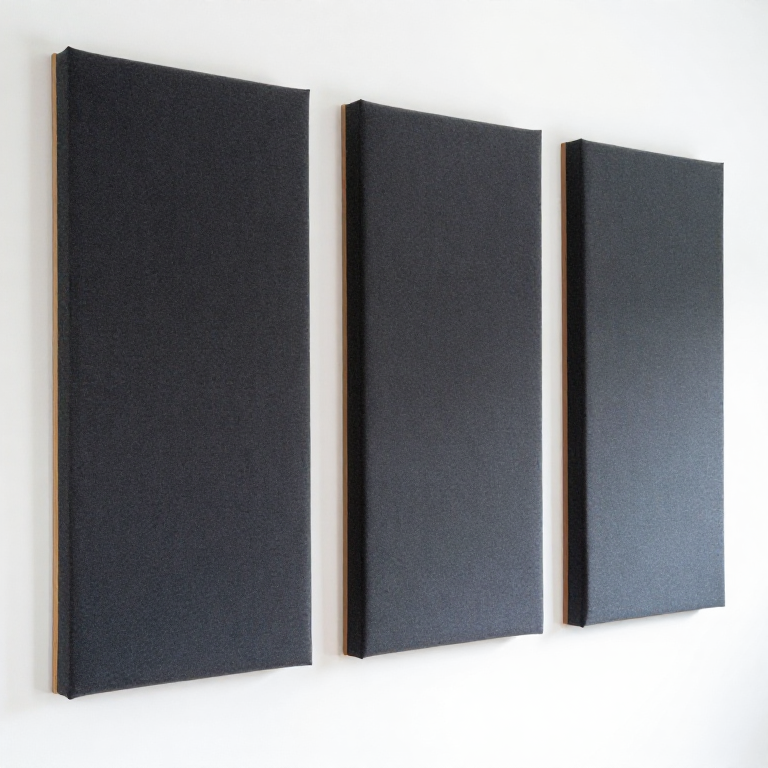


The Acoustic Panel
A room with hard parallel walls sounds bad for a measurable reason: sound bounces, arrives repeatedly at your ears delayed by a few milliseconds, and smears speech and music into itself. Treating a room means removing some of that energy on each bounce.
A porous absorber does it by friction. Sound is air moving back and forth; force air to move through a tangle of fibres and some of that motion is converted to heat. Simple — but there is a catch that decides the entire design, and almost everyone gets it wrong.
At a hard wall, air cannot move. The wall forces the air velocity to zero at its surface. A porous absorber works on velocity, so an absorber lying flat against a wall sits exactly where there is least to absorb. Air velocity rises with distance from the wall and peaks a quarter of a wavelength out.
Two consequences follow. Absorbers need real thickness — roughly a tenth of a wavelength to do anything useful and a quarter to absorb nearly all of it. And an air gap behind a thin panel is nearly as good as making it thicker: a 50 mm panel mounted 50 mm off the wall behaves much like a 100 mm one.
Build panels, measure the room before and after, and the numbers will settle every argument.
Інструкції
Measure the room before you touch it
Measure the room before you touch it
Record a sharp transient — a hand clap or a balloon burst — from a fixed position, and look at the decay in any audio editor.
Estimate how long it takes to fall away, and note any distinct repeats.
Do this first and keep the file. Acoustic treatment is judged almost entirely by memory otherwise, and memory is unreliable across the hours it takes to build panels.
Необхідні інструменти ({count})
 Секундомір
 Міліметровий папір
Find the reflection points geometrically
Find the reflection points geometrically
Have someone slide a mirror along each wall at ear height while you sit in the listening position. Wherever you can see a speaker in the mirror, mark the wall.
Do walls, then ceiling.
Those points are where the first reflections arrive, and treating them removes far more smearing per panel than covering an equal area anywhere else. Geometry beats guesswork and costs nothing.
Build the frames
Build the frames
Make simple timber frames sized to your absorber material — at least 50 mm deep, and 100 mm if you can. Keep the front and back open.
Do not put a solid backing on.
A closed back turns a porous absorber into a panel that reflects, and it removes the air gap you are about to exploit in step 5.
Матеріали для цього кроку:
 Сосновий пиломатеріал1 штука
Необхідні інструменти ({count})
 Ручна пилка
 Акумуляторний дриль
Fill and cover with fabric that breathes
Fill and cover with fabric that breathes
Fit the absorbent material into the frame without compressing it, and cover with an acoustically transparent fabric.
Test the fabric first: hold it to your mouth and blow.
If you cannot blow through it easily, sound cannot get through either.
A beautiful panel behind an airtight fabric absorbs nothing, and this one test — which takes two seconds — prevents the commonest complete failure.
Матеріали для цього кроку:
 Панелі акустичного поролону (клинові)1 пакет
 Акустична тканина2 метрів
Prove the air gap works
Prove the air gap works
Mount one panel flat against the wall and record a clap. Then mount the identical panel on 50 mm spacers and record again from the same position.
Compare the decay, especially in the lower frequencies.
Expect the spaced panel to do measurably more.
You moved the absorber into the region where air is actually moving, and you got the benefit of a thicker panel for the cost of four blocks of wood.
Measure again, and find the limit
Measure again, and find the limit
With all panels up, record the same clap from the same position and compare with step 1.
Expect a clear improvement in the mid and high range and very little change at low frequencies.
That is not a failure of your build.
A 100 Hz wave is over three metres long, so a quarter wavelength is nearly a metre — no realistic panel is thick enough, which is why bass needs corner traps or resonant absorbers instead.
Compendium — the physics, and the thing people buy by mistake
Compendium — the physics, and the thing people buy by mistake
The velocity argument is the whole design. A sound wave at a rigid boundary has maximum pressure and zero particle velocity at the surface, with velocity rising to a maximum a quarter-wavelength away. Porous absorption is a viscous process — it needs air to move through fibres — so it is most effective where velocity is highest. This single fact explains why thin foam on a wall does little at low frequencies, why thickness matters more than density, and why an air gap behind a panel shifts its useful range downwards. Density beyond a moderate value actually hurts: material too dense reflects sound off its face instead of letting it in.
🔴 The commonest and most expensive confusion: absorption is not soundproofing. Panels change how a room sounds to people inside it. They do essentially nothing to stop sound getting to the neighbours, because blocking transmission requires mass, sealing and decoupling — heavy, airtight, structurally separated barriers — and a lightweight fibrous panel has none of those properties. Anyone who buys foam to stop noise passing through a wall has bought the wrong product for the wrong problem, and this is by far the most frequent misunderstanding in the subject.
What the numbers mean. Absorption is quoted as a coefficient from 0 to 1 per frequency band, and an NRC or SAA figure averages several bands. Coefficients above 1.0 appear routinely in published data and are not errors — they are an artefact of how the standard chamber test treats panel edges, and they mean the panel absorbed more than its stated flat area. Room performance is described by reverberation time, RT60, the time for sound to fall by 60 dB, and treating a room is fundamentally about bringing RT60 to something appropriate for the room's use rather than to zero.
Do not over-treat. A room with every surface absorbing sounds oppressive and unnatural — voices lose support and the space feels like a closed box. Studios deliberately leave diffusion and some liveness, and control rooms treat the first reflection points and the corners rather than every square metre. Diffusers scatter rather than absorb, which preserves energy while removing the strong single reflections, and a good room usually needs both.
Materials and safety. Mineral wool and fibreglass are the standard fill and are far more effective per centimetre at low frequencies than open-cell acoustic foam; both shed fibres, so wear a mask, long sleeves and eye protection when cutting, and seal the fill inside breathable fabric. Check the fire rating of anything you mount in quantity on a wall — this matters more than any acoustic property, and untreated foam in particular can be a serious fire risk in the volumes people install it.
Матеріали
3- 1 штукаЗаповнювач
- Заповнювач
- 2 метрівЗаповнювач
Необхідні інструменти
4- Заповнювач
- Заповнювач
- Заповнювач
- 1 vendor sell this, none ship to you yetЗаповнювач
Матеріали з пов'язаних креслень

Пов'язані креслення
Ці креслення діляться знаннями — техніки, матеріали або принципи

CC0 Суспільне надбання
Це креслення випущено під ліцензією CC0. Ви можете вільно копіювати, змінювати, поширювати та використовувати цю роботу для будь-яких цілей без запиту дозволу.
Підтримайте мейкера, купуючи продукти через його креслення, де він отримує Комісію мейкера встановлену вендорами, або створіть нову ітерацію цього креслення та включіть його як зв'язок у власне креслення для розподілу доходу.