МИСТЕЦТВО
КРАСА ТА ЗДОРОВ'Я
РЕМЕСЛО
КУЛЬТУРА ТА ІСТОРІЯ
РОЗВАГИ
СЕРЕДОВИЩЕ
ЇЖА ТА НАПІЇ
ЗБОРНА ІНЖЕНЕРІЯ
НАУК
СПОРТ
ТЕХНОЛОГІЯ
НОСИМО
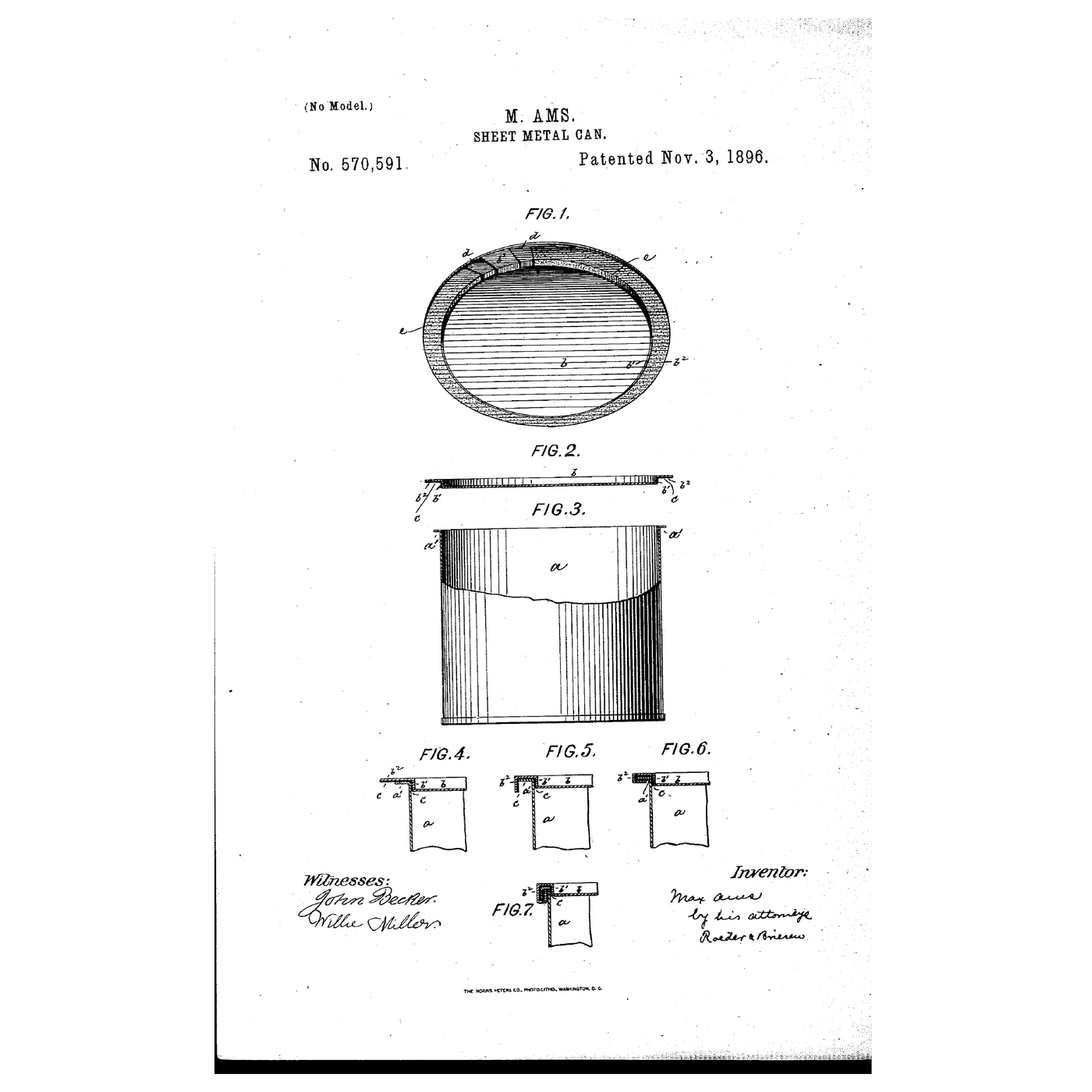


The Double Seam: Closing a Can Without Solder
The tin can arrives in the catalogue in 1810 and is soldered shut. That solder is lead, it sits on the inside of the can, and for most of a century it quietly poisoned the food it was protecting — the Franklin expedition is the famous case and it was not the only one.
Max Ams's 1896 patent closes a can with **no solder at all**. The end and the body are rolled together into five flattened thicknesses of metal, with a soft compound filling the last microscopic gaps. Nothing enters the food but the metal it was always going to touch, and the closure is mechanical, so it can be made at machine speed.
This rung reads that patent, sections a real seam, rolls one by hand, and works out the one measurement that says whether a seam will hold: the **overlap**.
Середній
About 4 hours
Інструкції
1
1
Read the claim, and count the layers
Read the claim, and count the layers
**US 570,591**, *Sheet-metal can*, **Max Ams** of New York; filed **28 July 1896**, granted **3 November 1896**, long expired. The drawing on this page is its own, and Figures 4 through 7 are the seam being made, stage by stage.
The specification describes the sequence exactly: the body is flanged at its upper end; the cover is *countersunk* so it has an upright neck that fits inside the body, with a wide flange round the neck; the cover's neck and flange are coated with the sealing body; the cover is set on; then the projecting part of the cover flange is **crimped downward, then inward, then the two flanges are jointly bent downward to produce a lap joint**.
The claim itself is short and it is about the compound: *the combination of a sheet-metal can with a flanged and countersunk cover and with an adhesive coating secured to the cover, and consisting of rubber cement and an asbestos film*. And the spec states the result plainly — *a perfectly tight joint is produced without the use of solder or washers*.
Write down the two things the patent is claiming to have solved, because they are different problems:
1. **No solder**, so nothing toxic is introduced and no hand operation is needed.
2. **No washer**, because a loose washer resists the crimping and *the consequent frequent imperfections of the seam are entirely avoided*. A coating applied to the cover before assembly does the same job and is not in the way.
That second point is the one worth taking away. The invention is not the seal, it is **putting the seal somewhere it does not interfere with the forming operation**.
2
2
Section a real seam and find the five thicknesses
Section a real seam and find the five thicknesses
Take an **empty, washed** food can. Cut a strip out of the seam with the angle grinder or a fine hacksaw, then file the cut face flat and work through progressively finer abrasives until you have a clean cross-section. Finish on a fine file and then polish; you need to see layers a fifth of a millimetre thick.
Put it under the digital microscope. You are looking for five distinct lines of metal rolled flat together, in the order the notebook lists: end, body, cover hook, body hook, end again. Between them, if the light is right, a thin darker line — that is the compound.
Measure four things against the microscope's scale or with the calipers on a bigger section. Two of them sound alike and are not:
- **seam length W**, measured DOWN the seam from top to bottom — about 3 mm;
- **seam thickness**, measured ACROSS the five layers — about 1.3 mm;
- **BH**, the body hook, the length of body metal turned back inside;
- **CH**, the cover hook, the same for the end.
Then measure the plate thicknesses themselves with the micrometer, on a flat part of the body and a flat part of the end. They are not the same: the end is usually thicker, because it has to hold the pressure the notebook computes in step 5.
Put those five numbers into step 5's arithmetic. You will get an overlap percentage for a can that somebody's production line made, and you can judge it against the same acceptance figure a cannery uses.
Wear gloves and eye protection. A cut can seam is the sharpest thing in this batch, and grinding galvanised or tinned steel throws metal dust — work with extraction or outdoors.
Матеріали для цього кроку:
 Бляшана консервна банка2 штук
Необхідні інструменти ({count})
 Кутова шліфмашина
 Напилки (ручний напилок)
 Набір напилків
 Цифровий мікроскоп
 Мікрометр
 Цифровий штангенциркуль 6 дюймів
 Слюсарні лещата
 Прозорі захисні окуляри
 Захисний щиток для обличчя
 Шкіряні робочі рукавиці
 Лабораторний журнал (з копією)
3
3
Roll one by hand
Roll one by hand
You are not going to match a seamer, which does this in two rolls at a couple of hundred cans a minute. You are going to make the same joint slowly, and find out what each stage is for.
**Make the body.** Roll a strip of tinplate or 0.3 mm brass into a cylinder about 70 mm across. Close its side seam any way you like for now — rung 5 does that properly. Flange the open end outward about 2.5 mm, working round with the hand seamer in small bites, or over a forming stake with a rubber mallet. Even is what matters; a wavy flange is a leaky seam.
**Make the end.** Cut a disc about 8 mm larger in diameter than the body. Press a shallow countersink into its centre over a round former so it has an upright neck that just enters the body. Curl the outer edge of the disc over — about 2 mm, downward — using the seamer's jaws or a pair of round-nose pliers, working round a little at a time.
**Compound.** Run a thin bead of silicone sealant inside the curl of the end and let it skin over. This is the modern stand-in for Ams's rubber-and-asbestos coating; step 6 says why that substitution matters.
**First operation.** Set the end on the body and, with the seamer, tuck the end's curl **under** the body flange all the way round. Do not flatten it. At this stage the seam should look like a loose hook inside a hook, and you should be able to see that both hooks exist.
**Second operation.** Now flatten the whole assembly. Work round with the seamer's flat jaws, or over a stake with a flat-faced hammer using light overlapping blows. Go round three or four times with light pressure rather than once hard — the metal has to flow, not to crease.
Test it: fill with water, invert, and look. Then squeeze the body and look again. Section your own seam as you did in step 2 and compare the five layers with the factory one.
Матеріали для цього кроку:
 Лист білої жерсті1 штука
 Латунний лист1 штука
 Високотемпературний силіконовий герметик1 штука
Необхідні інструменти ({count})
 Ручні фальцювальні кліщі
 Формувальне ковадельце
 Підтримка для вибивання
 Гумовий молоток
 Слюсарний молоток із кульковим бойком
 КовадлоСлюсарні лещата
 Ножиці по металу
 Розмічальний циркульЦифровий штангенциркуль 6 дюймів
 Знімач задирокПрозорі захисні окуляриШкіряні робочі рукавиці
4
4
Make the same seam badly, on purpose
Make the same seam badly, on purpose
A seam that works teaches you less than four that do not. Make these deliberately, section each one, and put them in a row with a label.
**Short body hook.** Flange the body only 1.2 mm instead of 2.5. The seam will close and look fine from outside. Section it: the body hook barely reaches the cover hook, and step 5's overlap number collapses. This is the commonest real failure in a cannery and it is invisible without sectioning — which is exactly why canneries section seams on a schedule.
**Over-rolled.** Flatten the second operation far too hard. The seam gets thinner than the five thicknesses allow, the compound is squeezed out of the ends of the hooks, and the metal at the top of the seam is thinned. It looks *better* than a good seam — tighter, neater — and it leaks.
**Under-rolled.** Stop the second operation early. A thick, obviously loose seam. Easy to spot, and the one fault nobody ships.
**No compound.** Leave the sealant out entirely. Metal to metal, however well rolled, is not hermetic: put it under water and squeeze.
Measure all four seams plus your good one and run them through step 5. The short hook and the loose seam fail on **overlap**. The over-rolled one passes overlap comfortably and fails on **thickness**, because the five layers are already as close together as metal can get and there is no room left for compound. Two faults, two different measurements, and neither of them visible from the outside of the can. That is what sectioning is for.
Матеріали для цього кроку:
Лист білої жерсті2 штукВисокотемпературний силіконовий герметик1 штукаНеобхідні інструменти ({count})
Ручні фальцювальні кліщіФормувальне ковадельцеГумовий молотокСлюсарний молоток із кульковим бойкомСлюсарні лещатаЦифровий мікроскопМікрометрЦифровий штангенциркуль 6 дюймівНапилки (ручний напилок) Перманентний маркерПрозорі захисні окуляриШкіряні робочі рукавиціЛабораторний журнал (з копією)
5
5
Five thicknesses, overlap, and the load on the ring
Five thicknesses, overlap, and the load on the ring
Завантаження блокнота Jupyter…
6
6
History and context
History and context
**Attribution.** US 570,591, *Sheet-metal can*, Max Ams of New York; filed 28 July 1896, granted 3 November 1896, expired. The drawing on this page is the patent's own. Ams's machine company built the seamers that made the process industrial, and the family name appears on a run of related filings through the following decade — the *sanitary can* of the trade press is this line of work, not one patent.
**What it removed.** Before 1896 a can was soldered, and the solder was lead. Lead entered the food from the inside seam, and the effects were real and documented — the 1845 Franklin expedition is the case everyone cites, and the argument about how much it contributed is still live, but the exposure is not in dispute. The double seam ends the practice completely for the end closure, and rung 5 ends it for the side seam six years later.
It also made canning fast. A soldered end is a hand operation with a flame; a double seam is two rolls and a chuck, and a modern seamer closes over 2,000 cans a minute. Everything about the twentieth century's food supply that depends on cheap preserved food depends on this joint.
**The asbestos, stated plainly.** Ams's claim specifies *rubber cement and an asbestos film*, and in 1896 that was a sensible choice: asbestos is chemically inert, survives the retort and holds the rubber as a skin. It is also a carcinogen, and that was not known then. **Do not attempt to reproduce the original compound.** Modern sealing compound is a water-based or solvent-based rubber latex, applied to the end and dried before the ends are shipped, and it does the same job. Step 3 uses silicone sealant, which is a workable bench substitute and is not food-contact rated for anything you intend to eat.
**Honest limits.** A double seam is only as good as the hooks inside it, and you cannot see them from outside. That is why the industry's quality control is destructive — cans are cut open and measured on a schedule, not inspected. A hand-rolled seam like step 3's will hold water and will not survive a retort; do not use it to preserve food. And the joint is specific to a cylinder with a flange: it does not transfer to a flat panel or a box corner, which is what rung 5's lock seam is for.
Матеріали
4- 2 штукЗаповнювач
- 2 штукЗаповнювач
- 1 штукаЗаповнювач
- Заповнювач
Необхідні інструменти
21- 1 vendor sell this, none ship to you yetЗаповнювач
- Заповнювач
- Заповнювач
- Заповнювач
- Заповнювач
- Заповнювач
- Заповнювач
- Заповнювач
- Заповнювач
- Заповнювач
- Лабораторний журнал (з копією)10% комісіяЗаповнювач
- Заповнювач
- Заповнювач
- Заповнювач
- Заповнювач
- Заповнювач
- Заповнювач
- Ножиці по металу10% комісіяЗаповнювач
- Заповнювач
- Заповнювач
- Заповнювач
Пов'язані креслення
Ці креслення діляться знаннями — техніки, матеріали або принципи


CC0 Суспільне надбання
Це креслення випущено під ліцензією CC0. Ви можете вільно копіювати, змінювати, поширювати та використовувати цю роботу для будь-яких цілей без запиту дозволу.
Підтримайте мейкера, купуючи продукти через його креслення, де він отримує Комісію мейкера встановлену вендорами, або створіть нову ітерацію цього креслення та включіть його як зв'язок у власне креслення для розподілу доходу.