МИСТЕЦТВО
КРАСА ТА ЗДОРОВ'Я
РЕМЕСЛО
КУЛЬТУРА ТА ІСТОРІЯ
РОЗВАГИ
СЕРЕДОВИЩЕ
ЇЖА ТА НАПІЇ
ЗБОРНА ІНЖЕНЕРІЯ
НАУК
СПОРТ
ТЕХНОЛОГІЯ
НОСИМО
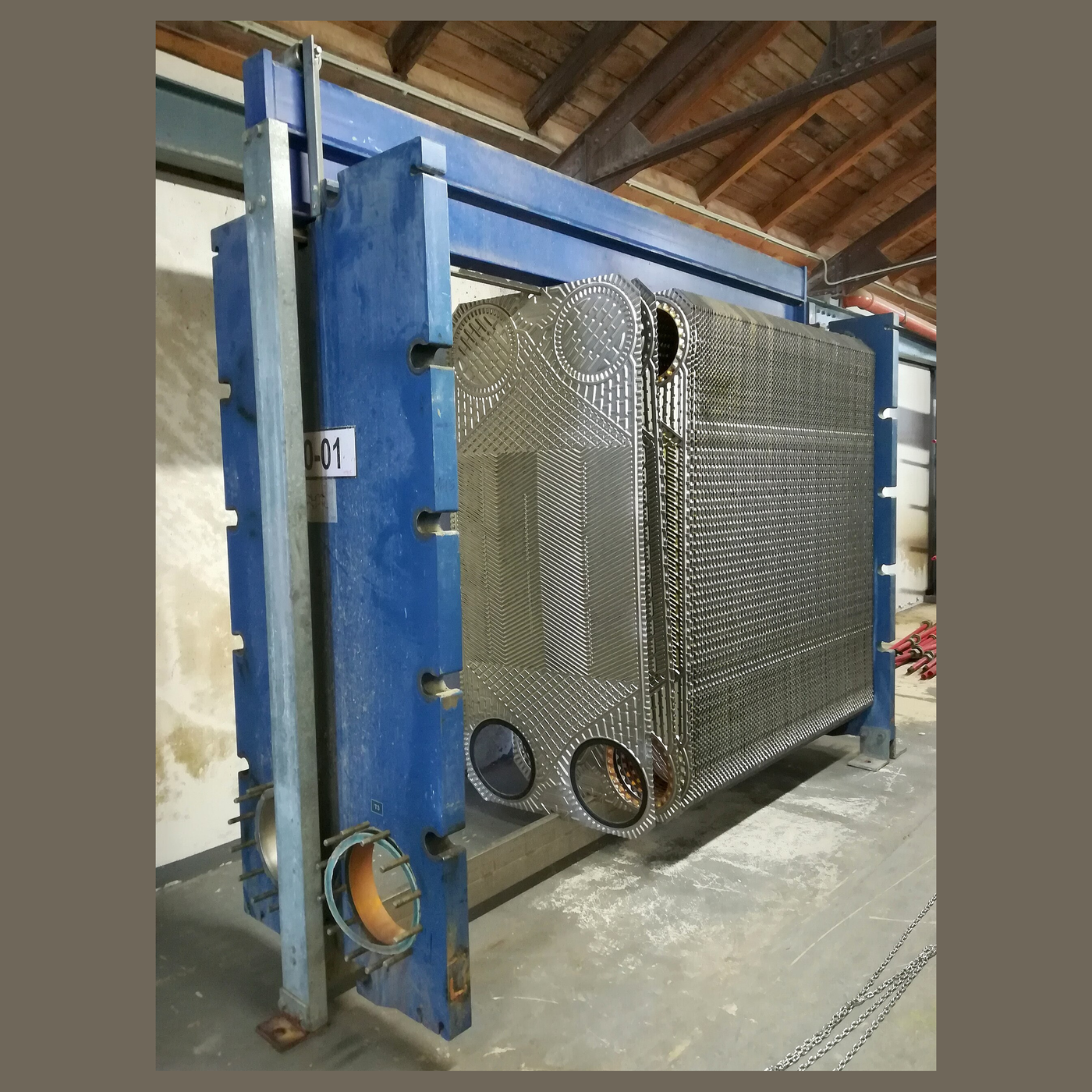

The Plate Heat Exchanger: Thin Plates, Turbulence, and a Frame You Can Open
A stack of thin pressed-metal plates, each sealed to the next by a gasket round its edge, clamped between two heavy frame plates by long bolts. Hot and cold liquids flow in alternate gaps, so every plate has hot on one face and cold on the other.
Richard Seligman's plate heat exchanger of 1923, made by his Aluminium Plate & Vessel Company (APV), was built for the dairy: milk had to be heated and cooled quickly for pasteurisation, and the equipment had to come apart for cleaning every day. Thin corrugated plates give very high heat transfer in a small space; the gasketed frame opens with a spanner.
This rung works out where the size advantage comes from, and builds a two-channel plate exchanger from copper sheet, printed gaskets and a clamped frame.
Середній
About 6 hours
Інструкції
1
1
Where the high U comes from, and what fouling costs
Where the high U comes from, and what fouling costs
Завантаження блокнота Jupyter…
2
2
Plate exchangers run in counterflow
Plate exchangers run in counterflow
A plate exchanger's ports are arranged so the two liquids run in opposite directions through alternate gaps. The embedded blueprint explains why, and measures it on a tube-in-tube exchanger.
3
3
Build a two-channel plate exchanger
Build a two-channel plate exchanger
Cut three copper sheets 150 × 100 mm. The middle one is the heat-transfer plate; the outer two are blanks. Print two gasket frames in TPU, 3 mm thick, each the outline of the plate with a 10 mm border, so each frame encloses a flow gap.
Stack: acrylic end plate / copper blank / gasket frame / copper plate / gasket frame / copper blank / acrylic end plate. Drill four corner bolt holes through everything and clamp with threaded rod and wing nuts, tightening evenly.
Drill and fit hose tails so that gap 1 is fed at the top-left and drains at the bottom-right, and gap 2 is fed at the bottom-right and drains at the top-left — counterflow across the plate. Add ridges to the gasket frames or press shallow chevrons into the copper with a blunt punch to break up the flow.
Матеріали для цього кроку:
 Мідний лист1 аркуш
 Гнучкий філамент TPU40 г
 Акриловий лист1 аркуш
 Шпилька різьбова1 штука
 Баранцева гайка4 штук
 Набір фітингів для ПВХ-труби1 набір
 Силіконовий герметик1 штука
Необхідні інструменти ({count})
 3D-принтер FDM
 Акумуляторний дриль
 Набір свердел
 Лінійка
 Розвідний ключ
 Шкіряні робочі рукавиці
4
4
Test it, then open it
Test it, then open it
Run hot water through one gap and cold through the other at equal, timed flows, and read the four temperatures with the thermometer (or reuse the four-probe logger from the counterflow rung). Work out the heat carried by each side.
Now the reason the design exists: undo the wing nuts, lift the stack apart and look. Any sediment, scale or film is on the copper where you can wipe it. Wipe, restack and tighten. An exchanger you can open is an exchanger you can keep clean — which in a dairy is the difference between a safe product and a spoiled one.
Retighten evenly: a gasket squeezed harder on one side leaks on the other.
Матеріали для цього кроку:
 Вода30 літрів
Необхідні інструменти ({count})
 Електрочайник скляний
 Відро
Відро Мірний глечик
 Секундомір
 Кухонний термометрРозвідний ключ
5
5
History and context
History and context
**Richard Seligman, 1923** — the first commercially successful plate heat exchanger, made by the Aluminium Plate & Vessel Company he had founded in London in 1910, for the high-temperature short-time pasteurisation of milk. No patent number is asserted here: it could not be read from a primary source, and the design is fully documented.
Plate exchangers now run in food, brewing, district heating, heat pumps and chemical plant; brazed versions with no gaskets at all are the small cube in many domestic boilers.
**Honest limits.** Gaskets limit the temperature and pressure, and the chemicals they can meet. Narrow gaps clog on fibrous or particle-laden liquids, where shell-and-tube exchangers still win. And the high pressure drop of those turbulent gaps costs pumping power.
Матеріали
8- 1 аркушЗаповнювач
- Заповнювач
- 1 аркушЗаповнювач
- 1 штукаЗаповнювач
- Баранцева гайка10% комісія4 штукЗаповнювач
- 1 набірЗаповнювач
- 1 штукаЗаповнювач
- 30 літрівЗаповнювач
Необхідні інструменти
11- Заповнювач
- 1 vendor sell this, none ship to you yetЗаповнювач
- Заповнювач
- Заповнювач
- Заповнювач
- Заповнювач
- Заповнювач
- Заповнювач
- Заповнювач
- Заповнювач
- Заповнювач
Пов'язані креслення
Ці креслення діляться знаннями — техніки, матеріали або принципи
Counterflow: The Same Area Does More When the Streams Run Opposite
від Emma
Механіка
15
0
0
0
0
0

The Economiser: The Heat Still Going Up the Chimney
від Martin
Механіка
15
0
0
0
0
0
The Centrifugal Pump: Speed Squared, and Why It Cannot Lift Air
від Emma
Механіка
17
0
0
0
0
0
The Ferrule Fitting: Gripping and Sealing With One Nut
від Emma
Інструменти
17
0
0
0
0
0
CC0 Суспільне надбання
Це креслення випущено під ліцензією CC0. Ви можете вільно копіювати, змінювати, поширювати та використовувати цю роботу для будь-яких цілей без запиту дозволу.
Підтримайте мейкера, купуючи продукти через його креслення, де він отримує Комісію мейкера встановлену вендорами, або створіть нову ітерацію цього креслення та включіть його як зв'язок у власне креслення для розподілу доходу.