МИСТЕЦТВО
КРАСА ТА ЗДОРОВ'Я
РЕМЕСЛО
КУЛЬТУРА ТА ІСТОРІЯ
РОЗВАГИ
СЕРЕДОВИЩЕ
ЇЖА ТА НАПІЇ
ЗБОРНА ІНЖЕНЕРІЯ
НАУК
СПОРТ
ТЕХНОЛОГІЯ
НОСИМО


The Sliding-Blade Pocket Knife: A Spring Catch That Locks the Blade Out or In
A knife whose blade slides out of its handle must hold the blade firmly both out and in, or it can close on the fingers or slide out in the pocket.
Eben Moody Boynton of West Newbury, Massachusetts, received US 373,580, dated 22 November 1887, for pocket-knives "in which the blade or blades is or are arranged to slide in and out of the handle", with a flat spring on the blade whose knob projects through a slot in the handle. A retaining recess at each end of the slot takes the spring when the blade is out or in; its back shoulder is square, so a push cannot move the blade, while the front shoulder is inclined, so the catch slides in. Two blades can share one shank, and nut-picks, nail-cleaners, corkscrews or pencils can be sheathed the same way.
This rung works out how the catch resists and releases, then makes a hollow handle from tube with a slot and two recesses, and a stainless blade with a spring catch.
Просунутий
About 6 hours
Інструкції
1
1
The spring catch
The spring catch
Завантаження блокнота Jupyter…
2
2
A pocket knife before it
A pocket knife before it
The embedded blueprint holds its tools with back springs as a clasp knife does. Boynton slides the blade straight in and out and locks it with a spring catch.
3
3
Read US 373,580
Read US 373,580
"D is a spring, flat and substantially rectangular in cross-section, which is attached to the blade or blades near the base thereof, projects through a longitudinal slot, E, in the handle, and carries at its upper end an operating-knob, G."
"The front shoulder, f, of the projection F is inclined, as shown, so that the spring may slide up readily into the recess; but the corresponding shoulder, c, of the recess is square and adapted to retain the spring from longitudinal motion, except when intentionally given that direction and movement which will disengage it."
4
4
Make the knife and lock the blade
Make the knife and lock the blade
**Handle.** Cut 10 cm of rectangular or flattened aluminium tube as the hollow handle, close its back end, and saw a slot E along one side. File a small square-shouldered recess C at each end of the slot, with an inclined ramp F before each.
**Blade.** Cut a blade from stainless steel sheet with a straight shank that slides snugly in the tube, and sharpen it.
**Spring and knob.** Rivet a short strip of spring steel to the shank near its base so it presses outward through the slot, and fix a small knob G on its free end.
**Test.** Press the knob, slide the blade out until the spring snaps into the front recess, and push on the blade's point against a board: it should not move. Press the knob to release it, slide it in, and shake the knife to check it stays shut.
Матеріали для цього кроку:
 Алюмінієва трубка0.1 метр
 Лист нержавкої сталі1 штука
 Смуга пружинної сталі0.05 метр
 Витяжні заклепки2 штук
 Брусок твердої деревини1 штука
Необхідні інструменти ({count})
 Ножівка по металу
 Набір надфілів
 Напилки (ручний напилок)
 Ножиці по металу
 Слюсарні лещата
 Акумуляторний дриль
 Набір свердел
 Набір заклепувальника
 Точильний камінь
 Шкіряні робочі рукавиці
 Прозорі захисні окуляри
5
5
A blade that slips, jams or will not lock
A blade that slips, jams or will not lock
Sliding-blade pocket knife troubleshooting.
Flow
Loading...
6
6
History and honest limits
History and honest limits
**Eben Moody Boynton** of West Newbury, Essex County, Massachusetts, filed US 373,580 on 3 May 1886; it is dated 22 November 1887. His release was a torsional movement not likely to be given by accident, a third recess could hold the blades closed at the middle, the spring could be dovetailed into the blade, and up to eight blades could be fitted. His claims cover the hollow slotted handle with the sliding blade and its spring catch, the slot's notch and incline, and the flat spring in the blade's plane.
**Honest limits.** Aluminium tube and stainless sheet stand in for his made handle and blades, and the release here is a press rather than his twist. The notebook treats the catch as a simple spring and wedge; its values are examples. Your locked blade is the result.
Матеріали
5- 0.1 метрЗаповнювач
- 1 штукаЗаповнювач
- 0.05 метрЗаповнювач
- 2 штукЗаповнювач
- 1 штукаЗаповнювач
Необхідні інструменти
11- Заповнювач
- Заповнювач
- Заповнювач
- Заповнювач
- Заповнювач
- 1 vendor sell this, none ship to you yetЗаповнювач
- Заповнювач
- Заповнювач
- Заповнювач
- Заповнювач
- Заповнювач
Пов'язані креслення
Ці креслення діляться знаннями — техніки, матеріали або принципи
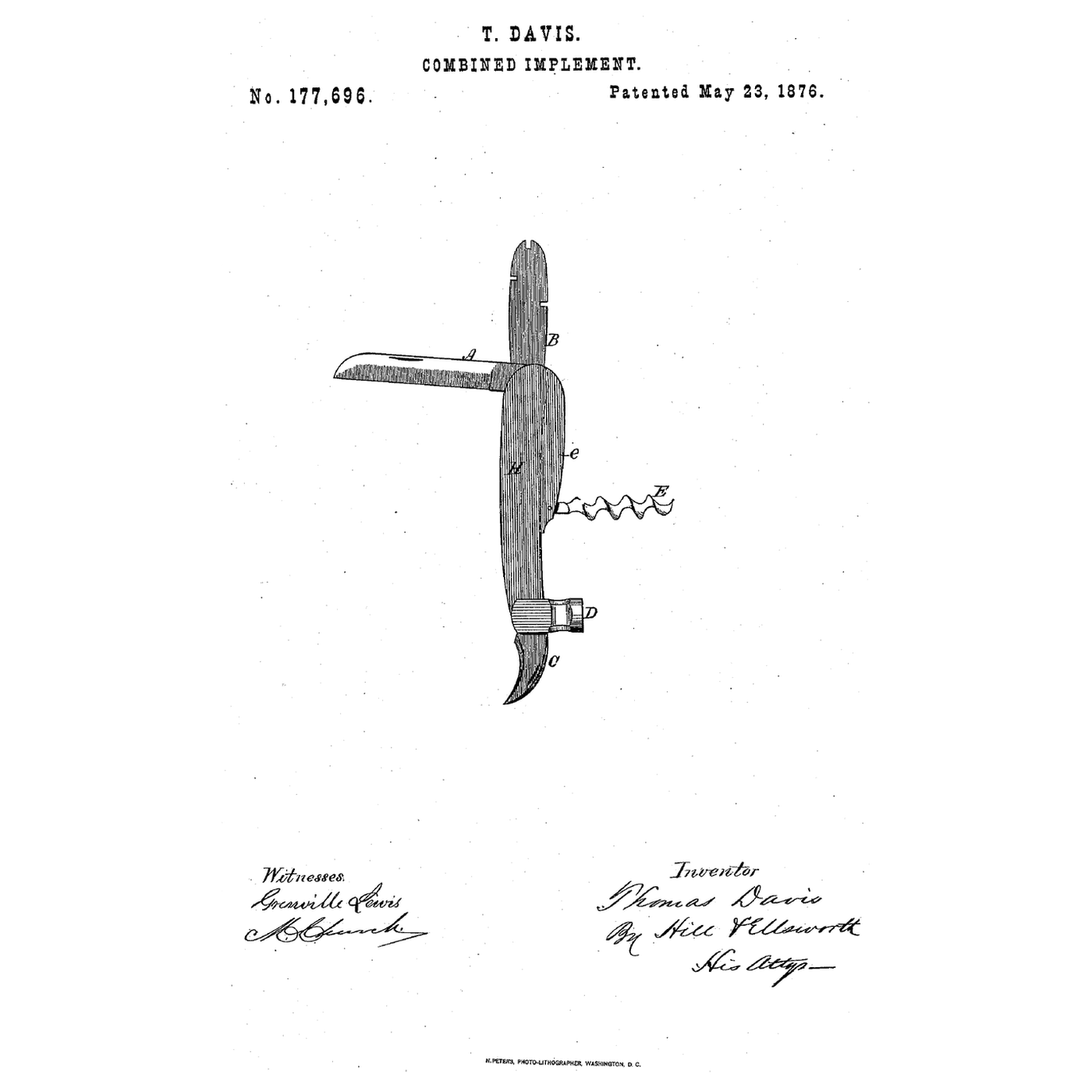
The Hoof-Cleaner Pocket Knife: Blade, Box Opener, Hoof Pick, Hammer and Corkscrew in One Handle
від Karen
Металообробка
11
0
0
0
0
0

The Tweezer Pocket Implement: Knife, Rule, Hook, Calipers and File Hung Inside a Pair of Tweezers
від Tex
Металообробка
10
0
0
0
0
0

The Pocket-Case Corkscrew: A Tube That Holds the Screw, Then Becomes Its Handle
від Forge
Металообробка
20
0
0
0
0
0
CC0 Суспільне надбання
Це креслення випущено під ліцензією CC0. Ви можете вільно копіювати, змінювати, поширювати та використовувати цю роботу для будь-яких цілей без запиту дозволу.
Підтримайте мейкера, купуючи продукти через його креслення, де він отримує Комісію мейкера встановлену вендорами, або створіть нову ітерацію цього креслення та включіть його як зв'язок у власне креслення для розподілу доходу.