МИСТЕЦТВО
КРАСА ТА ЗДОРОВ'Я
РЕМЕСЛО
КУЛЬТУРА ТА ІСТОРІЯ
РОЗВАГИ
СЕРЕДОВИЩЕ
ЇЖА ТА НАПІЇ
ЗБОРНА ІНЖЕНЕРІЯ
НАУК
СПОРТ
ТЕХНОЛОГІЯ
НОСИМО


The Stamped Cross Plant Marker: One Pressed Body and a Spring Name Plate
A plant marker with a frame, a cover and a key has parts to lose and costs more to make.
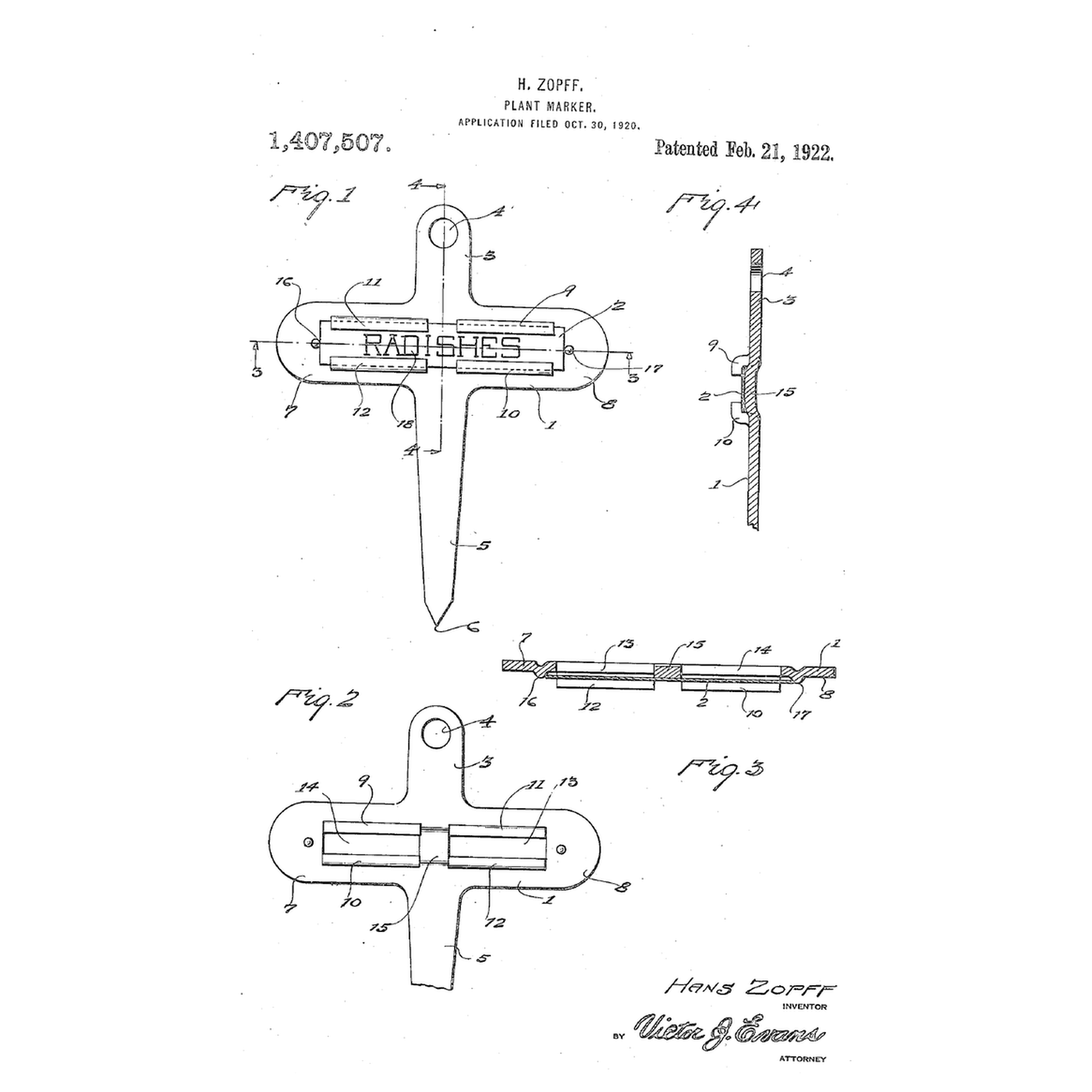
Hans Zopff of Monroe, Michigan, received US 1,407,507, patented 21 February 1922, for a marker "constructed of a minimum number of parts" and "preferably stamped from sheet metal": a cross-shaped body with a perforated head, a tapered pointed stake and two arms whose struck-out guides hold a sprung name plate, pressed tight by a rib and stopped by bosses.
This rung works out how hard the rib presses the plate, then cuts the body from aluminium sheet and measures the pull needed to slide the plate out, with and without the rib.
Середній
About 3 hours
Інструкції
1
1
Rib pressure on the plate
Rib pressure on the plate
Завантаження блокнота Jupyter…
2
2
A sprung sheet-metal marker before it
A sprung sheet-metal marker before it
The embedded blueprint holds a card with a spring strip in a riveted frame. Zopff stamps the holder into the body itself and makes the name plate the spring.
3
3
Read US 1,407,507
Read US 1,407,507
"The carrying body 1 is cast in one piece, or preferably stamped from sheet metal substantially in cross shape, providing a head 3 which is perforated at 4 to permit the marker to be attached by means of a wire, string, or the like, to tag nursery trees or the like if it is so desired."
"The bracing rib 15 is slightly struck forwardly, as clearly shown in Figs. 3 and 4 of the drawing, for forcing the name plate 2 firm against the guides 9, 10, 11 and 12 to prevent accidental movement of the name plate relative to the carrying body."
4
4
Cut the cross
Cut the cross
Mark a cross on 1 mm aluminium sheet: a stake 30 mm wide and 200 mm long tapering to a point, arms 140 × 40 mm across its top, and a 30 mm head above. Cut it with tin snips and file every edge smooth.
Матеріали для цього кроку:
 Алюмінієвий лист1 штука
Необхідні інструменти ({count})
 Ножиці по металу
 Напилки (ручний напилок)
 Лінійка
 Перманентний маркер
 Шкіряні робочі рукавиці
5
5
Drill the head
Drill the head
Centre-punch the head and drill a 6 mm hole for a tie wire.
Необхідні інструменти ({count})
 Кернер
 Молоток
 Акумуляторний дриль
 Набір свердел
 Прозорі захисні окуляри
6
6
Strike out the guides
Strike out the guides
Mark a 25 mm band across the arms. On each arm chop two pairs of parallel slits 4 mm apart and 40 mm long with the cold chisel on the vice's anvil, one pair centred on the band's top edge and one on its bottom edge. Push each strip between its slits 1 mm forward from the back: four bridges.
Необхідні інструменти ({count})
 Слюсарне зубилоМолоток
 Слюсарні лещатаЛінійкаПерманентний маркерПрозорі захисні окуляри
7
7
Raise the rib and bosses
Raise the rib and bosses
Open the vice jaws 8 mm and lay the body face down across them. Set a drill bit's shank on the band's centre and tap it in about 2 mm: the rib. From the back, centre-punch a dimple 52 mm each side of the centre: the bosses.
Необхідні інструменти ({count})
Слюсарні лещатаНабір сверделКернерМолоток8
8
Stamp and fit the plate
Stamp and fit the plate
Cut a plate 25 × 100 mm from aluminium sheet, file its corners and drill a 3 mm hole 4 mm from one end. Stamp the plant's name on it. Bow it slightly and slide it under the bridges until it springs in between the bosses.
Матеріали для цього кроку:
Алюмінієвий лист1 штукаНеобхідні інструменти ({count})
Ножиці по металуНапилки (ручний напилок)Акумуляторний дрильНабір свердел Набір клейм по металу (ювелірний)Молоток
9
9
Measure the plate's grip
Measure the plate's grip
Hook the force meter through the plate's hole and pull along the arms until it slides out; note the force. Repeat three times, then tap the rib flat and repeat.
Необхідні інструменти ({count})
 Динамометр (пружинні ваги)
10
10
A plate that rattles, jams or slides out
A plate that rattles, jams or slides out
Stamped cross marker troubleshooting.
Flow
Loading...
11
11
History and honest limits
History and honest limits
**Hans Zopff**, a citizen of Germany residing at Monroe, Michigan, filed US 1,407,507 on 30 October 1920; it was patented 21 February 1922. He preferred a name plate of resilient or spring sheet metal, with its indicia printed on or cut out, and wrote that an all-metal marker may be "Parkerized" or chemically treated to render it rust proof, so it can be used a number of seasons. It comprises two pieces: the body and the name plate.
**Honest limits.** He gives no sizes; ours are examples, and slits and pliers stand in for a stamping die. Aluminium needs no rust-proofing; a steel body would. The notebook treats the plate as a simple beam, and an aluminium plate presses less than his spring metal. Your pull forces are the result.
Матеріали
1- 1 штукаЗаповнювач
Необхідні інструменти
14- Заповнювач
- Заповнювач
- Заповнювач
- Заповнювач
- Заповнювач
- Заповнювач
- Заповнювач
- 1 vendor sell this, none ship to you yetЗаповнювач
- Заповнювач
- Заповнювач
- Заповнювач
- Заповнювач
- Заповнювач
- Заповнювач
Пов'язані креслення
Ці креслення діляться знаннями — техніки, матеріали або принципи



CC0 Суспільне надбання
Це креслення випущено під ліцензією CC0. Ви можете вільно копіювати, змінювати, поширювати та використовувати цю роботу для будь-яких цілей без запиту дозволу.
Підтримайте мейкера, купуючи продукти через його креслення, де він отримує Комісію мейкера встановлену вендорами, або створіть нову ітерацію цього креслення та включіть його як зв'язок у власне креслення для розподілу доходу.