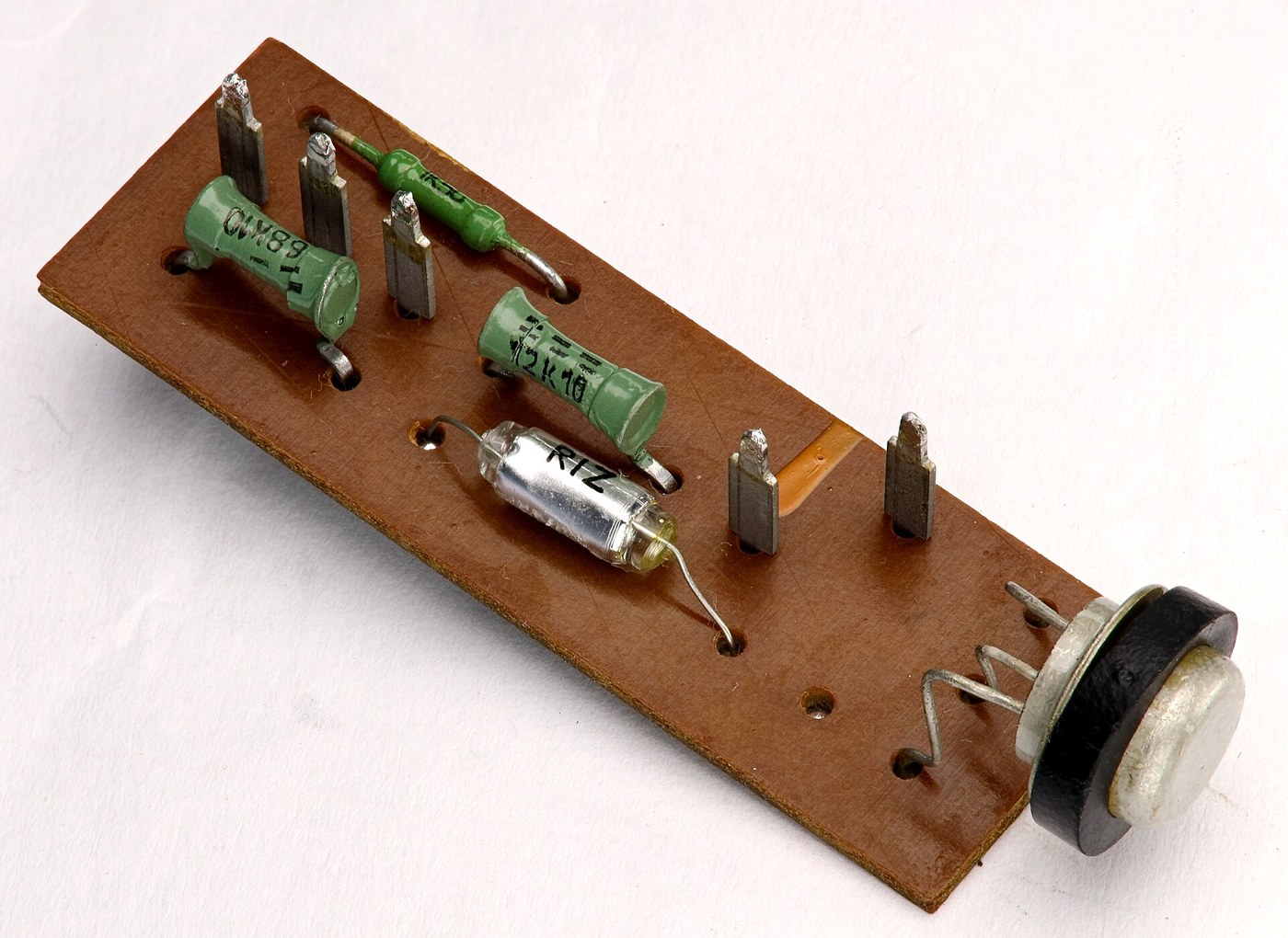

The Transistor Logic Gate
Інструкції
Build the same three gates, a thousand times faster
Build the same three gates, a thousand times faster
Rebuild the relay blueprint's gates with transistors and compare them directly.
- NOT: one NPN transistor, base through a resistor to the input, collector through a resistor to supply. Output at the collector.
- NOR: two transistors sharing one collector resistor — either input high pulls the output low.
- NAND: two transistors in SERIES — both inputs must be high to pull the output low.
- Verify each truth table, then measure propagation delay with the oscilloscope.
Series is AND and parallel is OR, exactly as with relay contacts — the topology did not change, only what is doing the switching. The delay will be tens of nanoseconds against the relay's milliseconds.
Note that the natural transistor gates are the INVERTING ones — NAND and NOR — because a transistor pulls its output DOWN when driven. A non-inverting AND costs an extra inverter. That is why real logic families are built from NAND and NOR, and why the next step matters so much.Матеріали для цього кроку:
 Набір транзисторів1 набір
 Набір резисторів1 набір
 Набір індикаторних світлодіодів1 набір
 Макетна плата з перфорацією1 штука
 Монтажний провід1 reel
Необхідні інструменти ({count})
 Паяльна станція
 Осцилограф
 Генератор сигналів
 Цифровий мультиметр лабораторного класу
 Регульоване лабораторне джерело живлення
NAND is enough for everything
NAND is enough for everything
Робочий простір Blockly
Loading Blockly workspace...
Необхідні інструменти ({count})
 Настільний комп'ютер
Fan-out, noise margin and why digital is reliable
Fan-out, noise margin and why digital is reliable
Необхідні інструменти ({count})
Настільний комп'ютерMeasure the power, and find the real wall
Measure the power, and find the real wall
The valve machine's limit was heat. Measure whether that limit really went away.
- Measure the current your transistor gate draws with the output high, and again with it low.
- Now drive it with a square wave and measure average current against frequency.
- Plot it and extrapolate.
Static current is small; average current rises roughly in proportion to switching frequency, because every transition charges and discharges the capacitance of the next stage, and that energy is dissipated as heat every single time.
So the heat problem never disappeared — it was postponed, and it returns the moment you have enough gates switching fast enough. That is precisely the wall processors hit around 2005, when clock speeds stopped rising and manufacturers began adding cores instead: not because faster was impossible, but because the heat was.
CMOS was the escape from the static half of the problem — it draws almost no current when it is not switching, which is why it displaced everything else and why a modern chip's power is almost entirely switching energy. ENIAC's engineers left their valves powered continuously because switching them on and off killed them; the same instinct, for a different reason, is why your phone aggressively idles its cores.Матеріали для цього кроку:
Набір транзисторів1 набірНабір резисторів1 набір Набір конденсаторів1 набір
Необхідні інструменти ({count})
ОсцилографГенератор сигналівЦифровий мультиметр лабораторного класу Струмові кліщі AC/DC 600 АРегульоване лабораторне джерело живлення
Assemble the batch into a computer
Assemble the batch into a computer
Everything needed has now been built. Put it together and notice that nothing is missing.
- Gates — from this blueprint, or from relays if you prefer to hear it working.
- An adder — from the binary adder blueprint.
- Registers — flip-flops from the Eccles-Jordan blueprint.
- Memory — core, or simply more flip-flops at small scale.
- A program counter, an instruction decoder and a conditional jump — from the stored-program blueprint.
- An assembler — from the previous blueprint, to make it usable by a human.
That is a complete general-purpose computer, and every part of it was invented before 1950. Everything since has been the same architecture made smaller, faster and cheaper — which is not a small thing, since it changed the world, but it is not a different thing.
The batch's real lesson is the one it has repeated at every step: the logic was finished in 1937 and the engineering was never finished at all. Shannon's algebra describes a relay machine, a valve machine, a transistor machine and the processor rendering this page, without alteration. What changed a million-fold, twice, was the switch — and each time the switch improved, the same ideas simply became affordable in larger quantities. If you want to know what computing does next, do not look at the algebra. Look at what is replacing the transistor.Необхідні інструменти ({count})
Настільний комп'ютерМатеріали
6- 1 набірЗаповнювач
- Заповнювач
- Заповнювач
- 1 штукаЗаповнювач
- 1 reelЗаповнювач
- 1 набірЗаповнювач
Необхідні інструменти
7- Заповнювач
- Заповнювач
- Заповнювач
- Заповнювач
- Заповнювач
- Заповнювач
- Заповнювач
Пов'язані креслення
Ці креслення діляться знаннями — техніки, матеріали або принципи

CC0 Суспільне надбання
Це креслення випущено під ліцензією CC0. Ви можете вільно копіювати, змінювати, поширювати та використовувати цю роботу для будь-яких цілей без запиту дозволу.
Підтримайте мейкера, купуючи продукти через його креслення, де він отримує Комісію мейкера встановлену вендорами, або створіть нову ітерацію цього креслення та включіть його як зв'язок у власне креслення для розподілу доходу.