
Understanding Oxygen Through Combustion — The Element That Makes Fire Breathe
Oxygen (O, element 8) is the most abundant element in Earth's crust (46% by mass), the third most abundant in the universe, and the element without which neither fire nor animal life could exist. Every breath you take extracts oxygen from the 21% O₂ in Earth's atmosphere; every fire you light consumes it. Yet for most of human history, no one knew oxygen existed — fire, rusting, and breathing were mysteries explained by phlogiston theory (a hypothetical fire-substance released during combustion).
Joseph Priestley isolated oxygen on August 1, 1774 by focusing sunlight on mercury oxide (HgO) with a lens, producing a gas that made a candle burn brighter and a mouse more active. Carl Wilhelm Scheele had independently isolated it earlier (1771–72) but published later. Antoine Lavoisier named it 'oxygène' (acid-former, from Greek 'oxys' + 'genes') in 1777 and proved that combustion is combination with oxygen, not release of phlogiston — this Oxygen Revolution is considered the birth of modern chemistry.
This blueprint teaches you to understand oxygen by observing its role in combustion — the same phenomena that puzzled humanity for millennia. Through simple experiments with candles, steel wool, and rust, you will see oxygen's three defining properties: it supports combustion, it combines with metals (oxidation), and it is essential for respiration.
Інструкції
Understand oxygen's properties and place in the periodic table
Understand oxygen's properties and place in the periodic table
Oxygen (O, element 8) sits in Group 16 (chalcogens), Period 2. It has an atomic weight of 15.999 and electron configuration [He] 2s² 2p⁴. With six valence electrons, oxygen needs two more to complete its octet — it achieves this by forming two covalent bonds (as in H₂O) or by gaining two electrons to form the oxide ion O²⁻ (as in metal oxides like Fe₂O₃). Oxygen's high electronegativity (3.44, second only to fluorine at 3.98) makes it one of the most powerful electron-attractors in nature.
Molecular oxygen (O₂) is a colorless, odorless gas that constitutes 20.95% of Earth's atmosphere. Unusually, O₂ is paramagnetic — it is weakly attracted to magnets — because it has two unpaired electrons in antibonding orbitals (a fact that defied explanation until molecular orbital theory). Oxygen also forms ozone (O₃), a pale blue gas with a sharp smell that absorbs ultraviolet radiation in the stratosphere, protecting life on Earth's surface.
Demonstrate oxygen consumption with an inverted jar over a candle
Demonstrate oxygen consumption with an inverted jar over a candle
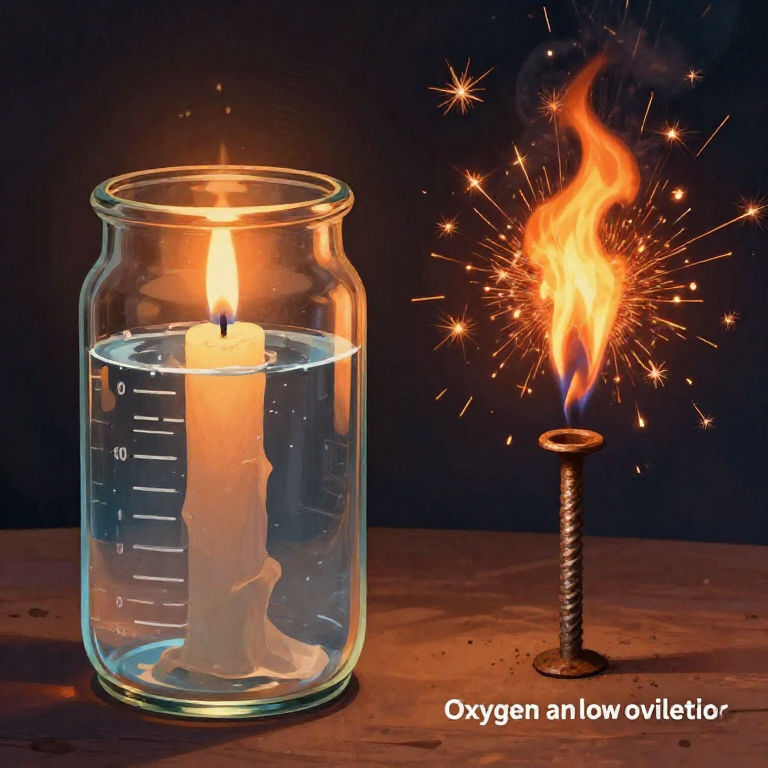
Light a candle and place it on a flat surface in a shallow dish of water. Lower an inverted glass jar over the candle, with the rim submerged in the water. The candle burns for a short time, then extinguishes as it consumes the oxygen trapped inside the jar. As the oxygen is used up (converted to CO₂ and H₂O vapor), the water level inside the jar rises — demonstrating that a portion of the air has been consumed.
The water rises approximately one-fifth of the jar's height, corresponding to the ~21% oxygen content of air. The remaining gas is mostly nitrogen (78%), which does not support combustion. This elegant experiment demonstrates two facts simultaneously: air is a mixture (not a pure substance), and combustion specifically requires the oxygen fraction. Lavoisier performed a more sophisticated version of this experiment in the 1770s to disprove phlogiston theory.
Матеріали для цього кроку:
 Скляна банка
 Чиста вода (для промивання)
Observe rapid oxidation: burn steel wool
Observe rapid oxidation: burn steel wool
Take a small wad of fine steel wool (grade 0000 or 000) and touch it to a flame or a 9V battery terminal. The steel wool ignites and burns with bright orange sparks — iron combining directly with oxygen: 4Fe + 3O₂ → 2Fe₂O₃. The reaction is spectacularly visible because the fine steel fibers have enormous surface area relative to their mass, allowing rapid contact with atmospheric oxygen.
This is the same reaction as rusting (slow oxidation), but happening fast enough to produce visible light and heat. A solid iron bar will not burn in air because its surface-to-volume ratio is too low — the heat of oxidation dissipates faster than it is generated. But the same iron, finely divided as steel wool, burns vigorously. Surface area controls reaction rate — a principle central to catalysis, combustion engineering, and metallurgy.
Observe slow oxidation: rust formation on iron
Observe slow oxidation: rust formation on iron
Place a clean iron nail or piece of steel wool in a shallow dish. Add water to moisten it and leave it exposed to air. Within hours to days, orange-brown rust (iron(III) oxide hydroxide, FeOOH) forms on the surface. This is the same chemical reaction as burning steel wool — iron + oxygen → iron oxide — but occurring so slowly that no heat or light is visible.
Rust requires both oxygen AND water: iron in dry air oxidizes extremely slowly (a thin protective oxide layer forms and stops); iron in water without dissolved oxygen does not rust; but iron in contact with both water and oxygen rusts rapidly because water provides the electrolyte medium for electrochemical corrosion. Salt accelerates rusting by increasing water's conductivity — this is why cars in coastal regions rust faster.
Demonstrate oxygen's role in respiration with a sealed jar experiment
Demonstrate oxygen's role in respiration with a sealed jar experiment
Place a small living plant (a sprig of aquatic weed like Elodea, or a terrestrial plant in a jar of water) in bright sunlight. Observe tiny bubbles forming on the leaves and rising through the water. These bubbles are oxygen gas — the product of photosynthesis: 6CO₂ + 6H₂O + light energy → C₆H₁₂O₆ + 6O₂. This is the reaction that produced virtually all the oxygen in Earth's atmosphere over 2.4 billion years (the Great Oxidation Event).
Before photosynthetic cyanobacteria evolved, Earth's atmosphere contained almost no free oxygen. The oxygen we breathe is a biological product — every O₂ molecule in the atmosphere was once part of a water molecule split apart by photosynthesis. In respiration, animals reverse this reaction: C₆H₁₂O₆ + 6O₂ → 6CO₂ + 6H₂O + energy. The entire biosphere is a cycle of oxygen between these two reactions.
Understand oxygen's connections to civilization
Understand oxygen's connections to civilization
Oxygen touches every aspect of human existence. Metallurgy: smelting metal ores is fundamentally about removing oxygen from metal oxides using carbon as a reducing agent (Fe₂O₃ + 3CO → 2Fe + 3CO₂). The Bessemer process (1856) revolutionized steelmaking by blowing air through molten iron to burn out excess carbon — oxygen as the refining agent. Medicine: supplemental oxygen saves millions of lives annually. Hyperbaric oxygen therapy treats decompression sickness and wound infections. Welding: oxy-acetylene torches (C₂H₂ + O₂) reach 3480 °C — hot enough to cut through steel. Rocketry: liquid oxygen (LOX) is the most common rocket oxidizer. Water treatment: ozone (O₃) disinfects drinking water more effectively than chlorine. Geology: oxygen combined with silicon forms silicates — 90% of Earth's crust. Combined with hydrogen, it forms water — covering 71% of Earth's surface.
Oxygen is the element that separates alive from dead, burning from cold, metal from ore. It is the most reactive common element, the product of photosynthesis, the fuel of respiration, and the shaper of the world we know. Lavoisier's identification of oxygen did not just explain combustion — it ended alchemy and began chemistry.
Матеріали
3- 1 штукаЗаповнювач
- 1 штукаЗаповнювач
- 1 штукаЗаповнювач
Матеріали з пов'язаних креслень

CC0 Суспільне надбання
Це креслення випущено під ліцензією CC0. Ви можете вільно копіювати, змінювати, поширювати та використовувати цю роботу для будь-яких цілей без запиту дозволу.
Підтримайте мейкера, купуючи продукти через його креслення, де він отримує Комісію мейкера встановлену вендорами, або створіть нову ітерацію цього креслення та включіть його як зв'язок у власне креслення для розподілу доходу.