Співпраця
МИСТЕЦТВО
КРАСА ТА ЗДОРОВ'Я
РЕМЕСЛО
КУЛЬТУРА ТА ІСТОРІЯ
РОЗВАГИ
СЕРЕДОВИЩЕ
ЇЖА ТА НАПІЇ
ЗБОРНА ІНЖЕНЕРІЯ
НАУК
СПОРТ
ТЕХНОЛОГІЯ
НОСИМО
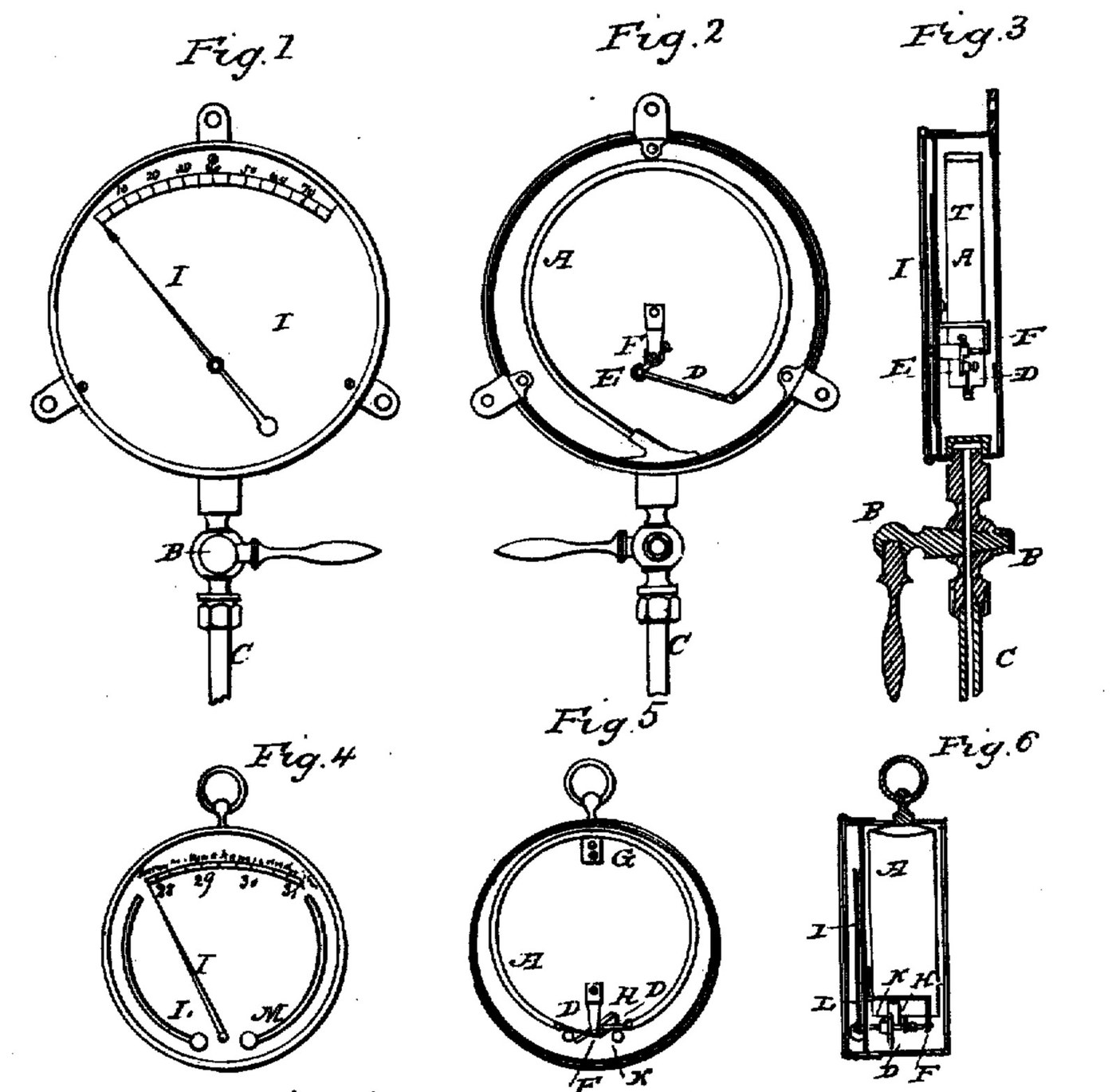


Vacuum Gauge: Flattened Curved Tube Driving an Index (Bourdon, US 9,163)
A vacuum gauge shows how far a line or vessel has been pumped below atmospheric pressure. Eugène Bourdon (US 9,163, 1852) found that a thin metal tube, flattened and bent into a curve, straightens a little under internal pressure and curls up more when the air is drawn out of it.
One end is open to the line through a cock; the closed end drives a lever on a spindle that carries the index. With the air withdrawn the index moves the opposite way to a pressure gauge, "and the instrument is then a vacuum gage."
Source: E. Bourdon, "Pressure-Gage", US Patent 9,163 (1852). Picture: its Figs. 1-6.
Просунутий
Unknown
Інструкції
1
1
Read Bourdon
Read Bourdon
"If the air be withdrawn from the interior of the tube A by means of an air pump or otherwise the curvature of the tube is increased and the index moves in the opposite direction and the instrument is then a vacuum gage."
2
2
Make the tube
Make the tube
Flatten a thin metal tube so its section is no longer round (Bourdon draws oval, flat, cross and Y sections) and bend it into a near circle. Close one end (how is not given) and leave the other open. Bourdon: the wall depends on the size, motion, pressure and metal; his only figure is brass about 1/100 in. thick for a barometer about 4 in. across. The metal, wall and size for the vacuum gauge are not given.
Матеріали для цього кроку:
 Невідомий метал1 tube
Необхідні інструменти ({count})
 Невідомий спосіб формування
 Невідомі розміри
3
3
Fit the movement
Fit the movement
Fix the open end of the tube in the case, connected through a cock to a pipe to the line or vessel. Join the closed end by a link to a short lever on a small spindle that carries the index (or drive the spindle by a toothed sector and pinion, or by a silk thread wound round it and kept tight by a spring). The lever multiplies the tube's movement at the index.
Матеріали для цього кроку:
 Невідомий вентиль1 cockНевідомий метал1 link, lever, spindle and indexНевідомий метал1 case
Необхідні інструменти ({count})
 Свердлильний верстат
 Набір свердел
 Напилки (ручний напилок)
4
4
Graduate the dial
Graduate the dial
Fit a dial behind the index. Bourdon graduates the arc by submitting the instrument to known pressures alongside an ordinary mercury gauge and marking each on the dial; equal steps of pressure give nearly equal degrees. Connect the gauge to a pump drawing the air out: the tube curls more and the index moves the opposite way to a pressure gauge. The reference used to mark a vacuum scale is not given.
Матеріали для цього кроку:
 Невідомий матеріал1 dial
Необхідні інструменти ({count})
 Вакуумний насос
Матеріали
3- 1 caseЗаповнювач
- 1 cockЗаповнювач
- 1 dialЗаповнювач
Необхідні інструменти
6- Заповнювач
- Заповнювач
- Заповнювач
- Заповнювач
- Заповнювач
- 1 vendor sell this, none ship to you yetЗаповнювач
За цим кресленням виготовляють
CC0 Суспільне надбання
Це креслення випущено під ліцензією CC0. Ви можете вільно копіювати, змінювати, поширювати та використовувати цю роботу для будь-яких цілей без запиту дозволу.
Підтримайте мейкера, купуючи продукти через його креслення, де він отримує Комісію мейкера встановлену вендорами, або створіть нову ітерацію цього креслення та включіть його як зв'язок у власне креслення для розподілу доходу.