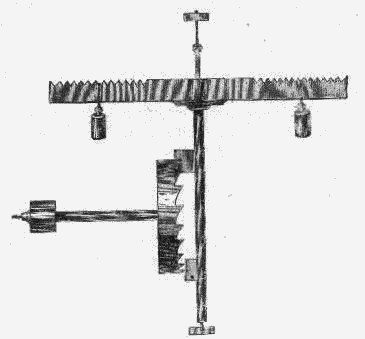


Verge Escapement
A falling weight will run a gear train straight to the floor in seconds. Something has to let it down in controlled instalments — and that something also has to be kept swinging by the very energy it is releasing. The escapement does both jobs at once, and the verge is the first one anybody built.
A crown wheel stands vertically. Across it, at right angles, sits a shaft — the verge — carrying two flags about 100° apart. A tooth pushes one flag, the verge swings, that flag clears, and the opposite flag catches the next tooth. One tooth escapes per swing. The bar or wheel on the verge stores the momentum that swings it back.
Build it big enough to watch. Everything wrong with the verge is visible at this scale — including the backward kick the crown wheel takes on every single beat.
Інструкції
Build it oversize on a board
Build it oversize on a board
Work at roughly 150 mm crown wheel diameter on a flat baseboard, not inside a case. The point of the model is that every interaction is visible and adjustable.
Матеріали для цього кроку:
 Дошка з твердої деревини1 штука
Cut a crown wheel with an odd tooth count
Cut a crown wheel with an odd tooth count
Cut a disc and form teeth standing up from its face, parallel to the axle, with an odd number of teeth — 13 or 15. Odd is not decorative: with an even count both pallets meet a tooth simultaneously and the escapement locks.
Матеріали для цього кроку:
 Латунний лист1 штука
Необхідні інструменти ({count})
 Ювелірний лобзик
 Набір надфілів
Shape the teeth asymmetrically
Shape the teeth asymmetrically
File each tooth with a steep face on the driving side and a slope on the back. The steep face delivers the push; the slope lets the pallet slide off cleanly.
Mount the crown wheel to turn freely
Mount the crown wheel to turn freely
Fit the wheel on a horizontal axle in two bearings. It must spin for several seconds from a flick — friction here masks everything you are trying to observe.
Матеріали для цього кроку:
 Латунний пруток1 штука
Mount the verge shaft across the wheel
Mount the verge shaft across the wheel
Fit a vertical shaft in its own bearings so it lies across the face of the crown wheel at right angles to the wheel's axle, close enough that flags on it can reach the teeth.
Fit two pallets about 100° apart
Fit two pallets about 100° apart
Fix two flat flags to the verge shaft, separated by roughly 100° around it, one engaging the wheel above its axle and one below. That angle is the heart of the mechanism and is worth making adjustable.
Set the depth of engagement
Set the depth of engagement
Adjust how far each pallet reaches into the teeth. Too shallow and teeth slip past; too deep and the wheel jams. There is a narrow band where it runs, and finding it by hand is the real work of this build.
Fit a foliot across the top
Fit a foliot across the top
Fix a horizontal bar to the top of the verge with a small weight near each end. This is the foliot, and it is the only thing storing momentum to swing the verge back.
Матеріали для цього кроку:
 Сталевий кульковий підшипник2 штук
Drive it with a small weight
Drive it with a small weight
Wind a cord on the crown wheel axle and hang a light weight from it. Start light and increase until the escapement runs steadily — too much drive and it slams, too little and it stalls.
Watch one full beat
Watch one full beat
Follow a single cycle by eye: tooth pushes upper pallet, verge rotates, upper pallet releases, lower pallet catches the next tooth, verge reverses. One tooth escapes per half-swing.
See the recoil
See the recoil
Watch the crown wheel closely at the end of each swing. It visibly runs backwards a little as the foliot's momentum shoves the pallet back into the tooth. That is recoil, it happens on every beat, and it is the verge's central flaw — friction, wear and a rate that depends on the drive force.
Time it and change the weight
Time it and change the weight
Count beats per minute, then double the driving weight and count again. It speeds up. A pendulum would not — the verge and foliot has no natural period of its own, and that single fact explains a hundred years of clock accuracy.
Необхідні інструменти ({count})
 Секундомір
Regulate by moving the weights
Regulate by moving the weights
Slide the foliot weights outward and re-time it. Further out, slower; further in, faster. This is how a medieval tower clock was set, and it is the only adjustment it had.
Swap the foliot for a short pendulum
Swap the foliot for a short pendulum
Replace the bar with a short pendulum hung from the verge and time it again. It steadies immediately, because now the timekeeper does have a period of its own. This one substitution is the whole seventeenth-century leap, done in five minutes.
History & Context
History & Context
The first mechanical escapement. The verge appeared in Europe in the late thirteenth or early fourteenth century — no inventor is known — and it is what made the mechanical clock possible at all. Before it, timekeeping meant water clocks. After it, the first tower clocks went up in Italian cities, and the same mechanism scaled down to domestic clocks and eventually to watches.
Why it is inaccurate. Two reasons, both structural. It is a recoil escapement: the momentum of the foliot pushes the crown wheel briefly backwards on every beat, which adds friction and wear and feeds variations in the drive train straight back into the rate. And the foliot has no natural frequency — a bar with weights on it will oscillate at whatever rate the force applied to it dictates. So the clock runs faster when the weight is heavier, when the train is freshly oiled, when the temperature changes the friction. A fourteenth-century tower clock with a verge and foliot was typically out by one to two hours a day.
The fix, and its size. Christiaan Huygens applied the pendulum to clockwork between 1656 and the 1670s. A pendulum has a period set by its own length and by gravity, largely independent of the driving force, so the escapement stopped defining the rate and started merely maintaining it. The accuracy improvement was roughly thirtyfold. Very few single changes in the history of technology are that large.
It did not die quickly. Verge watches were made well into the nineteenth century, long after better escapements existed, because the verge is cheap, robust and forgiving of dirt. Accuracy is not the only criterion a mechanism is judged on — a fact worth remembering before dismissing any superseded design.
Матеріали
4- 1 штукаЗаповнювач
- 1 штукаЗаповнювач
- 1 штукаЗаповнювач
- Заповнювач
Необхідні інструменти
3- Заповнювач
- Заповнювач
- Заповнювач
Матеріали з пов'язаних креслень
Пов'язані креслення
Ці креслення діляться знаннями — техніки, матеріали або принципи

CC0 Суспільне надбання
Це креслення випущено під ліцензією CC0. Ви можете вільно копіювати, змінювати, поширювати та використовувати цю роботу для будь-яких цілей без запиту дозволу.
Підтримайте мейкера, купуючи продукти через його креслення, де він отримує Комісію мейкера встановлену вендорами, або створіть нову ітерацію цього креслення та включіть його як зв'язок у власне креслення для розподілу доходу.