МИСТЕЦТВО
КРАСА ТА ЗДОРОВ'Я
РЕМЕСЛО
КУЛЬТУРА ТА ІСТОРІЯ
РОЗВАГИ
СЕРЕДОВИЩЕ
ЇЖА ТА НАПІЇ
ЗБОРНА ІНЖЕНЕРІЯ
НАУК
СПОРТ
ТЕХНОЛОГІЯ
НОСИМО


What Sets the Pitch: Length, Tension, Mass, and Nothing Else
A stretched string has exactly three properties that decide its note: how long the vibrating part is, how hard it is pulled, and how heavy it is per unit of length.
Everything else about the instrument — the wood, the shape, the varnish, the maker's reputation — changes the tone, the loudness and how long the note lasts. None of it changes the pitch.
Knowing that is what lets a maker design an instrument rather than copy one, and it is the reason a bass string is wound instead of simply thick. This rung is the string equation, worked, with a monochord to check it against.
Початківець
3 hours
Інструкції
1
1
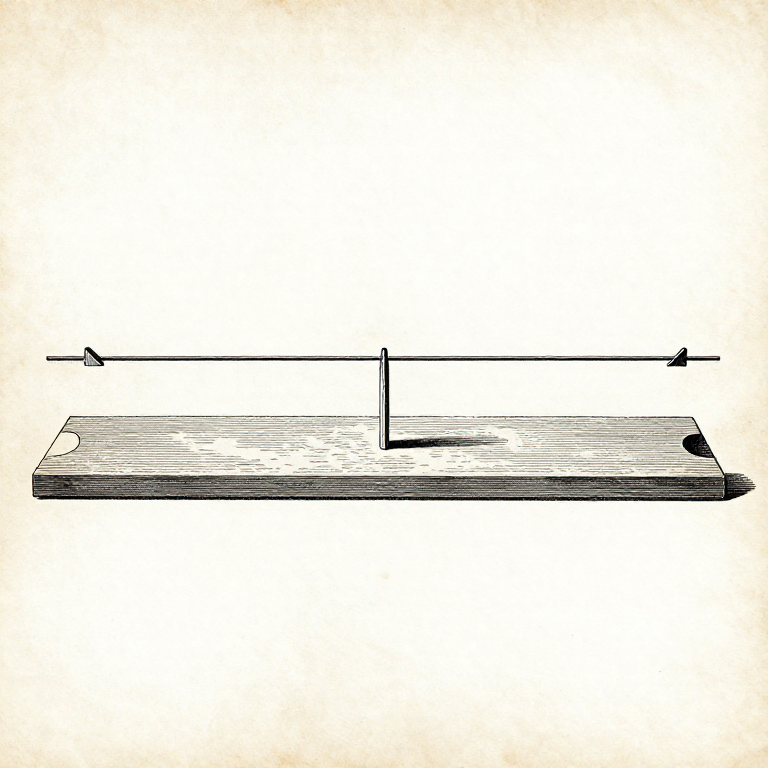
The monochord: one string, one movable bridge
The monochord: one string, one movable bridge
The instrument that demonstrates all of this is the simplest one there is: a single string stretched over a board between two fixed bridges, with a third wedge-shaped bridge that slides along under it.
A board about 800 mm long, a fixed bridge near each end, a tuning peg or a machine head at one end, and a hanging weight at the other if you want the tension known exactly rather than merely constant.
Slide the movable bridge to the middle and the two halves each sound an octave above the open string. At a third of the length, a twelfth. At a quarter, two octaves. This is the oldest experiment in acoustics and it still works on a plank in an afternoon.
Mark the divisions on the board as you find them by ear, then measure them. The ear gets there first and the ruler confirms it — which is the whole argument for building the thing.
Матеріали для цього кроку:
 Сталевий струнний дріт 0,032"1 штука
 Клеєна ялинова заготовка1 штука
 Нагелі2 штук
Необхідні інструменти ({count})
 Лінійка
 Хроматичний тюнер і метроном (прищіпка)
 Набір стамесок
2
2
The string equation, worked
The string equation, worked
Завантаження блокнота Jupyter…
Необхідні інструменти ({count})
 Настільний комп'ютер
3
3
Which variable a real instrument actually uses
Which variable a real instrument actually uses
Every instrument picks its variables, and the choice is what makes the family.
**Length, while playing.** A fingerboard shortens the string under the finger. Violin, oud, erhu, baglama: one string, many notes, and nothing to retune.
**Length, fixed per string.** A harp, a qanun, a lyre, a piano: one string per note, all sounding lengths set by the maker. Far more strings, but each can be optimised.
**Mass, across the set.** Every multi-string instrument uses this as well, because a harp whose bass strings were the same wire as its trebles would need to be metres long. Thicker and wound at the bottom, thin and plain at the top.
**Tension, for tuning only.** Tension is the fine adjustment, not the design variable, because the usable range is narrow: too low and the string is floppy and dull, too high and it breaks. Most instruments run their strings in a fairly tight band of tension and get their range from length and mass.
Look at any instrument in the catalogue and it can be read off: the mbira uses length alone, the panpipes use length alone, the oud uses all three.
Матеріали для цього кроку:
 Комплект гітарних струн (акустика, фосфориста бронза)1 набір
Необхідні інструменти ({count})
 Цифровий штангенциркуль 6 дюймівЛінійка
4
4
Harmonics, and why they matter to the maker
Harmonics, and why they matter to the maker
A string does not vibrate only as a whole. It vibrates in halves, thirds, quarters and so on at the same time, giving frequencies at two, three, four times the fundamental — the harmonic series. The mixture of those is the timbre.
Two consequences the maker can use directly:
**Where the string is struck or plucked decides which harmonics are strong.** A point exactly in the middle cannot excite the second harmonic at all, because the middle is that harmonic's node. Plucking near the bridge favours the high harmonics and sounds bright and thin; plucking near the middle sounds round and dull. This is free tone control with no change to the instrument.
**Touching lightly at a node gives the harmonic alone.** A finger resting at the halfway point silences every mode that needs motion there, leaving the octave. That is the harmonic every string player uses to tune, and it is the most precise pitch reference an instrument can produce without a tuner.
A real string is slightly stiff, so its upper partials run a little sharp of exact multiples. It is a small effect on gut or nylon, a real one on thick steel, and it is the reason piano tuners stretch the octaves.
Матеріали для цього кроку:
Сталевий струнний дріт 0,032"1 штукаНеобхідні інструменти ({count})
Хроматичний тюнер і метроном (прищіпка)ЛінійкаМатеріали
4- Заповнювач
- 1 штукаЗаповнювач
- 2 штукЗаповнювач
- Заповнювач
Пов'язані креслення
Ці креслення діляться знаннями — техніки, матеріали або принципи

CC0 Суспільне надбання
Це креслення випущено під ліцензією CC0. Ви можете вільно копіювати, змінювати, поширювати та використовувати цю роботу для будь-яких цілей без запиту дозволу.
Підтримайте мейкера, купуючи продукти через його креслення, де він отримує Комісію мейкера встановлену вендорами, або створіть нову ітерацію цього креслення та включіть його як зв'язок у власне креслення для розподілу доходу.