МИСТЕЦТВО
КРАСА ТА ЗДОРОВ'Я
РЕМЕСЛО
КУЛЬТУРА ТА ІСТОРІЯ
РОЗВАГИ
СЕРЕДОВИЩЕ
ЇЖА ТА НАПІЇ
ЗБОРНА ІНЖЕНЕРІЯ
НАУК
СПОРТ
ТЕХНОЛОГІЯ
НОСИМО
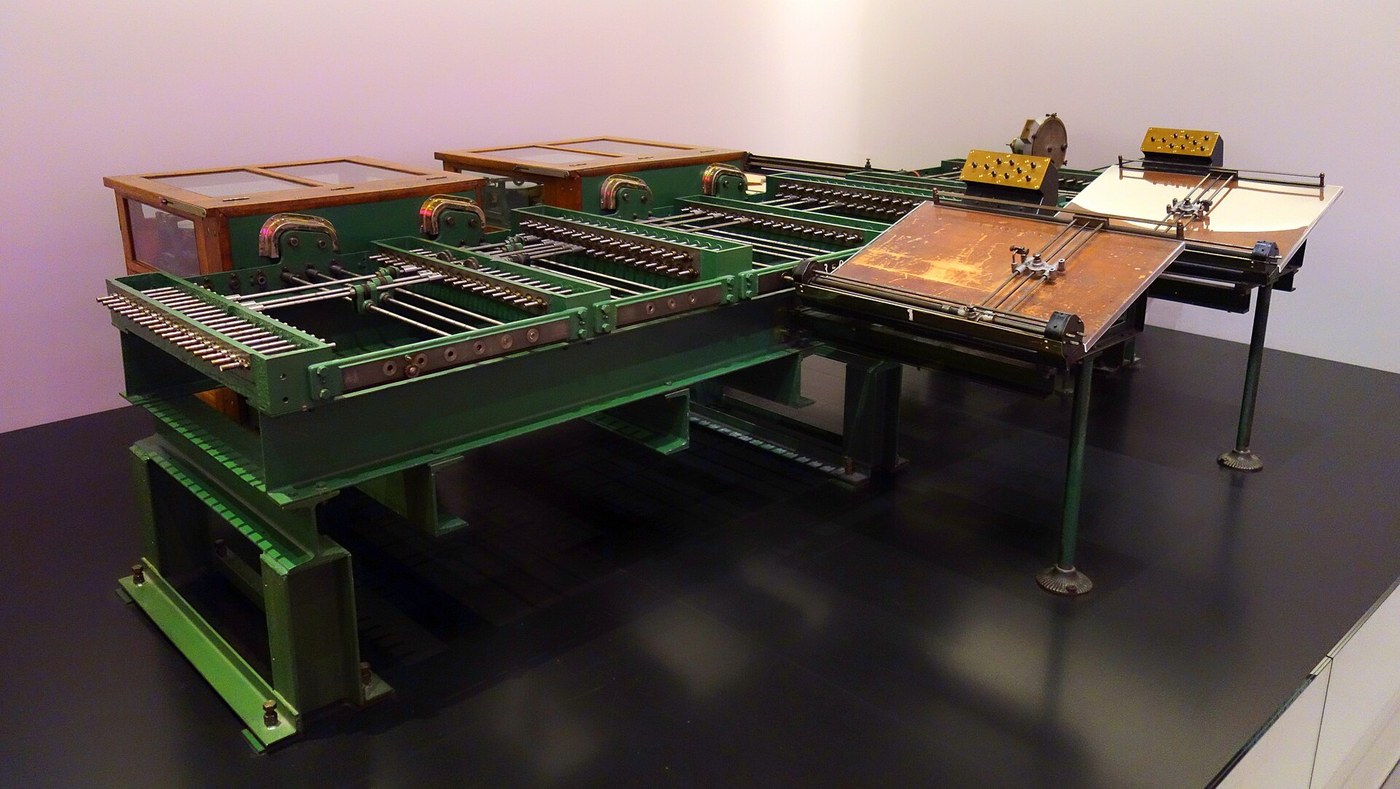


The Wheel-and-Disc Integrator
Stand a small friction wheel on a flat rotating disc with its axle pointing at the centre and its rim touching at radius x. Turn the disc once and the wheel is dragged along an arc of length two-pi-x, so it turns x over r times. Now move the wheel in and out while the disc keeps turning, and every increment of disc rotation adds whatever x happens to be at that instant. The wheel's total rotation is the integral of x, performed by friction, with no numbers anywhere.
William Thomson described this in 1876, together with a scheme for wiring several of them together to solve differential equations, and then could not build it. The reason is in the friction: a wheel pressed onto a disc with a few newtons can deliver perhaps twenty millinewton-metres before it slips, and setting the carriage of the NEXT integrator takes twenty times that. Each unit works; none of them can drive the next.
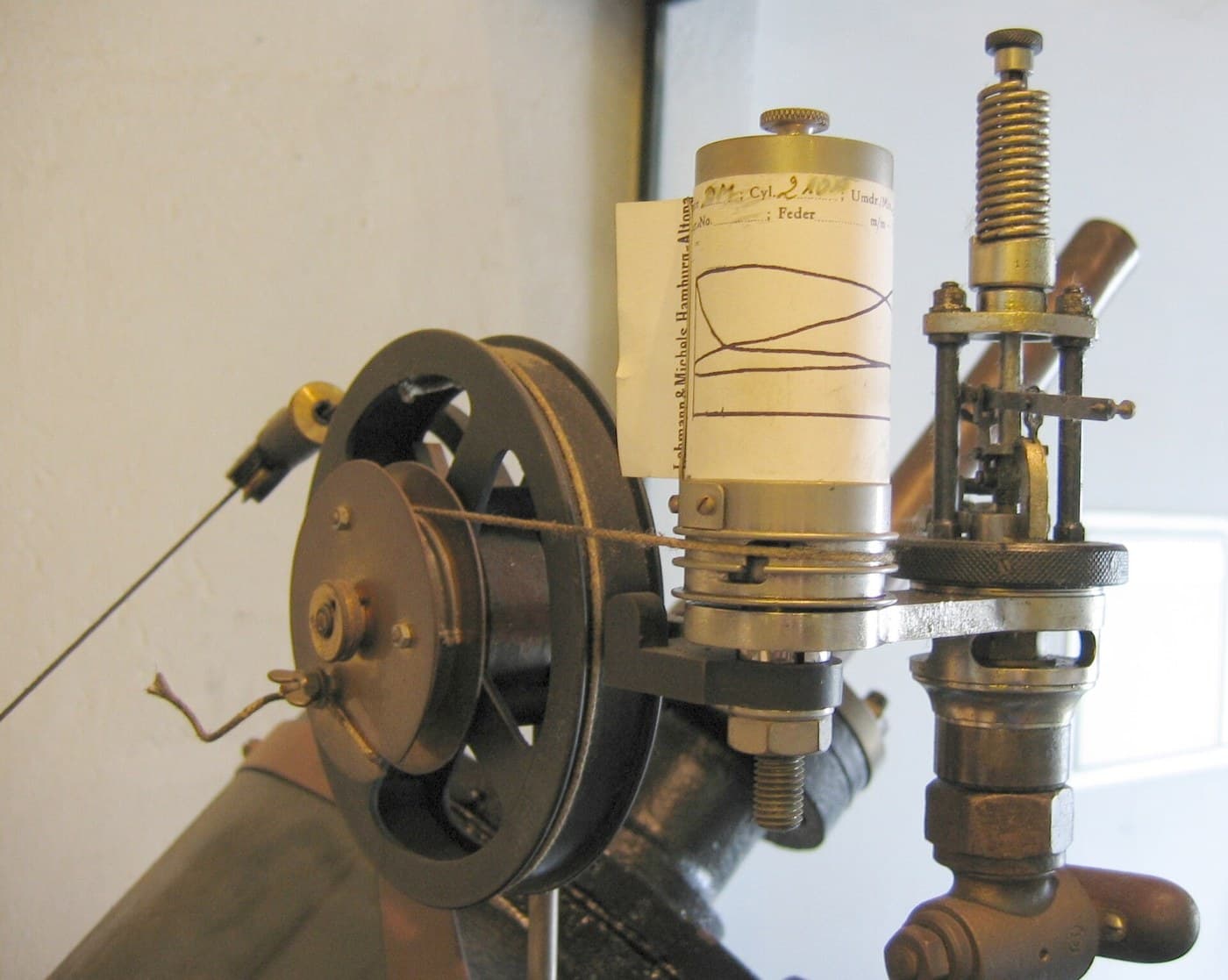
Vannevar Bush's differential analyser of 1931 solved it by putting a torque amplifier after every wheel. That is not a gearbox - gearing up the torque gears down the motion just as far, and the wheel has no motion to spare. It is a power amplifier: a band rides on a continuously driven capstan, the feeble wheel only has to tighten or slacken the band, and a separate motor does the work. Gains of ten thousand, from a mechanism that is itself a feedback loop, built a year before anybody could analyse one.
The machine that resulted solved ballistics, power-network transients and atomic-physics problems to about a tenth of a per cent per integrator, which was better than anything else available and is exactly the number that later lost to electronics. The op-amp integrator two blueprints further on does the same calculus by putting charge on a capacitor, and it wins because charge does not slip.
Середній
4 hours
Інструкції
1
1
A disc, a wheel, and a carriage
A disc, a wheel, and a carriage
Cut a 300 mm plywood disc, true it on the drill, and drive it slowly from the geared motor. Face it with paper for grip.
Make the wheel from an O-ring on a 30 mm hub, on a shaft carried in two bearings, and mount the whole shaft on a carriage that slides along a rail across the disc's radius. Mark the rail in millimetres from the centre.
Матеріали для цього кроку:
 Baltic Birch Plywood (1/4in)1 аркуш
 O-Ring Assortment Kit1 набір
 Ball Bearing2 штук
 Mild Steel Rod (6mm)300 mm
Необхідні інструменти ({count})
 Cordless Drill
 Geared DC Motor
 Digital Caliper 6-Inch
 Steel Ruler (30cm)
 Bench Power Supply (30V/5A)
2
2
Integrate something, then find the slip
Integrate something, then find the slip
Park the wheel at a fixed radius, count ten disc revolutions and count the wheel revolutions. The ratio should be the radius ratio; the shortfall is your slip.
Now do a real integral: crank the disc steadily and push the carriage out at a constant rate, so x rises linearly. The wheel should turn as t squared. Read it off at four times and plot against the arithmetic.
Матеріали для цього кроку:
 Graph Paper4 аркушів
Необхідні інструменти ({count})
 StopwatchSteel Ruler (30cm)
 Graphite Pencil Set
 Digital Tachometer
3
3
The kinematics, the torque that is missing, and four integrators
The kinematics, the torque that is missing, and four integrators
Завантаження блокнота Jupyter…
Необхідні інструменти ({count})
 Desktop Computer
4
4
Compendium: how a whole equation gets wired up
Compendium: how a whole equation gets wired up
The integrator is one unit; the analyser is what you make of six. Every variable in the problem is the angle of a shaft, and the machine is programmed by physically connecting shafts. To solve y-double-prime equals minus y you take a shaft carrying y, feed it to an integrator to get y-prime, feed that to a second to get y, and then couple the second output back to the first input through a reversing gear - a mechanical loop that literally is the differential equation. Addition is a differential gear; multiplying by a constant is a gear ratio; an arbitrary function is a shaped cam or a girl following a curve with a pointer while a servo copies her hand. Setting up one problem took a day or two, and changing a coefficient meant changing a gear.
It is worth knowing why the machines were kept long after electronic computers arrived. An analyser makes an error of a tenth of a per cent per integrator and never blows up, because friction is a physically bounded thing; early numerical integration on a digital machine could be far more accurate or catastrophically wrong depending on the step size, and nothing on the panel told you which. Operators who had watched a shaft turn could see the answer being wrong. That is a real advantage of an analogue machine and it is why the last differential analysers were still running into the 1950s.
Матеріали
5- 1 аркушЗаповнювач
- Заповнювач
- від$1.28
- 300 mmЗаповнювач
- 4 аркушівЗаповнювач
Необхідні інструменти
9- 1 vendor sell this, none ship to you yetЗаповнювач
- Geared DC Motor — Low RPM10% комісіяMagento Legacy Storeships internationallyЗаповнювач
- Заповнювач
- Заповнювач
- Заповнювач
- Заповнювач
- Заповнювач
- Заповнювач
- Заповнювач
Пов'язані креслення
Ці креслення діляться знаннями — техніки, матеріали або принципи


CC0 Суспільне надбання
Це креслення випущено під ліцензією CC0. Ви можете вільно копіювати, змінювати, поширювати та використовувати цю роботу для будь-яких цілей без запиту дозволу.
Підтримайте мейкера, купуючи продукти через його креслення, де він отримує Комісію мейкера встановлену вендорами, або створіть нову ітерацію цього креслення та включіть його як зв'язок у власне креслення для розподілу доходу.