Collaboration
ART
BEAUTY & WELLNESS
CRAFT
CULTURE & HISTORY
ENTERTAINMENT
ENVIRONMENT
FOOD & DRINKS
REVERSE ENGINEERING
SCIENCES
SPORTS
TECHNOLOGY
WEARABLES


Cane Glue Brush: the Bark Stripped from One End and the Fibres Hammered Loose (Adamson, Amateur Work, 1887)
The fret-cutter's glue brush recommended by D. B. Adamson in Amateur Work (1887): a piece of cane with the hard outer skin cut away at one end and the end hammered until the fibres loosen into a stiff brush, "better than any other" for rubbing glue into wood.
Beginner
A few minutes
Instructions
1
1
Read Adamson
Read Adamson
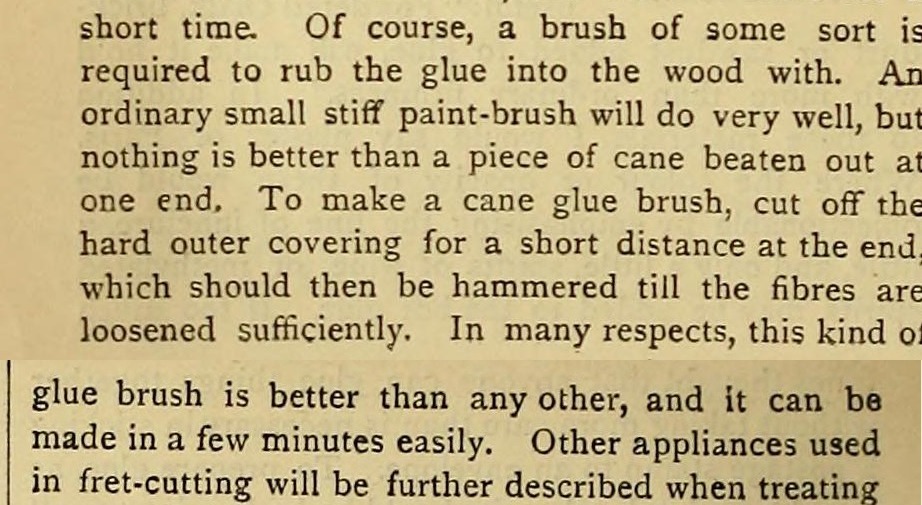
"Nothing is better than a piece of cane beaten out at one end."
2
2
Strip the end
Strip the end
Take a piece of cane (ours: about 15-20 cm) and cut off the hard outer covering for a short distance at one end (ours: about 2 cm).
Materials for this step:
 Rattan1 piece
Tools needed:
 Utility Knife
3
3
Beat out the fibres
Beat out the fibres
Lay the stripped end on a hard surface and hammer it until the fibres loosen into a brush.
Tools needed:
 Hammer
4
4
Use it
Use it
Warm the glue by standing its can or bottle in a basin of hot water, then rub the glue well into the wood with the brush.
Materials for this step:
 Water1 piece
Tools needed:
 Bucket
 Glue
5
5
Troubleshooting
Troubleshooting
Cane brush troubleshooting.
Flow
Loading...
6
6
History and honest limits
History and honest limits
From D. B. Adamson, "Fretsaw Work and Marquetry Cutting" III, **Amateur Work, Illustrated**, vol. VII (1887), p. 230 (checked on the archive.org scan amateurworkillus71887lond). He gives no lengths: those and the knife are ours.
This blueprint makes
CC0 Public Domain
This blueprint is released under CC0. You are free to copy, modify, distribute, and use this work for any purpose, without asking permission.
Support the Maker by purchasing products through their Blueprint where they earn a Maker Commission set by Vendors, or create a new iteration of this Blueprint and include it as a connection in your own Blueprint to share revenue.