Collaboration
ART
BEAUTY & WELLNESS
CRAFT
CULTURE & HISTORY
ENTERTAINMENT
ENVIRONMENT
FOOD & DRINKS
REVERSE ENGINEERING
SCIENCES
SPORTS
TECHNOLOGY
WEARABLES
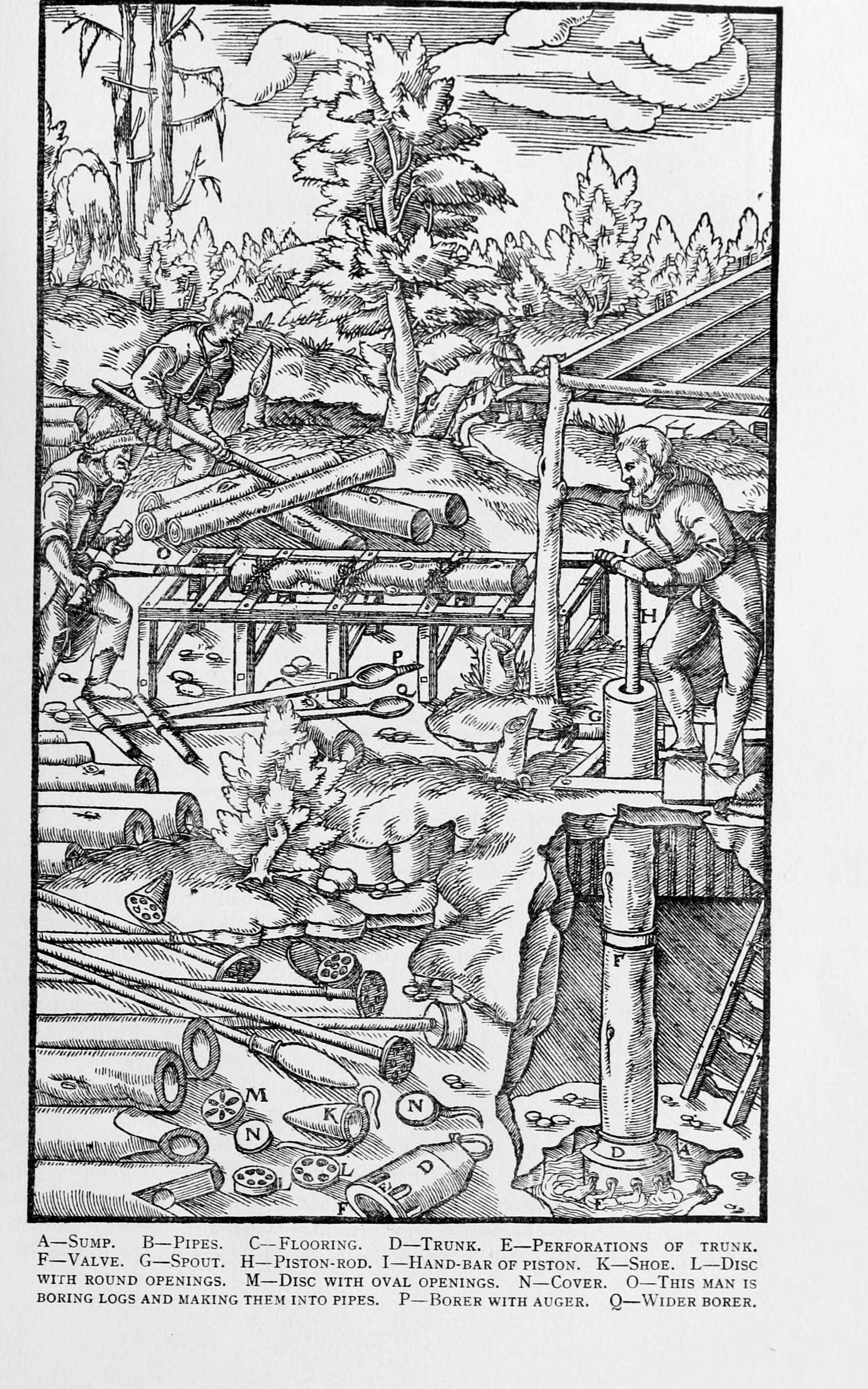


Mine Suction Pump of Bored Logs: Perforated Trunk, Valve Box and Leather-Shoe Piston (Agricola, 1556)
Agricola's first suction pump for draining mine sumps, from De Re Metallica, Book VI (1556): logs bored into pipes stand on a perforated trunk two feet deep in the sump, with a bottomless metal valve box one palm deep; a workman on the flooring works a piston whose leather shoe, or better a perforated iron or wooden disc, lifts the water to a spout into the tunnel drain.
Advanced
Several days
Instructions
1
1
Units and lift
Units and lift
Loading Jupyter Notebook...
2
2
Read De Re Metallica, Book VI
Read De Re Metallica, Book VI
"Thus the workman, eager at his labour, standing on the flooring boards, pushes the piston down into the pipe and draws it out again."
3
3
Bore the pipes
Bore the pipes
Bore straight logs through their length to make the pipe, first with a borer with an auger and then with a wider borer (Illustration 177, O-Q). Use one length, or two with one joined into the other.
Materials for this step:
 Log2 pieces
Tools needed:
 Auger
 Hand Auger
 Axe
 Drawknife
4
4
Make the trunk and valve box
Make the trunk and valve box
Make a trunk two feet deep, hollow like the pipe, its lower opening blocked with a round piece of wood and its sides perforated round about so water flows in. Make a box of iron, copper or brass one palm deep, without a bottom, closed by a rounded valve that stops the raised water running back. Set it in the top of the trunk if there is one pipe, or in the lower pipe at the joint if there are two.
Materials for this step:
Log1 piece Hardwood Board1 piece
 Mild Steel Sheet1 piece
 Harness Leather1 piece
Tools needed:
Auger Chisels
 Hacksaw
 Hammer
 Forge
 Anvil
5
5
Set the pipe
Set the pipe
Lay a flooring over the sump. Let the pipe down through it to the bottom of the sump with the trunk on its lower end, and fix it with pointed iron clamps driven in straight on both sides. Cut an opening or spout in the upper pipe reaching to the drain of the tunnel.
Materials for this step:
 Pine Board4 pieces
 Mild Steel Flat Bar2 pieces
 Nails1 piece
Tools needed:
 Hand SawHammerAuger
6
6
Make the piston
Make the piston
Fit the piston rod with a hand-bar at the top. At the bottom fix either a shoe, a leather covering stitched almost cone-shaped, tight round the rod and wide open at the top, or (far better) a disc of iron one digit thick or of wood six digits thick, fixed by an iron key through the rod or screwed on, with five or six round or oval openings in a star and a cover over them, the same diameter as the inside of the pipe.
Materials for this step:
Hardwood Board1 pieceHarness Leather1 pieceMild Steel Sheet1 pieceMild Steel Flat Bar1 pieceTools needed:
 Awl
 Two Harness Needles
 Hand Drill
 Files (Hand File)Hand Saw
7
7
Pump
Pump
Standing on the flooring, push the piston down and draw it up. On the up-stroke the cover closes the disc openings and the water above is lifted to the spout, while the valve of the box opens and water from the trunk rises by suction; on the down-stroke the valve closes and the water passes up through the disc.
8
8
Troubleshooting
Troubleshooting
Suction pump troubleshooting.
Flow
Loading...
9
9
History and honest limits
History and honest limits
From Georgius Agricola, **De Re Metallica** (1556), Book VI, translated by Herbert C. and Lou H. Hoover, 1912 (Gutenberg 38015; checked on the archive.org scan georgiusagricola00agri, pp. 176-177). He gives no bore, pipe length or lift. The metric equivalents of his Roman units, the suction limit and the tools are ours.
Materials
7- 2 piecesPlaceholder
- 1 piecePlaceholder
- 1 piecePlaceholder
- 2 piecesPlaceholder
- 4 piecesPlaceholder
- 2 piecesPlaceholder
- 1 piecePlaceholder
Tools Required
14- Placeholder
- Placeholder
- Placeholder
- Placeholder
- Placeholder
- Placeholder
- Placeholder
- Placeholder
- Placeholder
- Placeholder
- Placeholder
- Placeholder
- Placeholder
- Placeholder
This blueprint makes
Related Blueprints
These blueprints share knowledge with this one — techniques, materials, or principles that connect them in the learning graph.

CC0 Public Domain
This blueprint is released under CC0. You are free to copy, modify, distribute, and use this work for any purpose, without asking permission.
Support the Maker by purchasing products through their Blueprint where they earn a Maker Commission set by Vendors, or create a new iteration of this Blueprint and include it as a connection in your own Blueprint to share revenue.