ART
BEAUTY & WELLNESS
CRAFT
CULTURE & HISTORY
ENTERTAINMENT
ENVIRONMENT
FOOD & DRINKS
REVERSE ENGINEERING
SCIENCES
SPORTS
TECHNOLOGY
WEARABLES
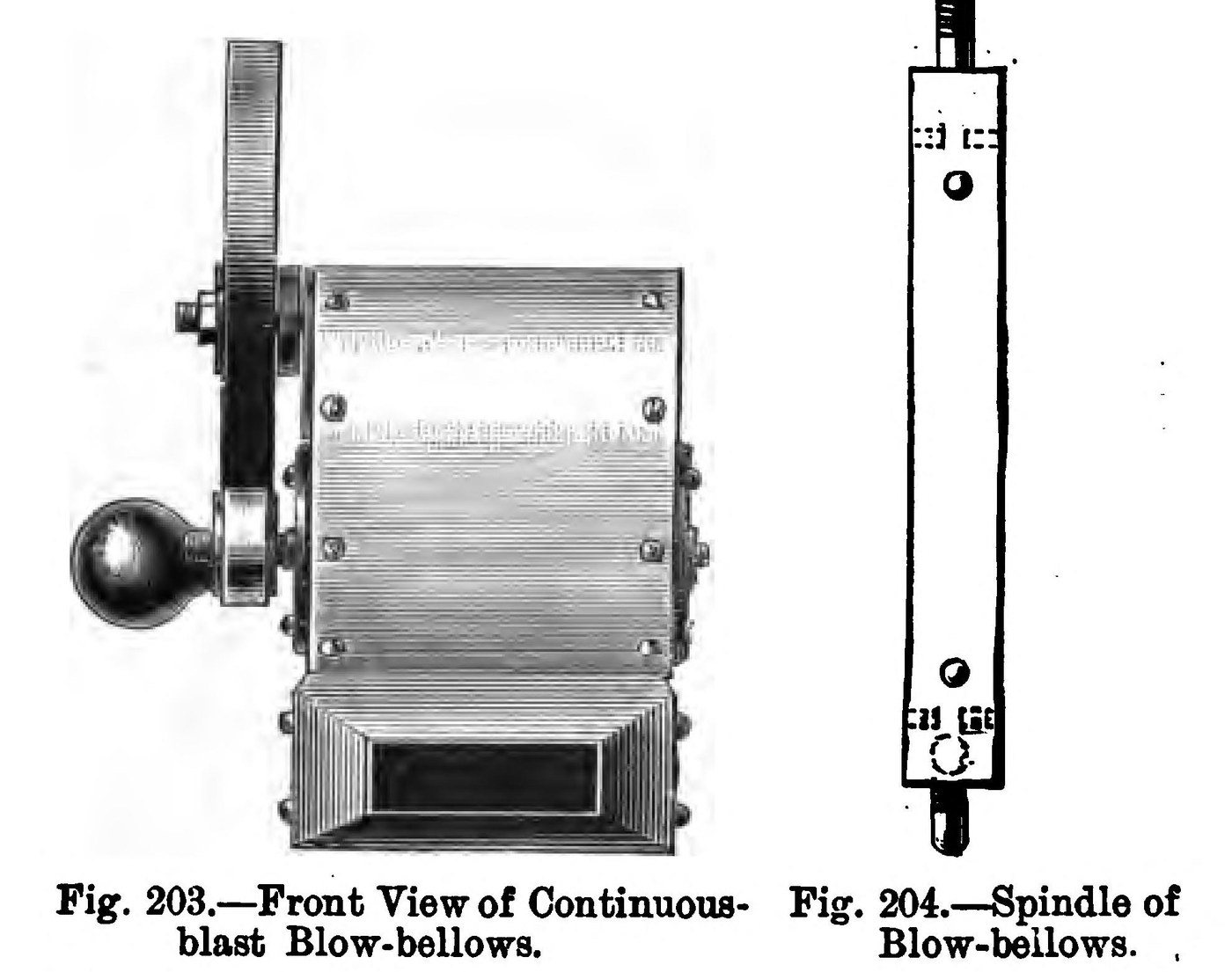


Air Blower: a Hand-Cranked Fan Blow-Bellows for a Portable Forge (Hasluck, 1904)
An air blower gives a fire a steady stream of air. Hasluck's Smiths' Work (1904) shows a small one for a home-made forge: a brass box with a four-winged tin fan on an iron spindle, spun fast by a hand wheel pressing on a rubber-covered roller. Unlike old bellows it blows continuously, through an outlet 2 1/2 in wide and 3/4 in deep.
The book's drawings carry no sizes for the box, so its size, the sheet thickness and the metals of the wire and the plate are unknown here; the tools are ours.
Source: P. N. Hasluck, Smiths' Work (1904), pp. 140-143, Figs. 202-211. Picture: their Figs. 203-204.
Intermediate
Two days
Instructions
1
1
Read Hasluck
Read Hasluck
"When this is all done, turn the handle rapidly; the fan inside will then revolve at a good rate, and a strong draught will be obtained."
2
2
Cut out the box
Cut out the box
Cut the two sides and the bottom of the box from sheet brass, and a piece for the top covering, but do not join them yet. Hasluck gives no sizes for the box (unknown); its outlet is to be 2 1/2 in wide and 3/4 in deep.
Materials for this step:
 Brass Sheet1 sides, bottom and covering
Tools needed:
 Tin Snips
 Unknown Dimensions
3
3
Make the fan
Make the fan
Make the iron spindle (Figs. 204, 205). Drill two holes in each of its four sides, one at each end, tap them, and screw in pieces of wire about 5/16 in long. Cut four pieces of tin, a little narrower than the box, and punch holes in them to match. Slip each wing over its wires, put a washer over each wire and rivet it over. Five or six wings may be used; then solder pieces of wire between them to stiffen them (Fig. 211).
Materials for this step:
 Iron Rod1 spindle
 Unknown Metal1 wire
 Tinplate Sheet1 four wings
 Flat Washer8 pieces
Tools needed:
 Hand Drill
 Tap and Die Set
 HacksawTin Snips
 Riveting Hammer
 Soldering Iron
4
4
Fit the spindle and close the box
Fit the spindle and close the box
Screw the brass bearings (Fig. 206), a ring with three spokes and a hole in the middle, to the two sides. Fit the iron spindle in the bearings, screw the sides and bottom together, then screw the covering over the top.
Materials for this step:
Brass Sheet1 two bearings Machine Screws1 set
Tools needed:
Hand DrillTap and Die Set5
5
Fit the hand wheel
Fit the hand wheel
The wheel has to be bought. Turn a brass spindle for it (Fig. 207), thread it at each end and fix it with a nut to a plate (Fig. 208); put on the wheel, hold it with a washer and another nut, and fit the knob on rather loosely. Before fixing the wheel, turn a small piece of wood (Fig. 209), put an india-rubber band over it and screw it onto the projecting end of the iron spindle. Fix the wheel so it presses tightly against this roller. Instead, both wheels may be grooved and driven by a band.
Materials for this step:
 Iron Hand Wheel1 piece
 Brass Rod1 wheel spindleUnknown Metal1 plate
 Hex Nut2 piecesFlat Washer1 piece
 Timber Plank1 roller
 Rubber Bands1 piece
Tools needed:
 Metal LatheTap and Die SetHand Drill
6
6
Fit the nose-piece
Fit the nose-piece
Cut the nose-piece from sheet brass to the pattern (Fig. 210) and bend it at right angles along the dotted lines so it fits over the outlet end of the box. Rivet or solder its two edges together, drill it and screw it on. Turn the handle quickly to test the draught.
Materials for this step:
Brass Sheet1 nose-pieceTools needed:
Tin SnipsSoldering IronHand Drill Safety Glasses
7
7
History and honest limits
History and honest limits
Hasluck's "Home-made Portable Forges" chapter offers this fan as a cheaper, steadier alternative to the old leather bellows, costing about half as much. He adds that gun-metal is better than brass for all parts except the covering and nose-piece.
The drawings carry no sizes, so the box size, the sheet thickness and the metals of the wing wires and wheel plate are unknown; the tools are ours.
Materials
11- 1 nose-piecePlaceholder
- 1 spindlePlaceholder
- 1 platePlaceholder
- 1 four wingsPlaceholder
- 9 piecesPlaceholder
- 1 setPlaceholder
- 1 piecePlaceholder
- 1 wheel spindlePlaceholder
- 2 piecesPlaceholder
- 1 rollerPlaceholder
- 1 piecePlaceholder
Tools Required
9- Placeholder
- Placeholder
- Placeholder
- Placeholder
- Placeholder
- Placeholder
- 2 vendors sell this, none ship to you yetPlaceholder
- Placeholder
- Placeholder
This blueprint makes

CC0 Public Domain
This blueprint is released under CC0. You are free to copy, modify, distribute, and use this work for any purpose, without asking permission.
Support the Maker by purchasing products through their Blueprint where they earn a Maker Commission set by Vendors, or create a new iteration of this Blueprint and include it as a connection in your own Blueprint to share revenue.