ART
BEAUTY & WELLNESS
CRAFT
CULTURE & HISTORY
ENTERTAINMENT
ENVIRONMENT
FOOD & DRINKS
REVERSE ENGINEERING
SCIENCES
SPORTS
TECHNOLOGY
WEARABLES
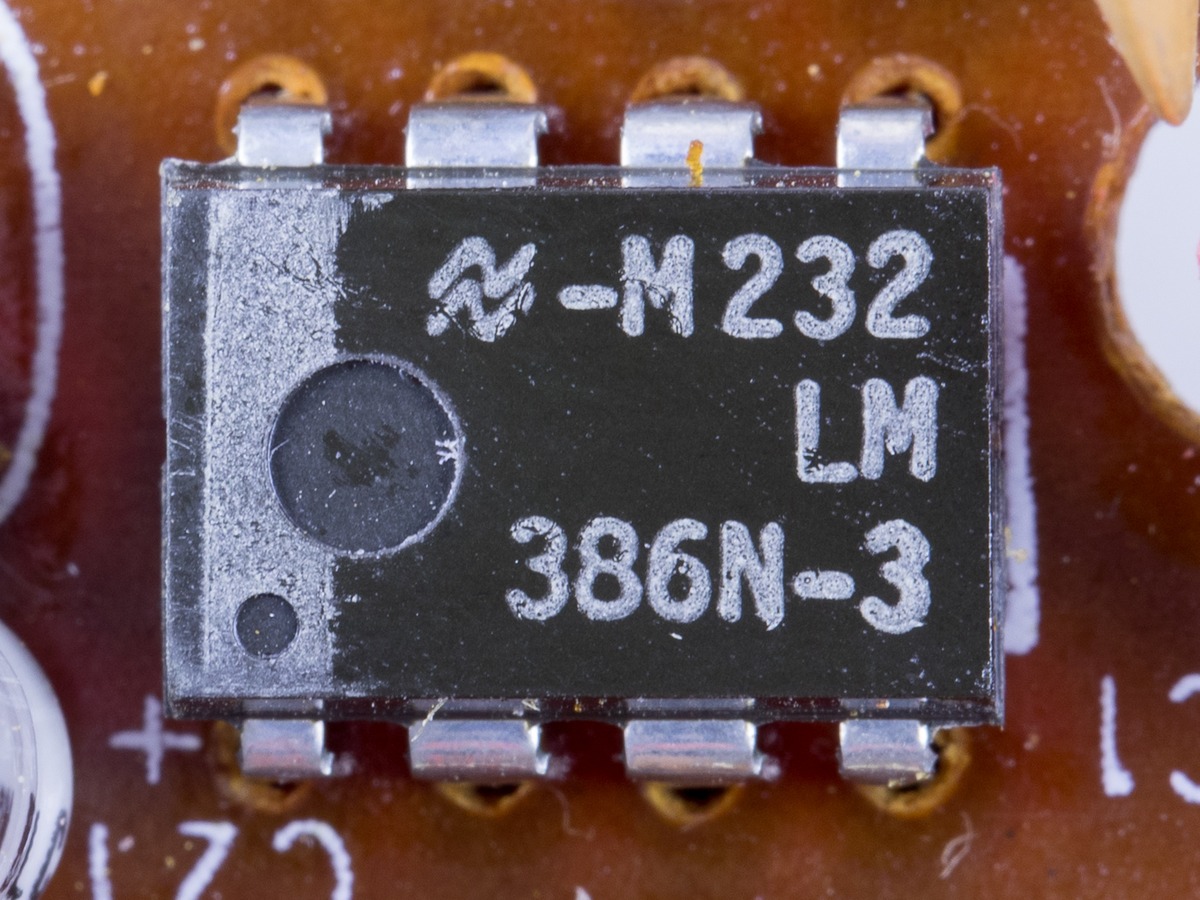


Audio Amplifier: an LM386 with Gain 20 and the Fewest Parts, on a 9 V Battery
A small loudspeaker amplifier for a phone, a microphone preamp or a guitar, built around the LM386 chip. Its gain of 20 is set inside the chip, so it needs only a volume control, two capacitors and a resistor, as in the datasheet's minimum part circuit. It runs from a 9 V battery and drives an 8 ohm speaker.
Beginner
About 2 hours
Instructions
1
1
An LM386 amplifier working
An LM386 amplifier working
An LM386 amplifier on a 9 V battery and an 8 ohm speaker (Tyro Mix).
2
2
The circuit
The circuit
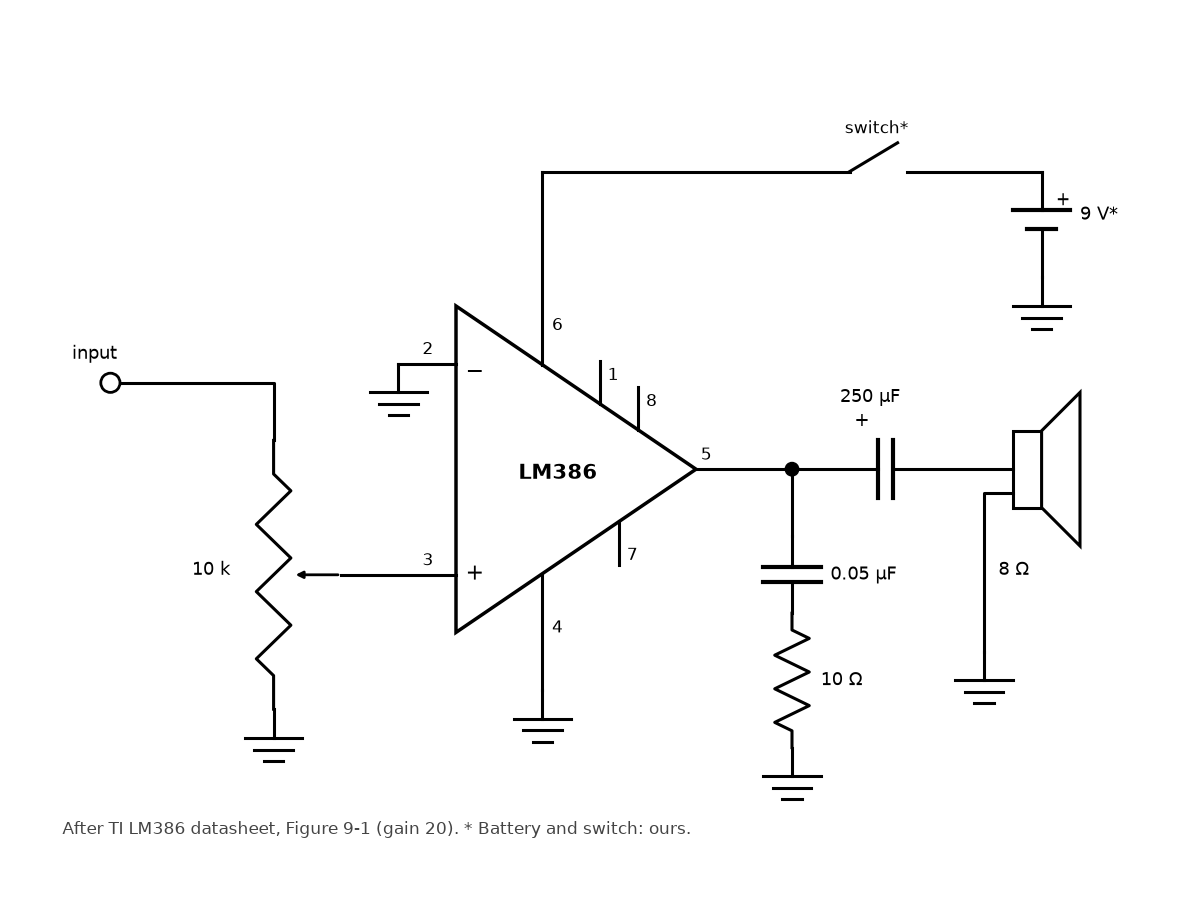
From the TI datasheet, Figure 9-1: the input goes across a 10 k potentiometer whose wiper feeds pin 3; pins 2 and 4 go to ground and pin 6 to the supply. Pin 5 drives the speaker through a 250 uF capacitor, with 0.05 uF and 10 ohm in series from pin 5 to ground. Pins 1, 7 and 8 stay open: "its gain is internally set to 20". The battery and switch are ours.
3
3
Bass, gain and battery
Bass, gain and battery
Loading Jupyter Notebook...
4
4
Build it on stripboard
Build it on stripboard
Place the chip across the middle of a small piece of stripboard and cut the copper strips between its two rows of pins with a drill bit turned by hand. Solder the chip, then the 10 ohm resistor and 0.05 uF capacitor (47 nF is the nearest stock value) in series from pin 5 to a ground strip, and the 250 uF capacitor (220 uF is the nearest stock value) from pin 5 with its + lead at pin 5. Link pins 2 and 4 to ground. Use an LM386N-3 for a 9 V battery.
Materials for this step:
 Audio Power Amplifier IC1 piece (LM386N-3)
 Resistor1 piece (10 ohm)
 Ceramic Capacitor Kit1 piece (0.05 uF / 47 nF)
 Electrolytic Capacitor1 piece (250 uF / 220 uF, 16 V or more)
 Stripboard1 piece (about 10 x 10 holes)
 Solder Wire1 m
Tools needed:
 Soldering Iron
 Flush Cutters
 Drill Bit Set
5
5
Wire the controls, speaker and battery
Wire the controls, speaker and battery
Wire the input jack's tip to one end of the 10 k potentiometer and its sleeve to the other end and to ground; the wiper goes to pin 3. Wire the speaker from the 250 uF capacitor's free lead to ground. Wire the battery's + lead through the switch to pin 6 and its - lead to ground.
Materials for this step:
 Potentiometer1 piece (10 k)
 Audio Jack1 piece (3.5 mm)
 Speaker1 piece (8 ohm)
 Toggle Switch1 piece
 9V Battery with Barrel Jack Lead1 piece
 Hook-Up Wire1 m
Tools needed:
Soldering Iron Wire StrippersFlush Cutters
6
6
Test it
Test it
With the volume down, switch on and measure pin 5 to ground: the datasheet says the output "automatically biases to one-half the supply voltage", so expect about 4.5 V from a fresh 9 V battery. Plug in a phone, start quietly and turn the volume up.
Tools needed:
 Digital Multimeter - Auto-Range, True RMS
7
7
Troubleshooting
Troubleshooting
Amplifier problems and fixes.
Flow
Loading...
8
8
History and honest limits
History and honest limits
The LM386 is a low-voltage audio power amplifier, sold today by Texas Instruments (the chip on the cover carries National Semiconductor's logo); this is its datasheet's minimum part circuit (SNAS545D, Figure 9-1). The battery, switch, stripboard layout and stock values are ours. The datasheet gives 700 mW typical for the LM386N-3 at 9 V into 8 ohm at 10 % distortion: enough for a room, not a hall. Keep to 4-12 V. The cover photo shows an LM386N on a board (Raimond Spekking, CC BY-SA 4.0, Wikimedia Commons). Not made by us yet.
Materials
12- 1 piece (LM386N-3)Placeholder
- 1 piece (10 ohm)Placeholder
- 1 piece (0.05 uF / 47 nF)Placeholder
- 1 piece (250 uF / 220 uF, 16 V or more)Placeholder
- 1 piece (about 10 x 10 holes)Placeholder
- 1 mPlaceholder
- Placeholder
- Placeholder
- Placeholder
- Placeholder
- Placeholder
- Placeholder
Tools Required
5- 2 vendors sell this, none ship to you yetPlaceholder
- Placeholder
- Placeholder
- Placeholder
- Placeholder
This blueprint makes
CC0 Public Domain
This blueprint is released under CC0. You are free to copy, modify, distribute, and use this work for any purpose, without asking permission.
Support the Maker by purchasing products through their Blueprint where they earn a Maker Commission set by Vendors, or create a new iteration of this Blueprint and include it as a connection in your own Blueprint to share revenue.