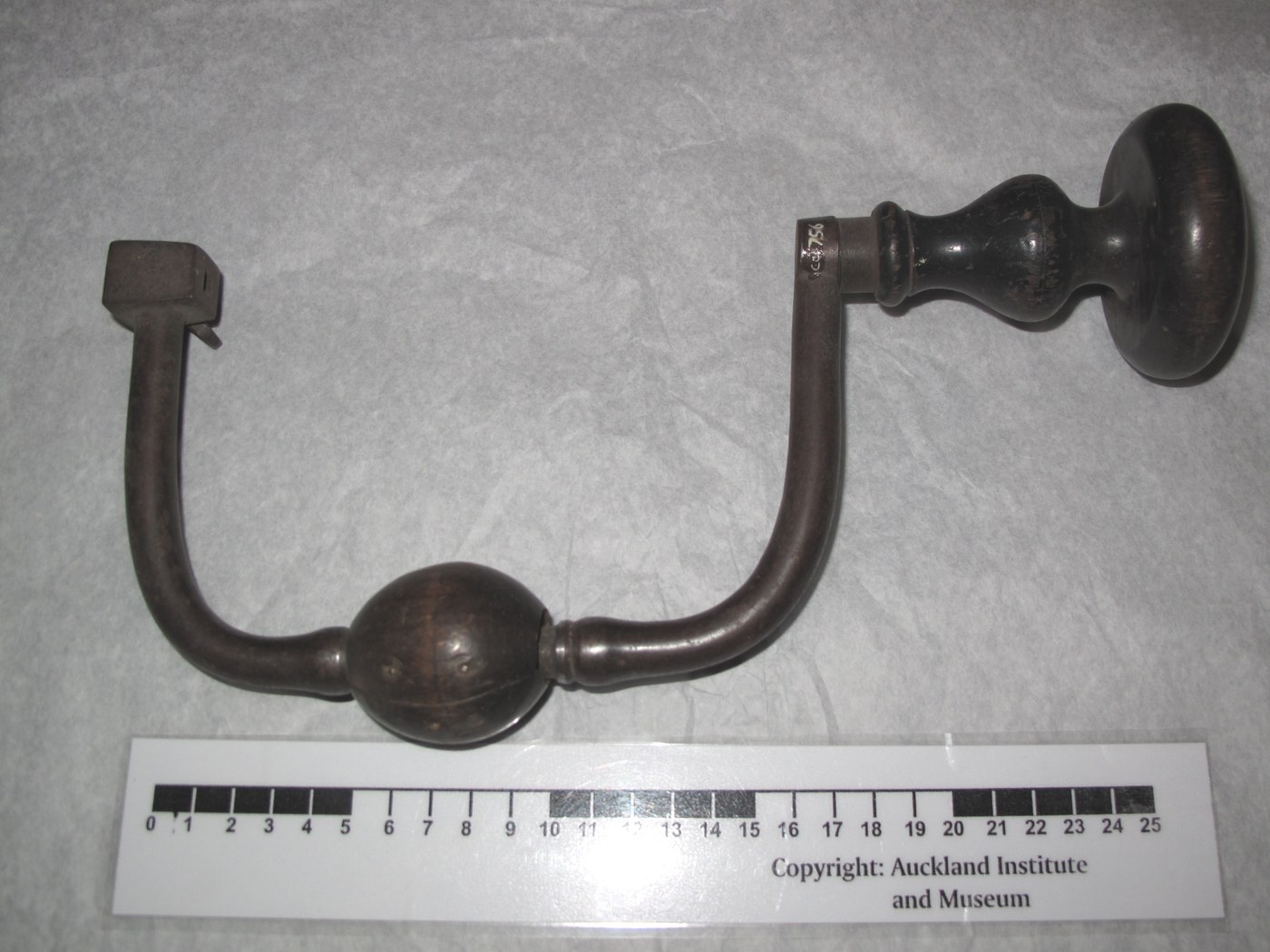


Auger and Brace
Instructions
Watch the lead screw do the feeding
Watch the lead screw do the feeding
Hands off the pressure and let the thread work.
- Start an auger bit in a board and turn it steadily with almost no downward force.
- Count turns and measure the depth reached.
- Divide to get millimetres per revolution.
Materials for this step:
 White Oak Board1 board
Tools needed:
 Steel Ruler
 Hand Auger
Prove what the spurs are for
Prove what the spurs are for
Compare a spurred bit against one without.
- Bore a hole with an auger bit that has scoring spurs.
- Bore another with a plain twist drill of the same diameter.
- Compare the rims, especially across the grain.
Understand the sweep
Understand the sweep
The brace's crank offset is a lever arm and it is chosen, not incidental.
- Measure the sweep — the diameter of the circle your hand travels.
- Bore a large hole and note the effort.
- If you have two braces of different sweep, compare them on the same bit.
Materials for this step:
 Protractor1 piece
Bore through without breaking out
Bore through without breaking out
The exit side is where hand-bored holes are ruined.
- Bore until the lead screw's point just breaks through the far face.
- Stop, withdraw, and finish the hole from the OTHER side.
- Alternatively clamp a sacrificial backing board and bore straight through.
History and context
History and context
The brace appears in Europe in the fifteenth century — one is visible in Flemish painting of the period — and is one of the earliest applications of the continuous crank to a hand tool. Before it, holes were bored with a T-handled auger turned in half-turns, or with a bow drill that reverses direction every stroke. A crank turns continuously in one direction, which suits a lead screw perfectly.
Russell Jennings patented the double-twist auger bit pattern in the mid nineteenth century, and the Jennings and Irwin patterns became the standards — Jennings with a fine double spiral for clean holes in hard wood, Irwin with a coarse single twist that clears waste faster in soft wood. Both are still made, and the choice between them is still made on the same grounds.
The ratchet brace was the significant refinement: a pawl mechanism lets the operator swing the crank back and forth through a partial arc in a corner where a full rotation is impossible. It is the reason a brace can bore a hole in a joist between two walls.
Not obsolete, just displaced. A cordless drill is faster in every ordinary case. A brace still wins where there is no power, where the hole is very large and the torque needed exceeds a light drill, where control matters more than speed — and in timber framing, where boring a clean 25 mm peg hole through a beam by feel is genuinely easier by hand than fighting a heavy powered auger.
Materials
2- 1 boardPlaceholder
- 1 piecePlaceholder
Related Blueprints
These blueprints share knowledge with this one — techniques, materials, or principles that connect them in the learning graph.

CC0 Public Domain
This blueprint is released under CC0. You are free to copy, modify, distribute, and use this work for any purpose, without asking permission.
Support the Maker by purchasing products through their Blueprint where they earn a Maker Commission set by Vendors, or create a new iteration of this Blueprint and include it as a connection in your own Blueprint to share revenue.