ART
BEAUTY & WELLNESS
CRAFT
CULTURE & HISTORY
ENTERTAINMENT
ENVIRONMENT
FOOD & DRINKS
REVERSE ENGINEERING
SCIENCES
SPORTS
TECHNOLOGY
WEARABLES
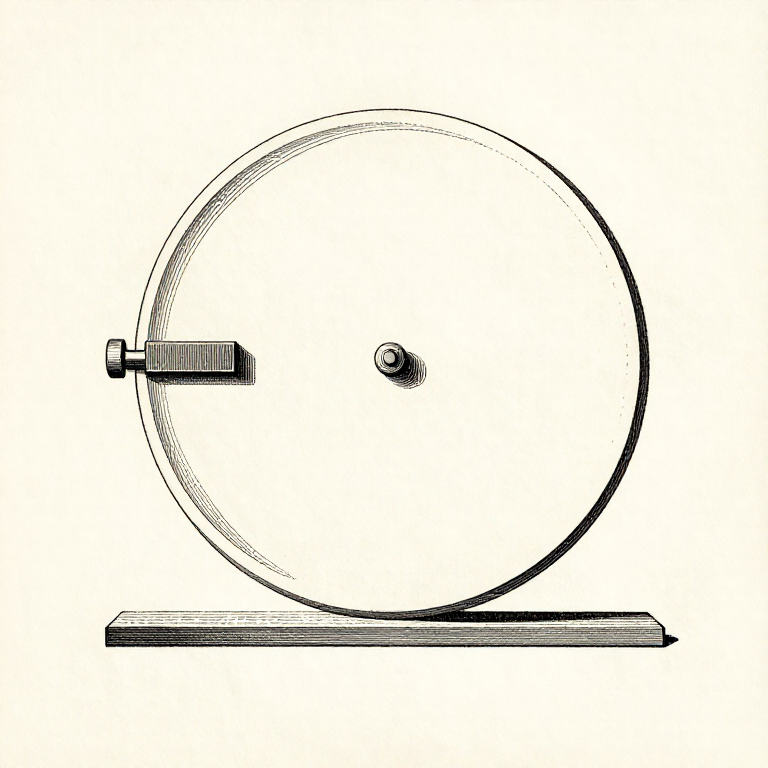


Balance: A Tiny Eccentricity Becomes an Enormous Force
A smear of paint on one side of a fan, or a fastener replaced with a slightly heavier one, is enough to put a rotor out of balance. Not because the mass is large, but because centrifugal force rises with the SQUARE of the speed.
Double the speed and an unbalance produces four times the force. Which means a rotor that is perfectly acceptable at 500 rpm can be destructive at 3000, from exactly the same small amount of extra mass in the wrong place.
It also means balancing is not optional above a certain speed, and that the tolerance tightens as speed rises. A balance grade is always quoted WITH a speed, and a rotor balanced for one is not balanced for another.
Advanced
3 hours
Instructions
1
1
The square law, in numbers
The square law, in numbers
Loading Jupyter Notebook...
Tools needed:
 Desktop Computer
 Precision Scale
2
2
Static and dynamic unbalance are different faults
Static and dynamic unbalance are different faults
STATIC unbalance is a single heavy spot. A rotor on frictionless supports will roll until that spot is at the bottom, which is how it is found without spinning anything, and it is corrected in one plane.
DYNAMIC unbalance is two heavy spots on opposite sides at opposite ends. The rotor balances perfectly at rest — the two cancel — and wobbles violently when it spins, because they form a couple that tries to tumble it.
So a rotor that passes a static check can still be badly out. Anything long relative to its diameter, and anything fast, needs balancing in TWO planes, which means a machine that can measure phase as well as amplitude.
Tools needed:
Precision Scale Dial Indicator
3
3
Unbalance has a signature: once per revolution
Unbalance has a signature: once per revolution
Unbalance vibrates at exactly the rotating frequency — once per revolution, 1X — and it is mostly radial. That signature is what distinguishes it from everything else on a machine.
MISALIGNMENT shows strongly at twice per revolution, 2X, and often has a large axial component. A LOOSE foot shows many harmonics. A failing bearing shows high frequencies unrelated to shaft speed.
So the frequency tells you which fault you have before anything is dismantled. Even without an analyser: vibration that rises smoothly with speed squared is unbalance, and vibration that appears suddenly at one particular speed is a resonance and is a different problem entirely.
Tools needed:
 Dial Indicator with Magnetic BaseDesktop Computer
4
4
Correct by removing metal, or by adding it deliberately
Correct by removing metal, or by adding it deliberately
Drill or grind material away at the heavy spot, or add a weight opposite it. Removing is usually preferred where the rotor allows it, because an added weight is something that can come off at speed.
Whatever is added must be POSITIVELY retained — bolted, welded or fitted in a designed slot. A balance weight held on with adhesive that departs at 3000 rpm does not merely restore the original unbalance; it doubles it and becomes a projectile.
Then re-measure. Balancing is iterative: the first correction is an estimate, and two or three rounds are normal. Stopping after one because the vibration is better is how a rotor ends up permanently mediocre.
Tools needed:
Precision ScaleDial IndicatorTools Required
4- Placeholder
- Placeholder
- Placeholder
- Dial Indicator with Magnetic Base10% commissionPlaceholder
Related Blueprints
These blueprints share knowledge with this one — techniques, materials, or principles that connect them in the learning graph.

CC0 Public Domain
This blueprint is released under CC0. You are free to copy, modify, distribute, and use this work for any purpose, without asking permission.
Support the Maker by purchasing products through their Blueprint where they earn a Maker Commission set by Vendors, or create a new iteration of this Blueprint and include it as a connection in your own Blueprint to share revenue.