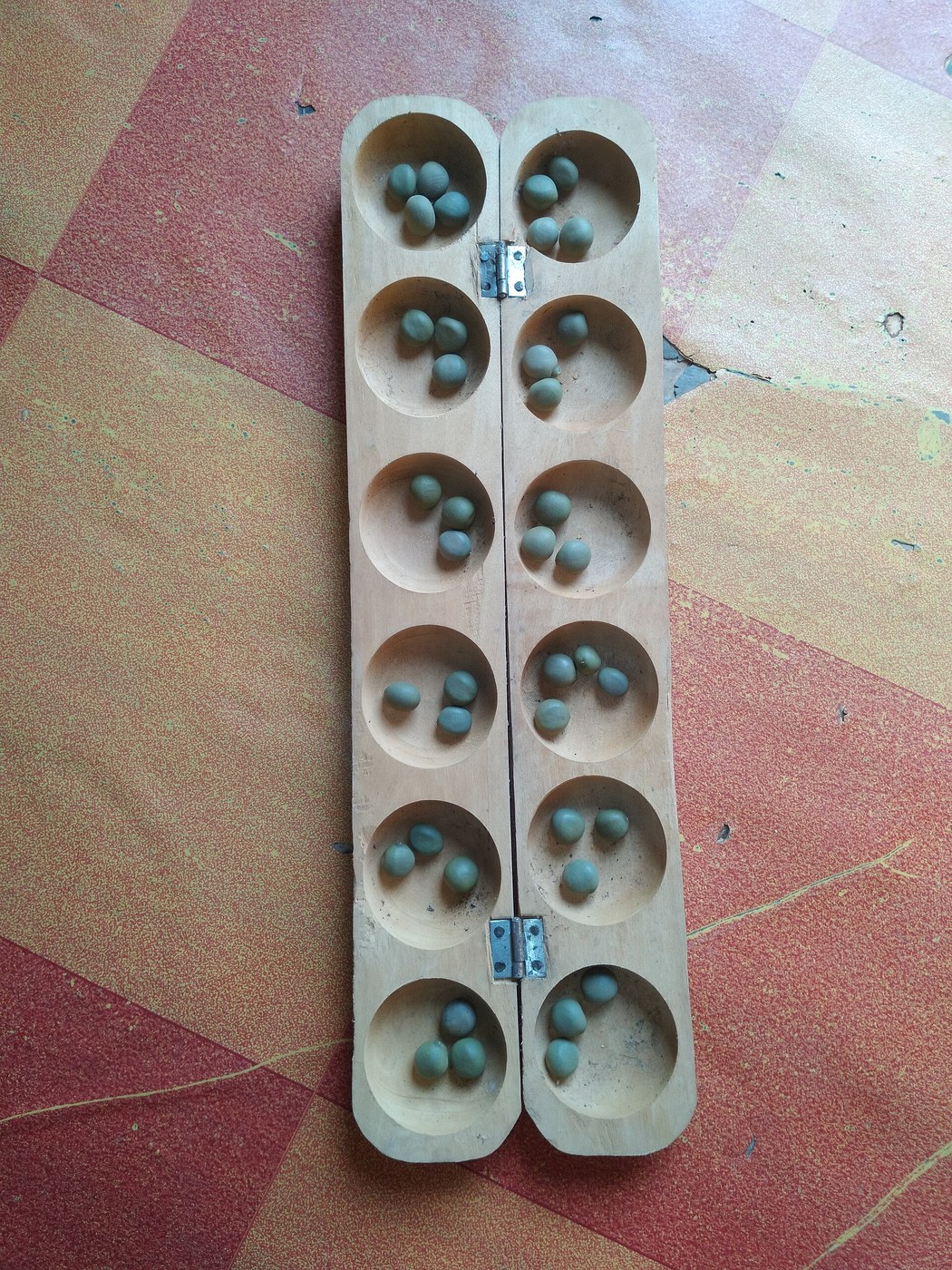

Mancala Board — Wooden Board and Seeds
Mancala is not one game. It is a large family of sowing games — you take the seeds from one pit and drop them one by one into the pits that follow, like a farmer sowing a field. That is why the technical name is "sowing games".
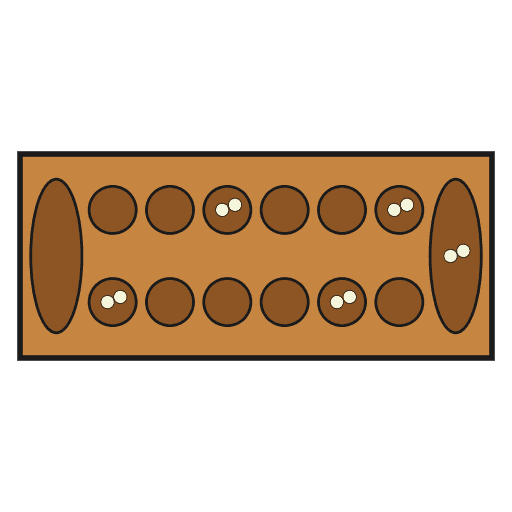
The board is simple: two rows of six pits, and one store at each end. The seeds are whatever you have — beans, pebbles, shells. The pits can be scooped straight into the ground, and that is how the game was played for centuries. A wooden board is a luxury.
One rule decides the game: if your last seed lands in an empty pit on your own side, you take all the seeds in the pit directly opposite it. Count carefully before you sow.
Instructions
Choose a wooden board
Choose a wooden board
Take a hardwood board 50 cm long, 18 cm wide and 4 cm thick. The thickness is needed because the pits are carved down into it.
Materials for this step:
 Hardwood Block1 piece
Lay out twelve pits
Lay out twelve pits
Draw two rows of six pits each. Each pit 5 cm across, with 1.5 cm between them.
Tools needed:
 Steel Ruler
Lay out the two stores
Lay out the two stores
Draw one large store at each end of the board. This is where each player keeps the seeds they have captured.
Carve the pits with a gouge
Carve the pits with a gouge
Carve each pit 2.5 cm deep with a curved gouge. Work from the centre outward so you do not split the wood.
Tools needed:
 Gouge
Gouge Carving Mallet
Round the inside of each pit
Round the inside of each pit
Make the inside of each pit smooth like a bowl. A pit with sharp corners traps seeds and the hand cannot lift them all in one movement.
Tools needed:
GougeSand the board
Sand the board
Sand with 120 then 220 grit. Hands will touch this board thousands of times — smoothness matters.
Tools needed:
 Sandpaper (120 Grit)
Oil the wood
Oil the wood
Rub in linseed oil, wait 20 minutes, then wipe off what remains. The oil protects the wood against the moisture of hands.
Materials for this step:
 Linseed Oil (Boiled)50 ml
Prepare 48 seeds
Prepare 48 seeds
Count out 48 matching seeds — beans or pebbles. Four seeds per pit, twelve pits.
Materials for this step:
 Beans48 pieces
Distribute the seeds
Distribute the seeds
Put four seeds in each pit. The stores start empty.
Sow the seeds
Sow the seeds
Take all the seeds from one pit on your side. Drop them one at a time into the pits that follow, going anticlockwise around the board, passing through your own store but not your opponent's.
Learn the capture rule
Learn the capture rule
If your last seed lands in an empty pit on your own side, you take that seed and all the seeds in the pit directly opposite. They all go into your store.
Play a full game
Play a full game
The game ends when one side is empty. The other player takes the seeds remaining on their side. Whoever has the most seeds in their store wins.
History & Context
History & Context
A family, not one game. Mancala is the family name for "sowing and capturing" games that spread across Africa, the Middle East, Asia and beyond. Every region has its own name and its own rules: bao in East Africa, oware in West Africa, ayoayo, omweso. To speak of "the rules of mancala" is like speaking of "the rules of card games" — there is no single set.
Its age. Archaeological evidence suggests forms of mancala were played as far back as the 6th or 7th century CE, and some scholars propose older roots reaching into the classical era, with evidence that such games existed in Ancient Egypt. The difficulty of proving it is that a mancala board was often just pits scooped in the ground or worn into a rock — and holes do not survive reliably in the archaeological record. Two rows of hollows in a stone may be a board, or may be something else entirely.
The 2x6 board. Many variants use a board of two rows of six pits with 48 seeds. On a two-rank board each player generally controls their own side, although moves are often made into the opponent's side as well. This is the most widespread form and the one built here.
Calculation, not luck. Mancala has no dice and no cards. Everything is visible on the table, and a player can calculate the consequence of each move in advance. That makes it a game of perfect information and pure strategy, like chess — chance plays no part at all. Experienced players count several moves ahead, looking for where the last seed will land in an empty pit.
Ground and seeds. The importance of mancala is that it requires nothing. Twelve holes in the ground and forty-eight pebbles, and the game has begun. That is why it spread so widely and lasted so long: the cost of starting is zero, and the rules are taught by demonstration rather than in writing.
Materials
3- 1 piecePlaceholder
- 50 mlPlaceholder
- 48 piecesPlaceholder
This blueprint makes
CC0 Public Domain
This blueprint is released under CC0. You are free to copy, modify, distribute, and use this work for any purpose, without asking permission.
Support the Maker by purchasing products through their Blueprint where they earn a Maker Commission set by Vendors, or create a new iteration of this Blueprint and include it as a connection in your own Blueprint to share revenue.