ART
BEAUTY & WELLNESS
CRAFT
CULTURE & HISTORY
ENTERTAINMENT
ENVIRONMENT
FOOD & DRINKS
REVERSE ENGINEERING
SCIENCES
SPORTS
TECHNOLOGY
WEARABLES


Belt-Driven Multiple Egg Beater: One Wheel Beats Three Bowls
A kitchen beating whites, yolks and batter needs several beaters going at once.
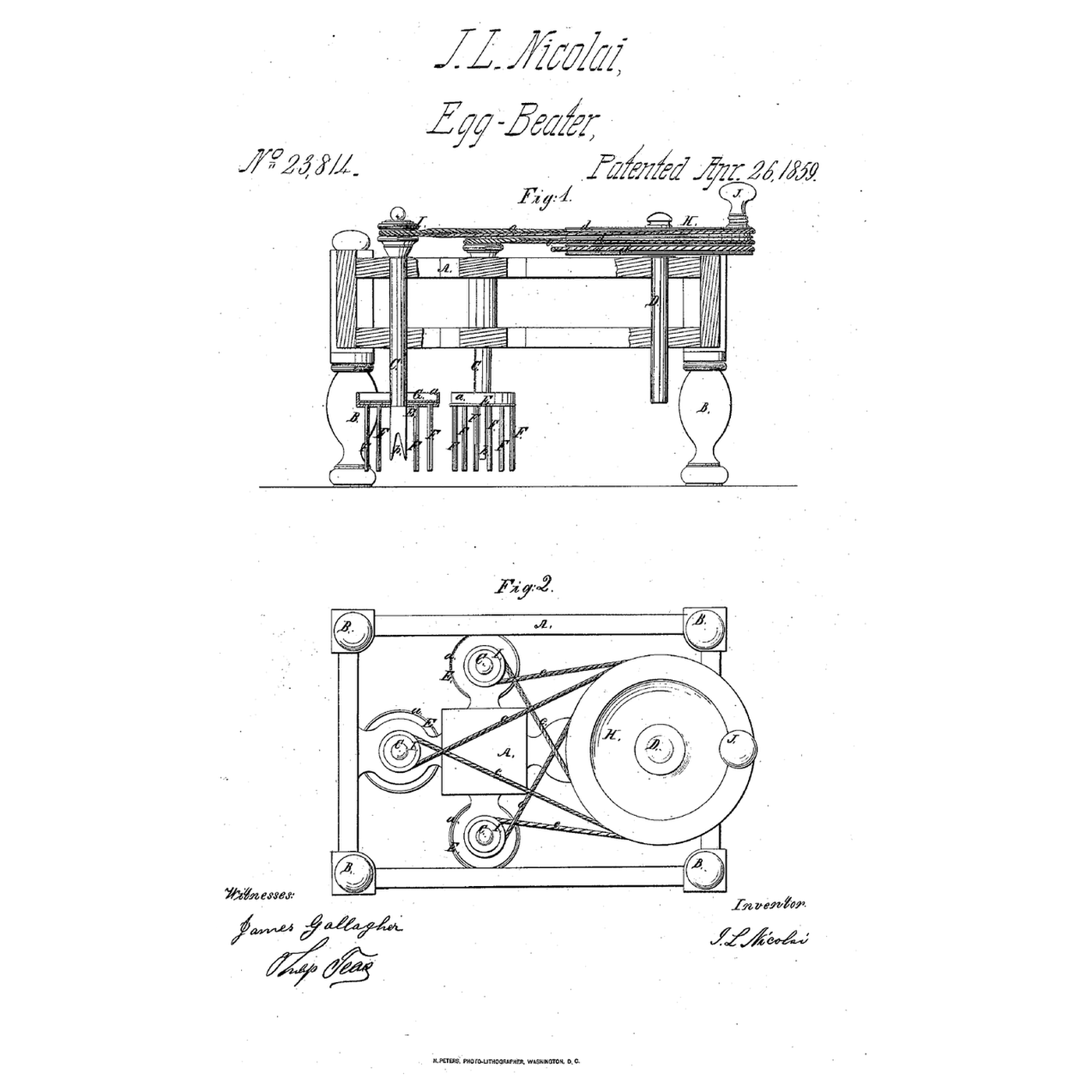
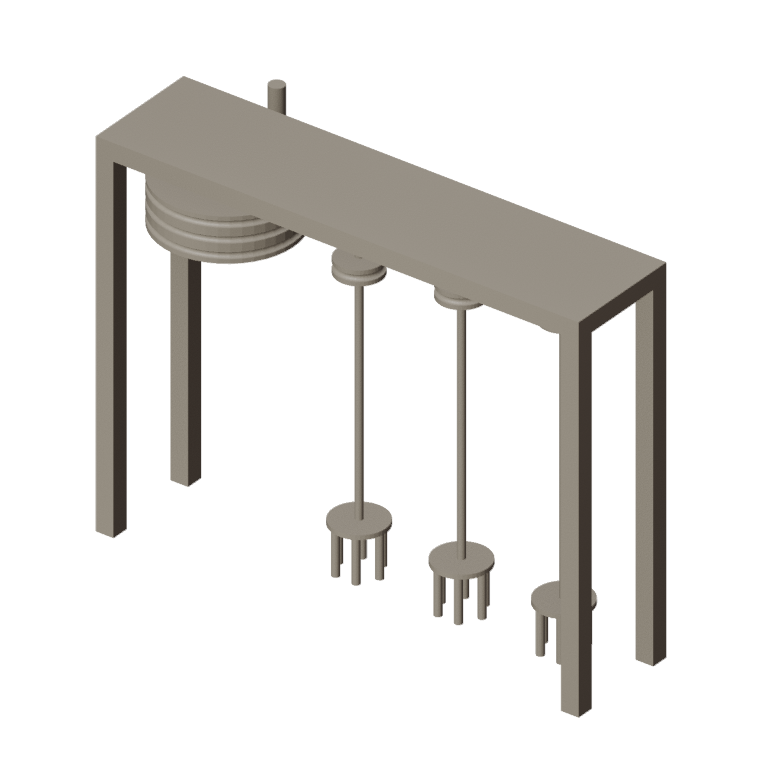
John L. Nicolai of Chicago received US 23,814, dated 26 April 1859, for an egg beater: a grooved driving wheel turned by a handle belts a series of vertical arbors in one frame, each with a disk of flexible fingers of rubber or gutta-percha; turning, the fingers spread and sweep "through every nook and corner of the vessel," so several vessels are beaten at once.
This rung works out the belt ratio and the fingers' spread, then prints the wheel, pulleys and disks and beats three bowls together.
Advanced
About 6 hours, plus printing
Instructions
1
1
Ratio and finger spread
Ratio and finger spread
Loading Jupyter Notebook...
2
2
A belt drive before it
A belt drive before it
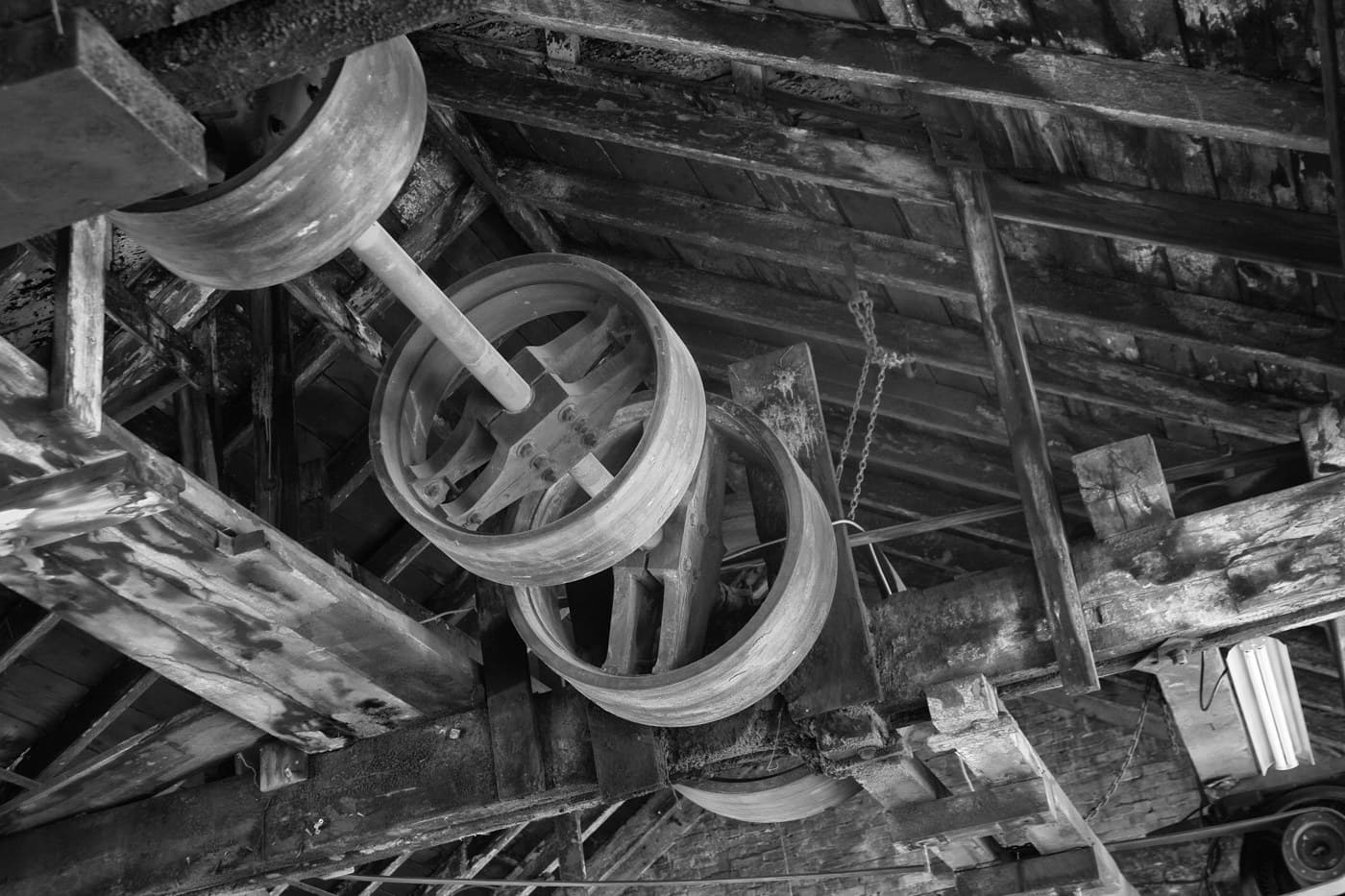
The embedded blueprint drives a pulley by a belt. Nicolai runs one belt per arbor in its own groove of a single wheel.
3
3
Read US 23,814
Read US 23,814
"By this motion and by the action of the substance in the vessels the fingers F spread out and a large quantity of the substance is agitated by the same at once, so that it takes but a very short time to reduce a quantity of eggs to froth or to mix a certain quantity of eggs with sugar, and as the fingers are flexible they diverge by being rotated with the disks and they adapt themselves to the shape of the vessel so that they actually sweep through every nook and corner of the vessel."
4
4
Print the wheel, pulleys and disks
Print the wheel, pulleys and disks
Print the three-groove driving wheel (/uploads/blueprints/belt-driven-multiple-egg-beater-wheel.stl), three pulleys (/uploads/blueprints/belt-driven-multiple-egg-beater-pulley.stl) and three finger disks (/uploads/blueprints/belt-driven-multiple-egg-beater-disk.stl). Print in PETG at 0.2 mm layers, 30 % infill, 4 walls.
Materials for this step:
 PETG Filament1 piece
Tools needed:
 FDM 3D Printer
5
5
Build the frame
Build the frame
Make a table frame of plywood 330 × 80 mm on four legs 240 mm high. Drill 5 mm holes for the wheel's shaft and three arbors 70 mm apart.
Materials for this step:
 Plywood Sheet1 piece
 Hardwood Block1 piece
 #8 x 1" Wood Screw1 piece
Tools needed:
 Coping Saw
 Cordless Drill
 Drill Bit Set
 Screwdriver Set
 Ruler
Ruler6
6
Arbors and fingers
Arbors and fingers
Cut three 200 mm arbors of 5 mm rod. Epoxy a pulley at each top, at the height of its own groove, and a disk at each foot. Push six 30 mm lengths of silicone tube into each disk's holes as fingers.
Materials for this step:
 Mild Steel Rod1 piece
 Silicone Tubing1 piece
 Two-Part Epoxy1 piece
Tools needed:
 Hacksaw
 Bench Vise
7
7
Belts and crank
Belts and crank
Fit the wheel on its shaft with a crank screw near its rim. Loop an O-ring from each groove to its pulley, choosing sizes that are taut.
Materials for this step:
 O-Ring Assortment Kit1 piece
 Machine Screws1 piece
 Hex Nut1 piece
Tools needed:
 Digital Caliper 6-Inch
 Adjustable Spanner
8
8
The patent drawing
The patent drawing
US 23,814 drawing sheet, public domain (expired patent).
9
9
Beat three bowls
Beat three bowls
Set three bowls under the arbors with one egg white each. Turn the crank about once a second and time each bowl to stiff peaks.
Materials for this step:
 Egg3 pieces
Tools needed:
 Stainless Steel Mixing Bowl (Large)
 Stopwatch
10
10
Belts that slip, cross or fingers that fly off
Belts that slip, cross or fingers that fly off
Belt-driven multiple egg beater troubleshooting.
Flow
Loading...
11
11
History and honest limits
History and honest limits
**John L. Nicolai** of Chicago, assignor to himself, S. E. Knott and R. F. Farrell, received US 23,814, dated 26 April 1859. The frame is wood or other material on legs; the disks may be flanged, plain sheet metal, or small cups; the arbors' ends pass through the disks and finish in a flattened fork that also mixes. For larger machines he would put a multiplying gear before the wheel; under steam power it is unnecessary.
**Honest limits.** FDM prints hold food in their layer lines, so wash well and replace when worn. O-rings stand in for his endless belts, silicone tube for rubber or gutta-percha fingers. Your times are the result.
Materials
11- 1 piecePlaceholder
- 1 piecePlaceholder
- 1 piecePlaceholder
- 1 piecePlaceholder
- 1 piecePlaceholder
- 1 piecePlaceholder
- 1 piecePlaceholder
- 1 piecePlaceholder
- 1 piecePlaceholder
- 1 piecePlaceholder
- 3 piecesPlaceholder
Tools Required
12- Placeholder
- Placeholder
- 1 vendor sell this, none ship to you yetPlaceholder
- Placeholder
- Placeholder
- Placeholder
- Placeholder
- Placeholder
- Placeholder
- Placeholder
- Placeholder
- Placeholder
Related Blueprints
These blueprints share knowledge with this one — techniques, materials, or principles that connect them in the learning graph.

CC0 Public Domain
This blueprint is released under CC0. You are free to copy, modify, distribute, and use this work for any purpose, without asking permission.
Support the Maker by purchasing products through their Blueprint where they earn a Maker Commission set by Vendors, or create a new iteration of this Blueprint and include it as a connection in your own Blueprint to share revenue.