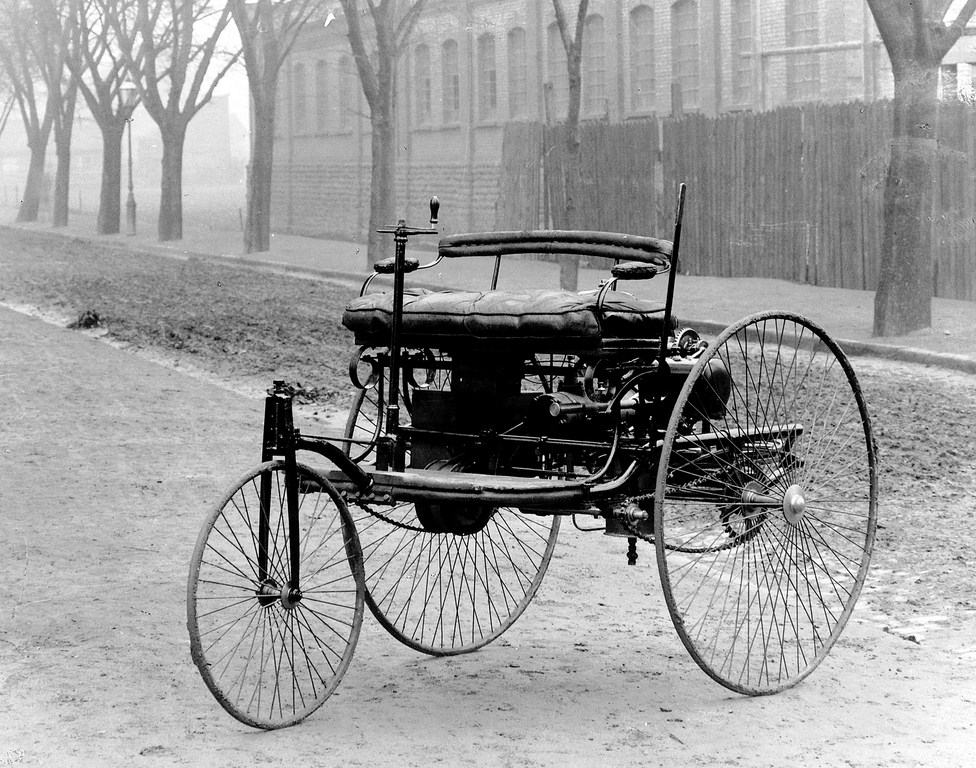

Benz Patent-Motorwagen
A carriage with an engine bolted on is not yet an automobile. Put a motor on an existing cart and you have a vehicle that used to be pulled by a horse and is now pushed instead — with steering, brakes and a frame designed for walking pace.
So the patent does not claim the engine. It claims the way the parts work together. Power transmitted through bevel gears and chains so the vehicle stays steerable. A brake that in one movement both brakes and disengages the drive. A cooling system in which vapour condenses in pipework and runs back. And a fuel level indicator, so gas generation stays even.
German Reichspatent DE 37435, "Fahrzeug mit Gasmotorenbetrieb" (Vehicle with gas engine operation), filed 29 January 1886 and published 2 November 1886. The applicant named is "Benz & Co. in Mannheim" — the firm, not Carl Benz as a person.
What gets built here is a rolling model. No engine and no fuel.
Instructions
No fuel, no engine
No fuel, no engine
This model is driven by hand or by a rubber band. Ligroin and similar light petroleum spirits are highly flammable — nothing here is vaporised and nothing is ignited.
Read DE 37435 and count the four claims
Read DE 37435 and count the four claims
Power transmission, a brake that disengages the drive in one movement, cooling by condensation, and a fuel level indicator. The engine itself is not the new part.
Build a four-wheeled chassis
Build a four-wheeled chassis
Cut a baseboard and fit four wheels, the front pair rigid. Push the vehicle and try to drive it round a curve.
Materials for this step:
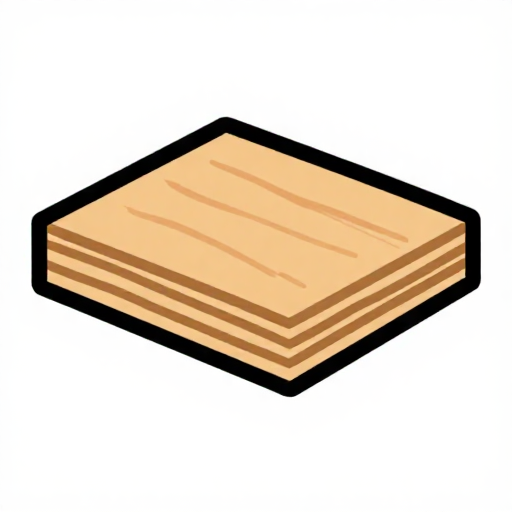 Plywood Sheet1 sheet
Steer both front wheels about one axis
Steer both front wheels about one axis
Mount the two front wheels on a single turntable board. In a curve the wheels scrub — the inner one ought to follow a tighter path than the outer.
Take one front wheel away
Take one front wheel away
Convert to a single, centrally steered front wheel. The scrubbing disappears. This is exactly why the Patent-Motorwagen has three wheels and not four.
Materials for this step:
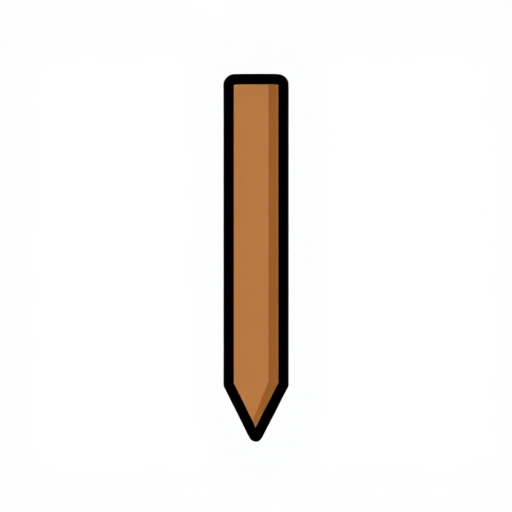 Dowel Rod1 piece
Fit a crank as the power source
Fit a crank as the power source
Mount a crankshaft across the frame. It stands in for the horizontal single cylinder — what interests us is only what happens behind it.
Tools needed:
 Flat-Nose Pliers
Transmit the power through a bevel gear pair
Transmit the power through a bevel gear pair
Turn the drive through 90° with two bevel gears. This lets the engine lie across the frame while the wheels are driven along it.
Run chains to both rear wheels
Run chains to both rear wheels
Take a chain from the countershaft to each rear wheel. Chains allow distance between engine and axle — precisely what the claim means by keeping the vehicle steerable.
Materials for this step:
 Galvanised Steel Wire1 meter
Drive a tight curve and watch the rear wheels
Drive a tight curve and watch the rear wheels
Both rear wheels turn at the same speed although they travel different distances. It judders. A differential is still missing, and that is the next step in the history.
Build the brake lever with disengagement
Build the brake lever with disengagement
Fit a lever that simultaneously presses a block against a wheel and pushes the drive belt off its pulley. One movement, two effects — as the patent states.
Brake once without disengaging
Brake once without disengaging
Disconnect the disengagement and brake alone. The drive works against the brake. That is exactly what Benz set out to prevent with a single movement.
Demonstrate evaporative cooling
Demonstrate evaporative cooling
Stand an open jar of hot water out and hold a cold sheet of metal above it. The vapour condenses and drips back — that is all the Motorwagen's cooling is.
Materials for this step:
 Clean Glass Jars with Lids1 piece
Measure how much water disappears
Measure how much water disappears
Weigh the water before and after ten minutes of boiling. The loss is substantial — a vehicle like this must top up water on the road, not just fuel.
Reproduce the level indicator
Reproduce the level indicator
Fit a vertical glass tube to a vessel. The level in the tube shows the level in the tank — simple, and expressly claimed in the patent.
History & Context — the firm in the patent and the woman in the car
History & Context — the firm in the patent and the woman in the car
The patent. DE 37435, "Fahrzeug mit Gasmotorenbetrieb", filed 29 January 1886, published 2 November 1886. Two things are almost always reported wrongly. First, 29 January is the filing date, not the day of grant. Second, the applicant is "Benz & Co. in Mannheim" — the company. Carl Benz built the vehicle, but the document names a firm, which was the norm for company patents of the period.
Why three wheels. Not for economy, but because the steering problem was unsolved. In a curve the two front wheels describe circles of different radii and must therefore be turned through different angles. A common turntable cannot do that — step 4 shows the scrubbing immediately. The solution, Ackermann steering, was known from Lankensperger and Ackermann, but Benz only adopted it in 1893 with the Victoria. Until then a single steered wheel was simply the cleaner route.
The missing differential. Step 9 shows the second unsolved problem: two rear wheels driven rigidly at the same speed judder in a curve. Benz later patented the differential gear himself. The Motorwagen is therefore not a finished automobile but the first machine in which engine, drive, brake and steering were designed together for the purpose — and that is exactly what the claims are aimed at.
🔴 Bertha Benz belongs inside this story, not as an anecdote. In August 1888 she drove, without her husband's knowledge and with their two sons, from Mannheim to Pforzheim, about 106 km — the first long-distance journey by an automobile. She bought ligroin at a pharmacy in Wiesloch, because filling stations did not exist; she had a cobbler line the brake blocks on the way, thereby inventing the brake lining; she cleared a blocked fuel line with a hatpin and insulated a wire with her garter. Her feedback led to better brakes and an additional low gear for hills. She had also put her own money into the firm. Without that journey the vehicle would have remained a technically interesting one-off — she supplied the proof that it worked in everyday use.
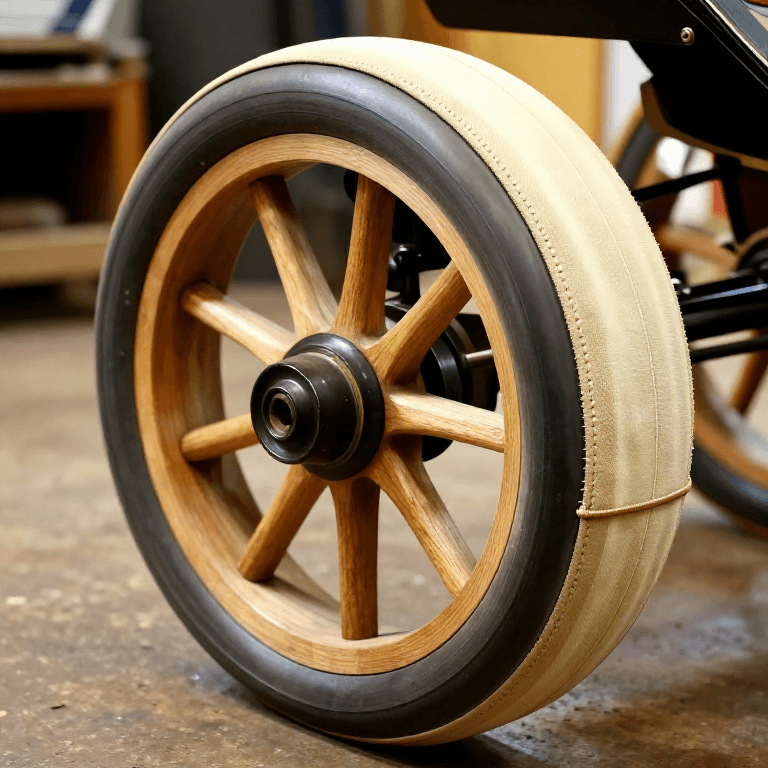
What was missing was the infrastructure. No fuel network, no surfaced roads, and no tyre that could take it — the Motorwagen's solid rubber wheels are why Dunlop's pneumatic tyre of 1888 mattered so quickly. As so often in this programme the machine was finished before its surroundings were; unlike Nipkow or Poulsen, however, the surroundings here caught up within a few years.
Materials
4- 1 sheetPlaceholder
- 1 piecePlaceholder
- 1 meterPlaceholder
- 1 piecePlaceholder
Tools Required
1- Placeholder
Related Blueprints
These blueprints share knowledge with this one — techniques, materials, or principles that connect them in the learning graph.

CC0 Public Domain
This blueprint is released under CC0. You are free to copy, modify, distribute, and use this work for any purpose, without asking permission.
Support the Maker by purchasing products through their Blueprint where they earn a Maker Commission set by Vendors, or create a new iteration of this Blueprint and include it as a connection in your own Blueprint to share revenue.