ART
BEAUTY & WELLNESS
CRAFT
CULTURE & HISTORY
ENTERTAINMENT
ENVIRONMENT
FOOD & DRINKS
REVERSE ENGINEERING
SCIENCES
SPORTS
TECHNOLOGY
WEARABLES
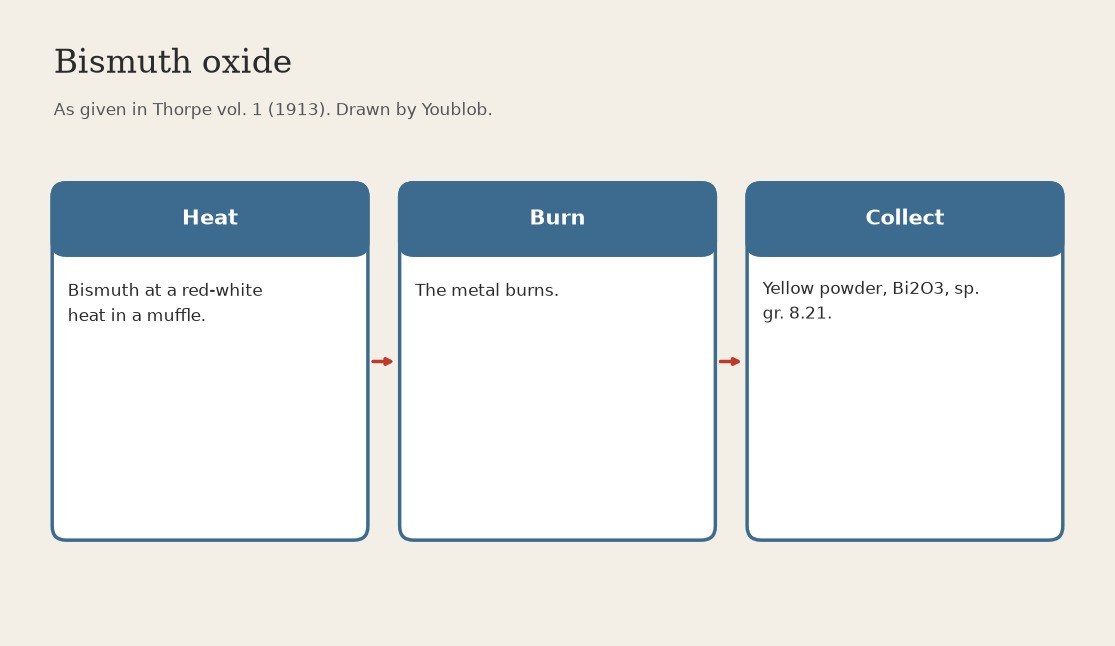


Bismuth Oxide: Bismuth Burned at a Red-White Heat in a Muffle (Thorpe 1913)
Heated to a red-white heat in a muffle, bismuth burns and its oxide condenses as a yellow powder. Bismuth trioxide, Bi2O3, has sp. gr. 8.21, contains 89.66 % bismuth, and melts at a red heat to a glass without losing weight.
Source: Thorpe, Dictionary of Applied Chemistry vol. 1 (1913), Bismuth. The porcelain dish and collecting the powder are ours. Picture drawn by Youblob.
Intermediate
half a day
Instructions
1
1
Heat bismuth to a red-white heat in a muffle
Heat bismuth to a red-white heat in a muffle
Put bismuth metal in the muffle (ours: in a porcelain dish) and raise it to a red-white heat. The metal burns. Ours: a dust respirator for the fume.
Materials for this step:
 Bismuth1 as required
Tools needed:
 Muffle Furnace
 Crucible with Lid (Porcelain)
 Crucible Tongs
 Heat-Resistant Gloves
 P100 Respirator
2
2
Collect the yellow oxide
Collect the yellow oxide
The oxide condenses as a yellow powder. Let the muffle cool and collect it.
Tools needed:
Crucible TongsP100 RespiratorTools Required
5- Placeholder
- Placeholder
- Placeholder
- Placeholder
- Placeholder
This blueprint makes

Related Blueprints
These blueprints share knowledge with this one — techniques, materials, or principles that connect them in the learning graph.

CC0 Public Domain
This blueprint is released under CC0. You are free to copy, modify, distribute, and use this work for any purpose, without asking permission.
Support the Maker by purchasing products through their Blueprint where they earn a Maker Commission set by Vendors, or create a new iteration of this Blueprint and include it as a connection in your own Blueprint to share revenue.