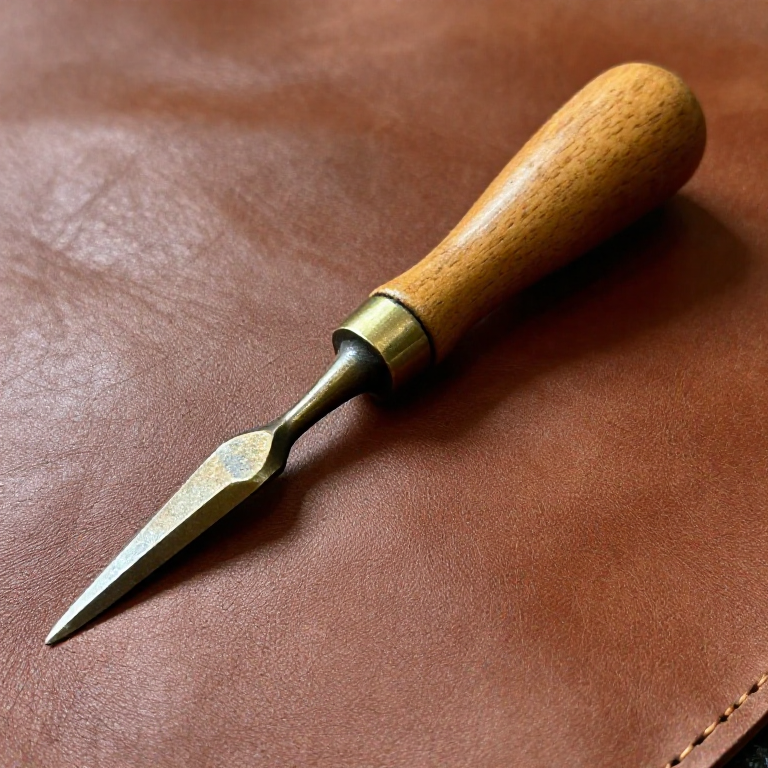


Making a Bronze Awl — The Leatherworker's Piercing Tool
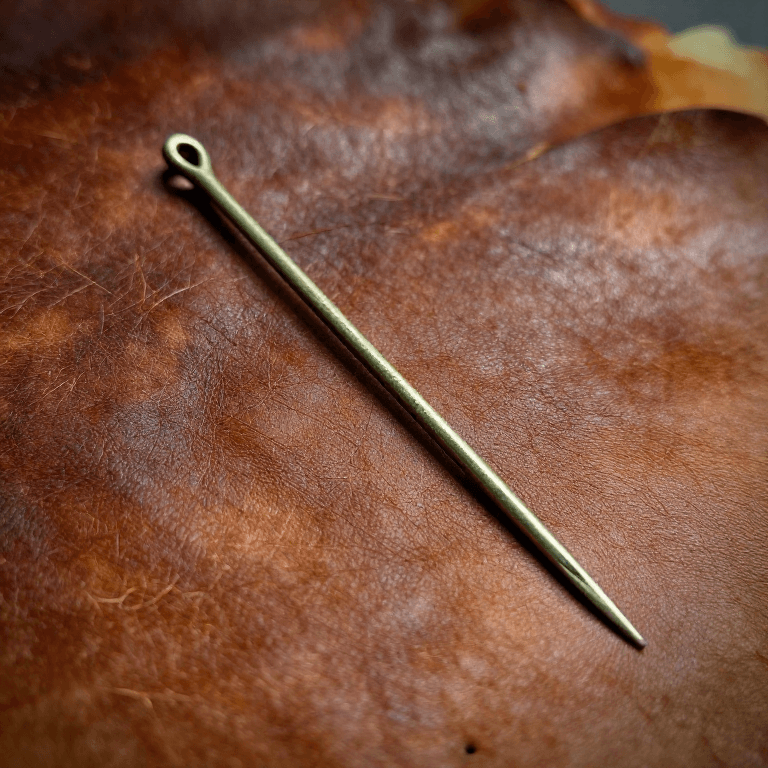
The awl is one of the oldest and simplest metal tools — a pointed bronze rod set into a handle, used to punch holes in leather, wood, and bark. Bronze awls appeared alongside the earliest copper tools and remained essential through the entire Bronze Age because no other tool could make a clean, round hole in thick leather for stitching.
An awl is cast as a simple rod in an open stone groove, then one end is hammered to a sharp conical point while the other end is left blunt and set into a wooden or antler handle. The simplicity of the form belies its importance: without the awl, there are no leather bags, no stitched hide clothing, no bound book covers, and no harness for draught animals.
Instructions
Cast a bronze rod
Cast a bronze rod
Materials for this step:
 Copper Sheet (0.5-1mm)36 g
Hammer the point
Hammer the point
Tools needed:
 Hammerstone
 Flat Stone Slab
Shape the tang
Shape the tang
Sharpen and polish the point
Sharpen and polish the point
Materials for this step:
 Fine Sand50 g
Tools needed:
 Whetstone
Make the handle
Make the handle
Set the awl into the handle
Set the awl into the handle
Tools Required
3- Placeholder
- Placeholder
- Placeholder
Connected Blueprint Materials
This blueprint makes
Related Blueprints
These blueprints share knowledge with this one — techniques, materials, or principles that connect them in the learning graph.
CC0 Public Domain
This blueprint is released under CC0. You are free to copy, modify, distribute, and use this work for any purpose, without asking permission.
Support the Maker by purchasing products through their Blueprint where they earn a Maker Commission set by Vendors, or create a new iteration of this Blueprint and include it as a connection in your own Blueprint to share revenue.